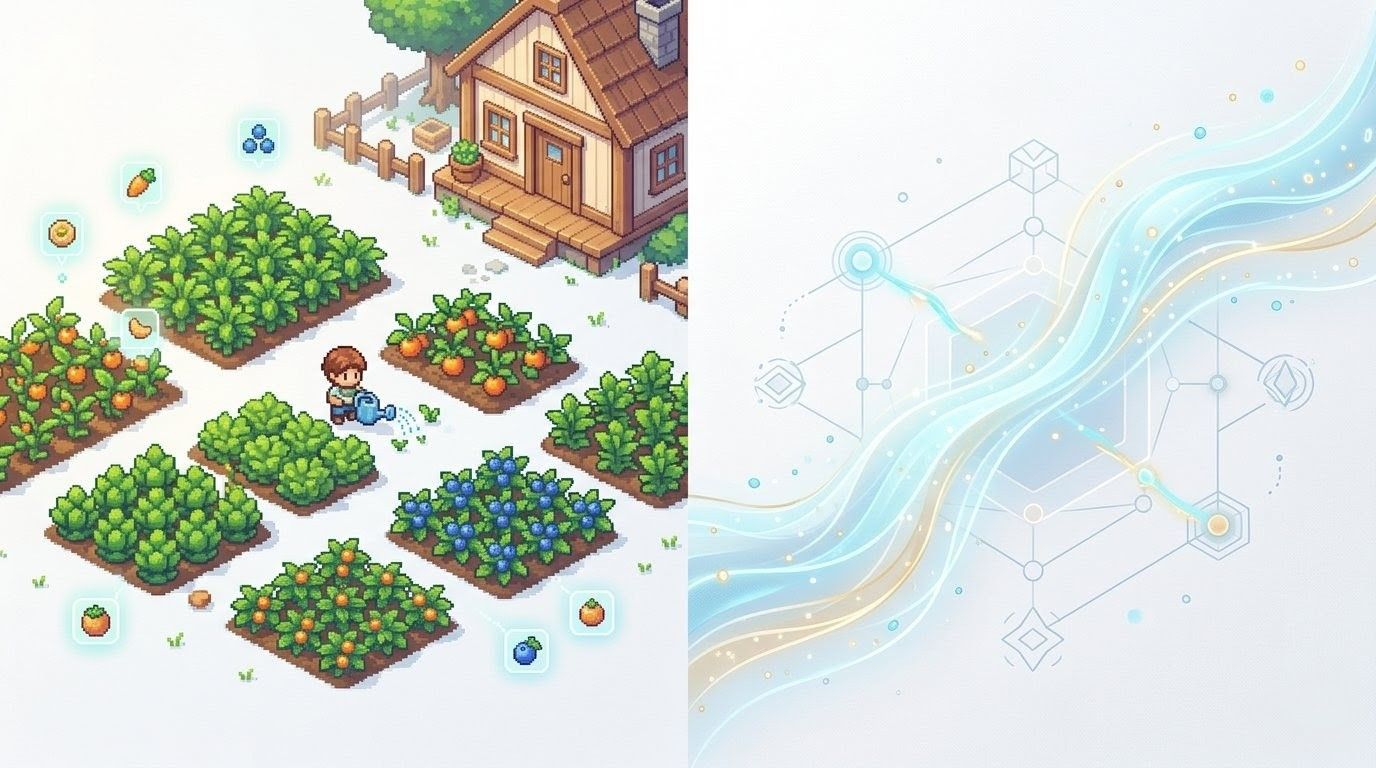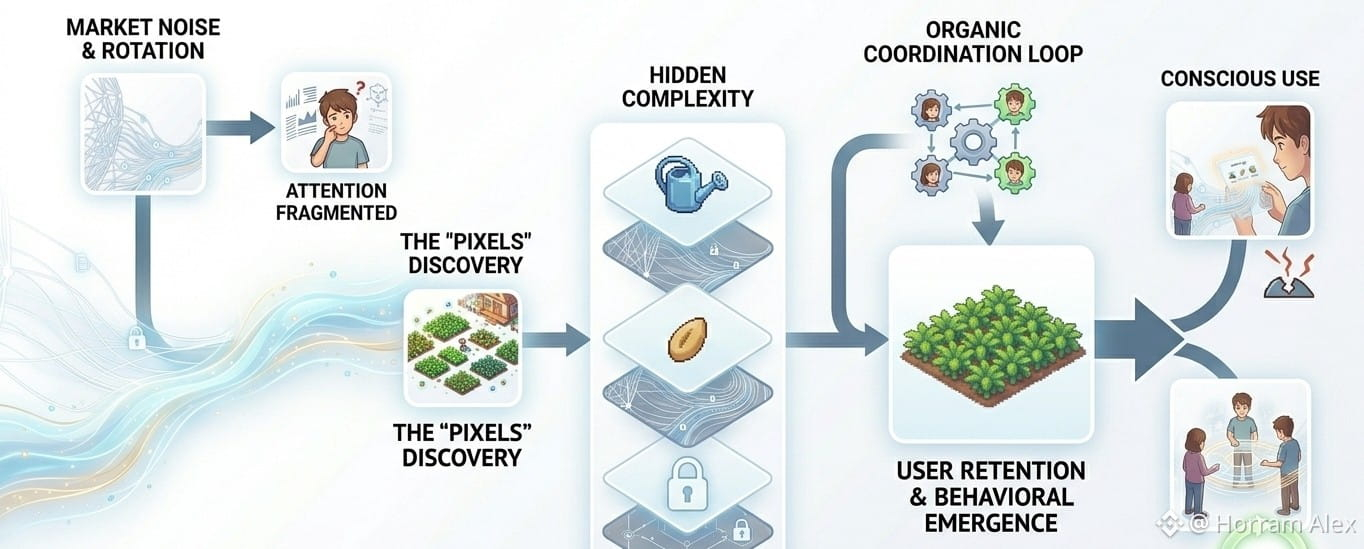
I didn’t land on Pixels because I was looking for a game. It showed up in the middle of something else one of those late scroll sessions where you’re trying to make sense of where attention is actually going. The market’s been in that weird phase again. Not dead, but not clean either. AI still pulling eyes but starting to feel crowded. RWAs getting institutional nods but not really sticking with retail. Restaking had its moment, then cooled just enough to make you question how deep that demand really goes.
Liquidity hasn’t disappeared. It’s just rotating without committing.
And somewhere in between all that, I kept noticing people posting screenshots of farms. Not charts. Not dashboards. Farms. Crops, avatars, little routines. It felt out of place. Almost unserious. Which, in this market, is usually the first signal that something might actually be worth paying attention to.
So I opened it.
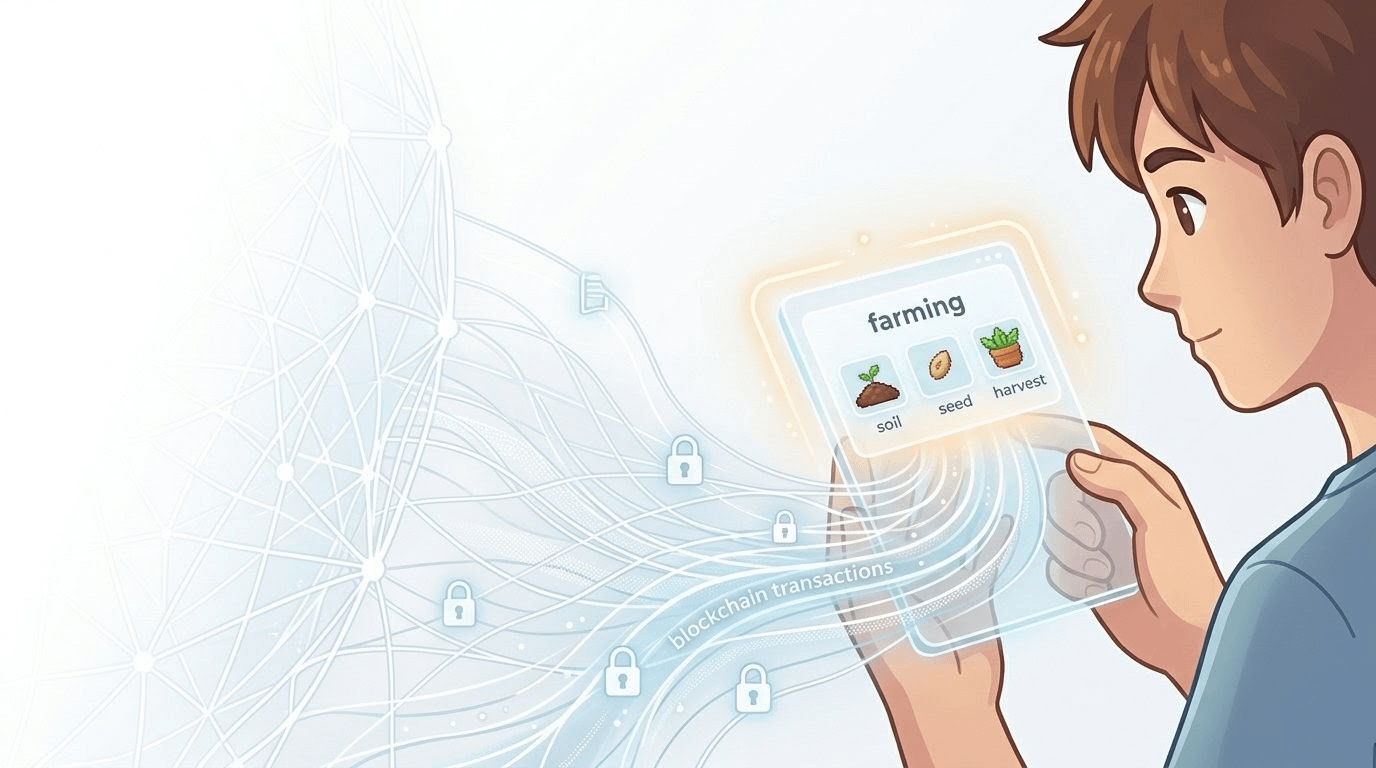
Pixels doesn’t try to impress you. That’s the first thing that stands out. No heavy explanation of infrastructure, no pressure to understand the system before you touch it. You just start. Move around, plant something, harvest it, trade a bit. It’s quiet. Almost suspiciously simple.
At first, I thought it was just another attempt at making Web3 “feel like Web2,” smoothing over complexity to attract users who don’t want to think about chains or wallets. We’ve seen that play before. It usually ends the same way initial curiosity, short retention, liquidity moves on.
But the longer I watched, the less it felt like a surface-level simplification and the more it felt like something else entirely.
Because under that simplicity, there’s coordination happening. Real coordination. Not the kind you read about in whitepapers, but the kind you can actually observe. Players interacting with shared resources, economies forming in small loops, behaviors repeating because they make sense not because incentives are artificially forcing them.
That’s where it started to click.
Pixels is built on Ronin, which already tells you something about its priorities. This isn’t trying to be the most generalized, flexible system. It’s optimized for a specific kind of interaction fast, low-friction, game-native activity. And that matters more than people like to admit. Most systems in crypto are technically impressive but behaviorally empty. They work, but no one stays.
Here, people stay.

Not because they’re farming a token in the traditional sense, but because the environment gives them a reason to return. That’s a subtle but important difference. The incentives aren’t screaming at you. They’re embedded. You participate, and over time you realize you’re part of a loop that connects effort, reward, and interaction with others.
It’s still a system of data, compute, and machines at the end of the day. Every action is recorded, processed, coordinated across the network. But none of that is pushed to the surface. You’re not thinking about execution layers or throughput. You’re just playing, while the system quietly does its job.
And maybe that’s the point.
For years, we’ve been building in the opposite direction. More visibility into the stack, more emphasis on the mechanics, more expectation that users should understand what’s happening underneath. Pixels flips that. It hides the complexity without removing the structure. Decentralization is still there, shared resources are still there, coordination is still happening but it feels like part of the environment, not a feature you have to consciously engage with.
That’s where I see the strength. Not in the game itself, but in how it reframes interaction.
But I’m not fully convinced. Not yet.
Because we’ve seen engagement before. We’ve seen systems that feel alive for a moment, driven by novelty or well-tuned reward loops, only to fade when attention shifts. The real question is whether this behavior is durable or just another phase in the rotation.
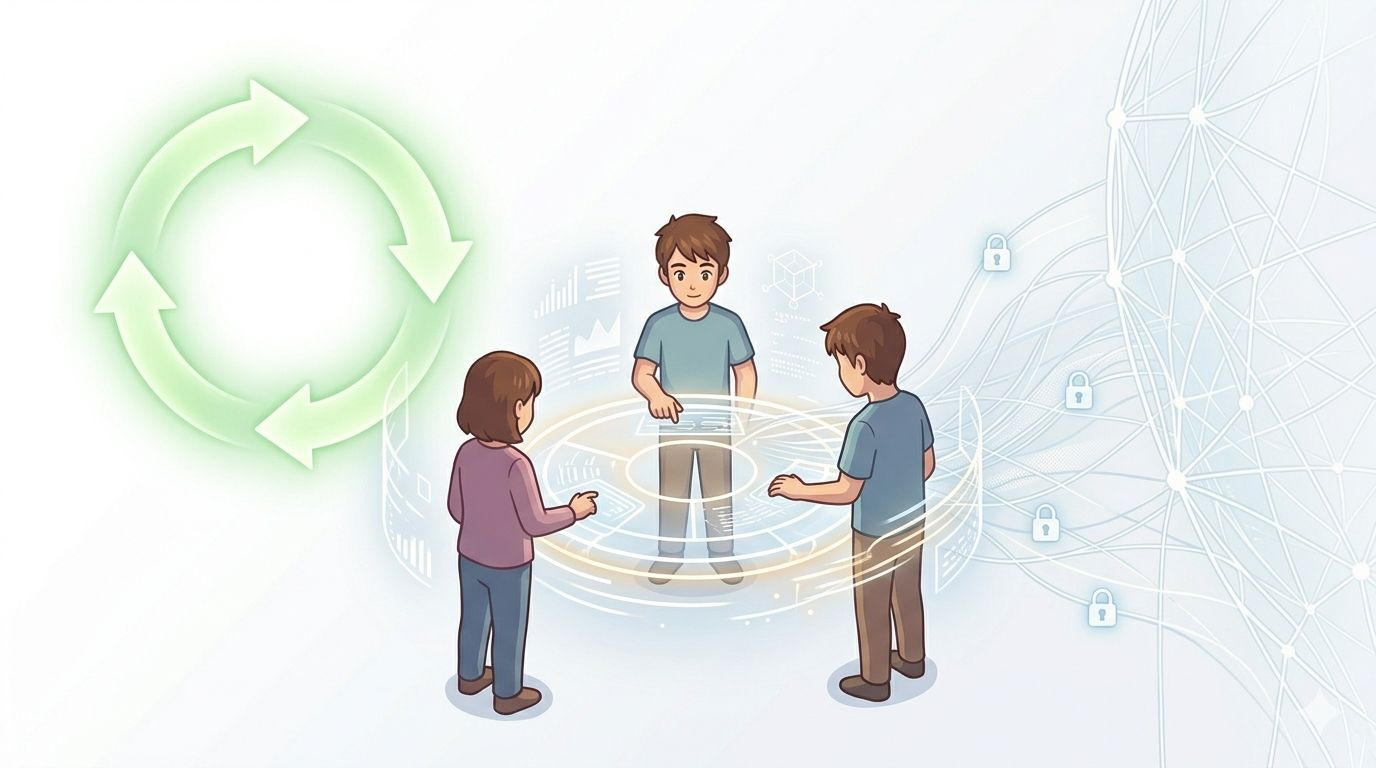
The token layer adds another dimension to that uncertainty. Incentives matter. They always do. If the economy inside the game starts to feel extractive instead of participatory, the dynamic changes quickly. People stop playing and start optimizing. And once that shift happens, it’s hard to reverse.
There’s also the broader market context. Right now, attention is fragmented. No single narrative is holding it for long. That can help something like Pixels grow quietly, without being overexposed too early. But it also means retention has to be real. Not just good compared to other games good compared to everything else competing for time and capital.
What I keep coming back to is how organic it feels. No aggressive push. No constant need to justify itself. It exists, people engage, and the system evolves through that interaction. That’s rare.
And maybe a bit overlooked.
We talk a lot about onboarding, about bringing the next wave of users into crypto. Usually that conversation revolves around better interfaces, clearer messaging, simpler abstractions. But what if the real shift isn’t about making people understand the system?
What if it’s about building environments where they don’t need to?
That thought stuck with me more than anything else.
Because if that’s true, then Pixels isn’t just a game. It’s a small test of whether coordination at scale can feel natural instead of forced. Whether decentralized systems can exist without constantly reminding you that they’re decentralized.
And if that works, even in a simple farming loop, it raises a bigger question.
Are we moving toward systems people consciously use or systems they simply live inside without thinking twice?