The Quiet Rotation Nobody’s Talking About I wasn’t looking for Pixels.
I was actually digging through the usual rotation AI tokens cooling off a bit after their last push, restaking narratives still trying to hold attention, RWAs getting another round of polite institutional nods but not much real retail energy. Liquidity felt cautious. Not gone, just selective. You could feel it moving, but only into things that didn’t look like they were trying too hard.
That’s when Pixels showed up on my radar. Not through a headline. Not through some over-engineered thread. Just people playing it.
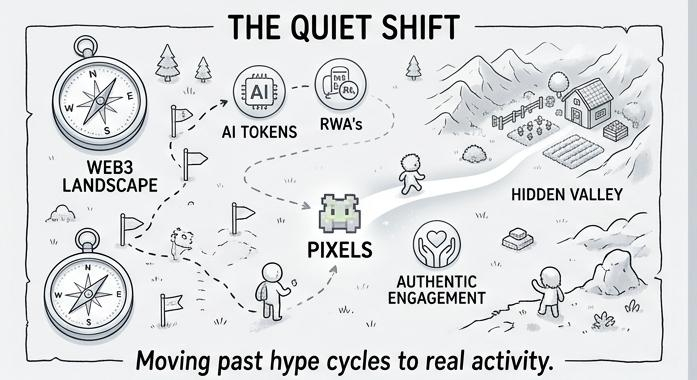
At first, I ignored it. We’ve seen this before “crypto game with real users” cycles that look good for a week and then fade the moment incentives dry up. Most of them are designed backwards anyway. Token first, experience later. You can feel it the second you log in.
But this one lingered.
So I opened it.
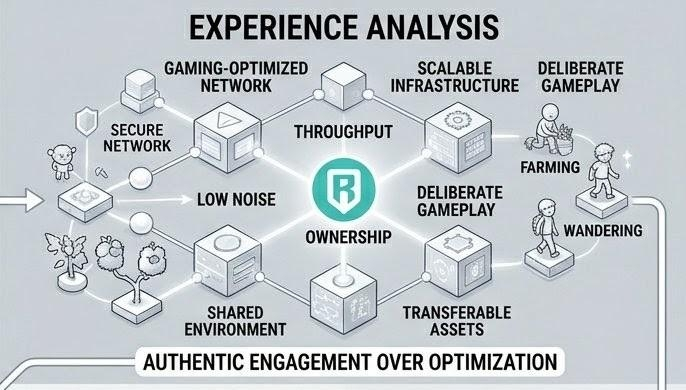
And it felt slow. Not in a bad way. Just deliberate. Farming, wandering, interacting with other players who didn’t seem like they were there to farm rewards and leave. That’s usually the tell. If a game’s economy is being extracted, you feel the rush. Everyone optimizing, nobody staying.
Here, it felt like people were actually presents
That made me pause.
Because underneath that calm surface, there’s something very crypto-native happening. Pixels runs on Ronin, which already tells you something about its intent. Ronin isn’t trying to be everything it’s optimized for games, for throughput, for real usage rather than theoretical scale. That choice alone filters out a lot of noise.
And then you start noticing how the system is structured. The resources you gather, the land you interact with, the assets you hold they’re not locked inside the game in the traditional sense. They exist in a shared environment. Ownership isn’t abstract. It’s real, transferable, visible.
It’s not revolutionary on paper. We’ve heard this pitch for years.
But here’s the difference: it’s actually being used.
That matters more than most people admit.
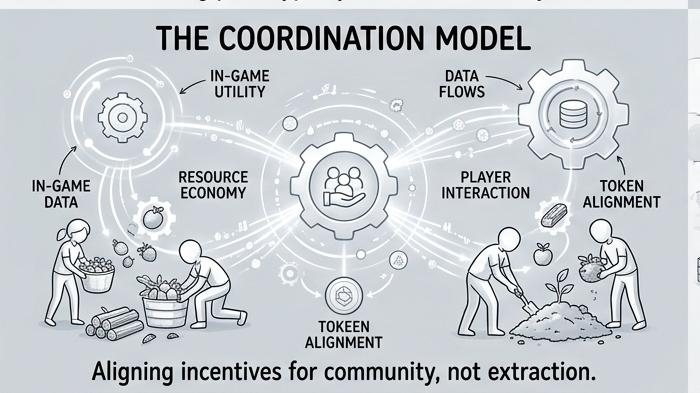
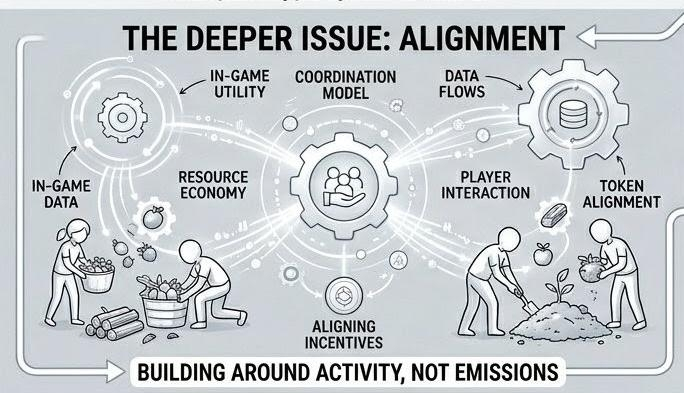
The problem Pixels is trying to solve isn’t just “make a fun Web3 game.” That’s surface level. The deeper issue is coordination. How do you get real people to participate in a shared system without turning it into a short-term extraction loop? How do you align incentives so that staying is more valuable than leaving?
Most projects brute-force this with emissions. High rewards, fast growth, inevitable collapse.
Pixels seems to be trying something quieter. The economy builds around activity, not just rewards. You earn, yes, but you also need to engage. The system nudges you into participation rather than pure optimization. It’s subtle, but you feel it.
And that’s where data, compute, and machines come into play just not in the way people usually frame it.
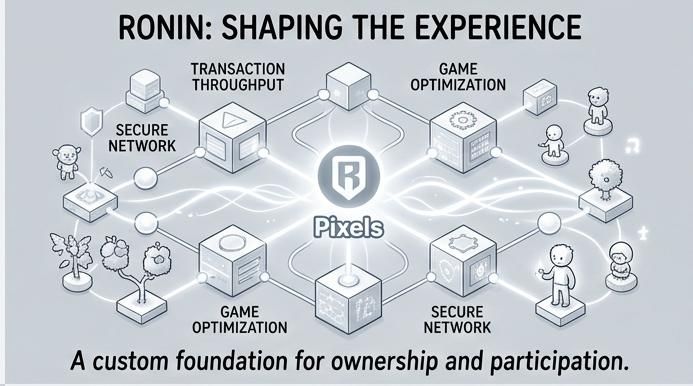
Every action inside Pixels feeds into a broader network. Data isn’t siloed; it’s part of a shared ledger. Compute happens across the system to maintain consistency, ownership, and state. And the machines the validators, the infrastructure aren’t controlled by a single entity. They coordinate to keep the world running.
It’s decentralization, but not the loud kind. The kind you notice only when it works.
Still, I’m not blindly optimistic.
There are real risks here. For one, the line between organic engagement and incentive-driven behavior is thin. Right now, it feels balanced. But if the token model leans too hard into rewarding activity, the entire dynamic could shift overnight. We’ve seen how quickly “community” turns into “liquidity farming.”
And then there’s the bigger question retention without novelty. Farming loops are calming, but they’re also repetitive. Can Pixels keep people engaged months from now, when the curiosity fades and only habit remains?
The token itself adds another layer. It’s tied to participation, to the in-game economy, to the broader ecosystem. That’s good in theory. But it also means the system is exposed to external market conditions. If sentiment turns risk-off again, does the economy hold? Or does it start leaking value as players quietly exit?
What I do find interesting and slightly under-discussed is how Pixels fits into the current market psychology.
Right now, people are tired of being pitched the future. They want something they can touch, even if it’s small. Something that works today, not something that might scale tomorrow.
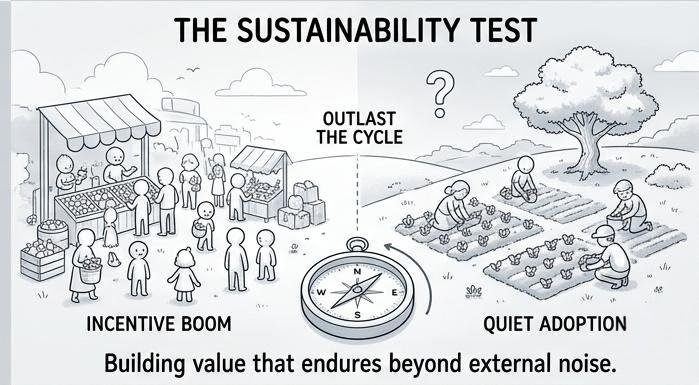
Pixels doesn’t try to be massive. It just exists. And in doing so, it’s attracting a different kind of attention. Not the loud, speculative kind. The slower, more observational kind. The kind that often precedes more durable adoption.
But that also makes it vulnerable.
Because in this market, attention is everything. And quiet projects don’t always survive long enough to be understood.
So I keep coming back to the same thought.
Maybe Pixels isn’t trying to win the cycle. Maybe it’s trying to outlast it.
And if that’s true, the real test isn’t how it performs when liquidity is flowing but how it behaves when things get quiet again.
Because that’s when you find out if people were ever really there or just passing through.
And I guess that’s the question I’m left with.
Is this the early shape of something sustainable or just another system that feels real until the incentives stop?