
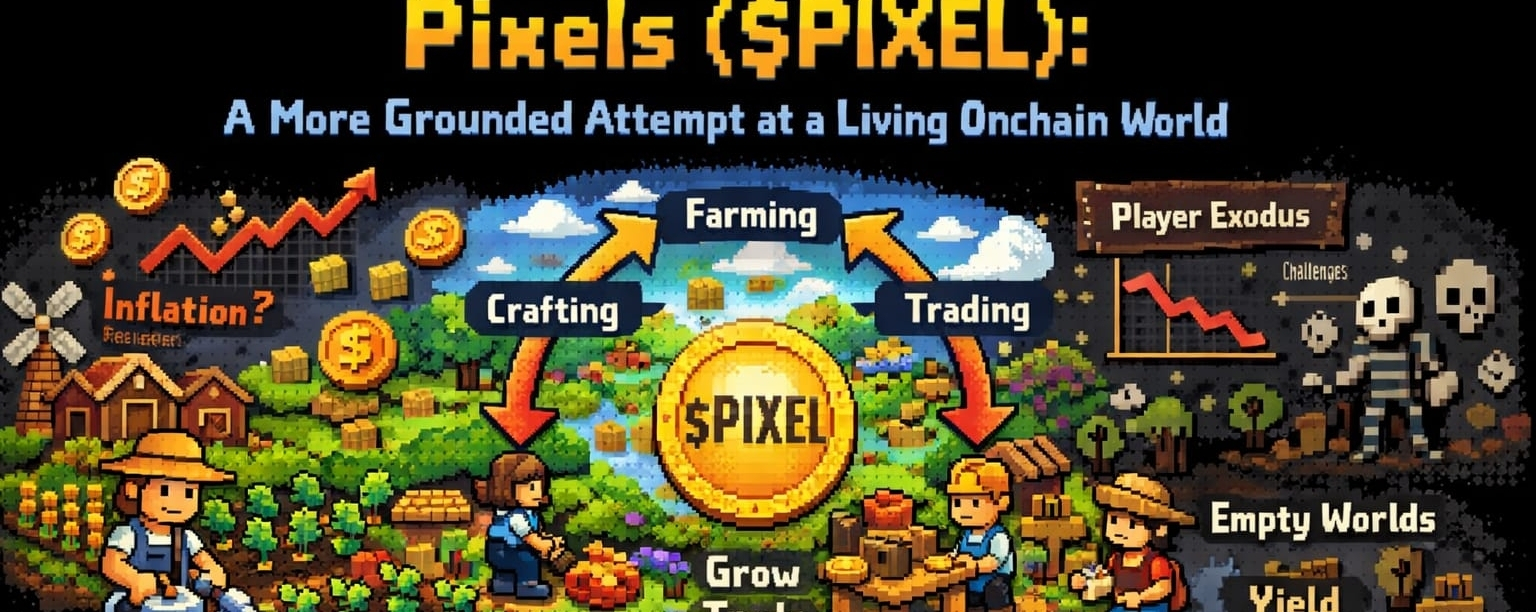
I keep coming back to this question: why do so many digital worlds feel active, but not actually alive? On paper, the metrics often look strong—daily users, transaction volume, token activity—but the moment incentives thin out, the energy disappears. Players leave, economies stall, and what looked like a thriving ecosystem reveals itself as something far more fragile. It’s a pattern that has repeated enough times that it’s hard not to approach any new onchain game with a degree of caution.
The root of the issue is not difficult to trace. Many tokenized gaming systems have leaned too heavily on financial incentives to bootstrap engagement. Early users arrive for rewards, not necessarily for the experience, and that distinction matters more than it first appears. When progression is tied more to extraction than enjoyment, behavior shifts. Players optimize for yield, not play. Economies inflate as rewards outpace meaningful sinks, and eventually the system either slows down or collapses under its own imbalance. The game becomes secondary to the economy, and once that happens, retention becomes extremely difficult to sustain.
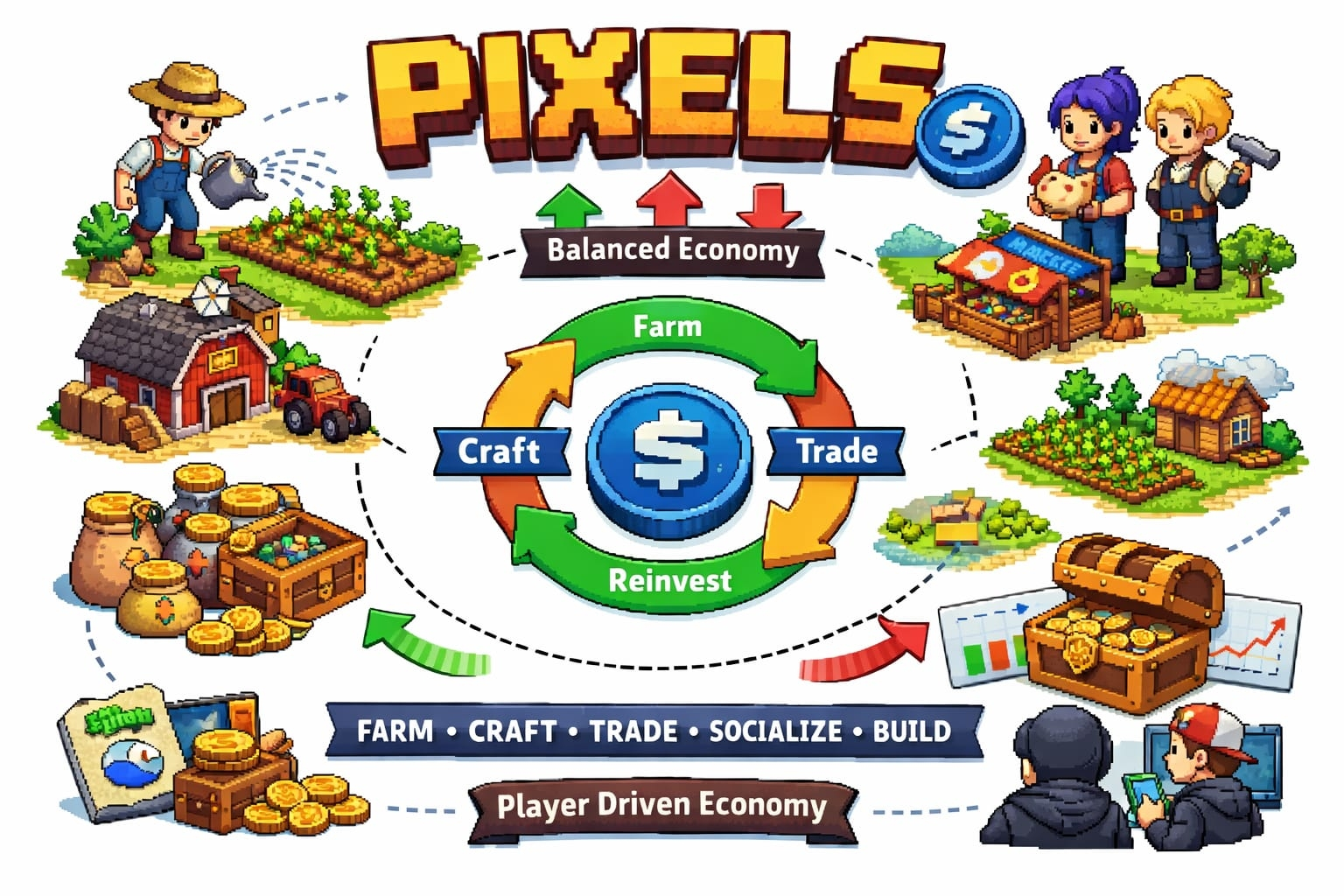
This is the context in which Pixels ($PIXEL) starts to make more sense—not as a breakthrough, but as an attempt to address a familiar structural problem. At its core, Pixels is a farming and social simulation game, which is a genre already built around repetition, progression, and routine. That foundation matters. Instead of forcing an economy onto a game loop, it tries to design both together. Farming, crafting, land management, and social coordination are not just features; they are the mechanisms through which activity is sustained over time.
What stands out is the focus on continuity. Players are not just completing isolated tasks for rewards, but participating in ongoing resource loops. Crops are grown, processed, traded, and reinvested. Land is not just owned, but utilized. Social interactions—whether through cooperation or market activity—become part of how the system functions. None of this guarantees success, but it does shift the emphasis away from short-term engagement spikes toward something that at least resembles a living environment.
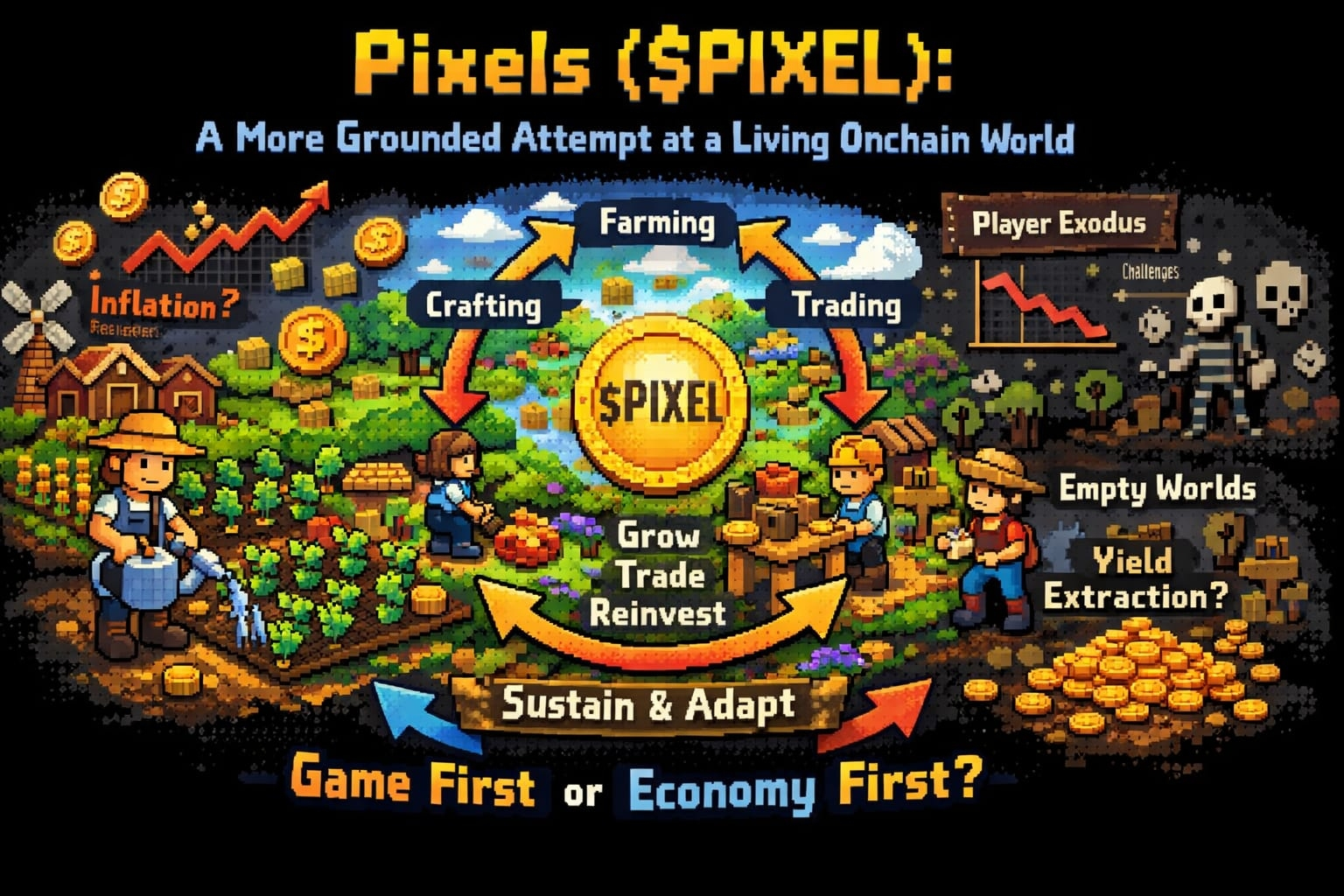
The role of $PIXEL within this system is where things become more delicate. Tokens in gaming economies are easy to distribute but much harder to stabilize. The real challenge is not rewarding players, but giving them consistent reasons to spend, reinvest, or hold without breaking the balance. If earning outpaces utility, inflation follows. If sinks feel forced, players disengage. Pixels appears to recognize this tension, structuring $PIXEL as part of a broader loop rather than a standalone incentive. Still, designing a balanced economy over time is less about intention and more about ongoing adjustment.
What I find myself watching most closely is player behavior. Systems can be well-designed on paper, but players tend to push them in unintended directions. If the majority engage with Pixels as a game first, the economy has a chance to stabilize around real activity. If it tilts too far toward extraction, the same familiar patterns may reappear.
Pixels does not feel like a guaranteed success, and that’s probably the right way to look at it. It feels like a more grounded attempt at aligning gameplay with economic design in a space that has often separated the two. Whether it works will depend less on its initial design and more on how well it adapts once real players start shaping the system in practice.#pixel @Pixels
