
@undefined What makes a digital world feel worth tending, even when no one is watching and no immediate reward is guaranteed? This question sits quietly beneath the surface of most online games, but it becomes sharper in the context of blockchain. For years, the conversation around Web3 gaming has revolved around ownership and earnings, yet both ideas assume that players need external justification to stay engaged. The more difficult problem is internal: how to design a system where participation itself feels meaningful over time.
Before projects like Pixels, the industry largely approached this challenge from the outside in. Traditional games offered rich experiences but retained full control over assets and progression, while early blockchain games attempted to reverse this by prioritizing ownership. However, neither approach fully addressed the question of continuity. In centralized systems, player effort could be reset or devalued by design changes. In early Web3 systems, effort often became transactional, reduced to repetitive actions aimed at extracting token rewards. In both cases, the sense of a living, evolving connection between player and world remained limited.
Attempts to solve this gap often leaned on economic structures rather than experiential design. Play-to-earn models introduced measurable incentives, but they also introduced fragility. When rewards fluctuated, so did engagement. Players were not necessarily attached to the world itself but to the outcomes it produced. This created a cycle where value needed constant reinforcement, and when that reinforcement weakened, the system struggled to sustain itself.
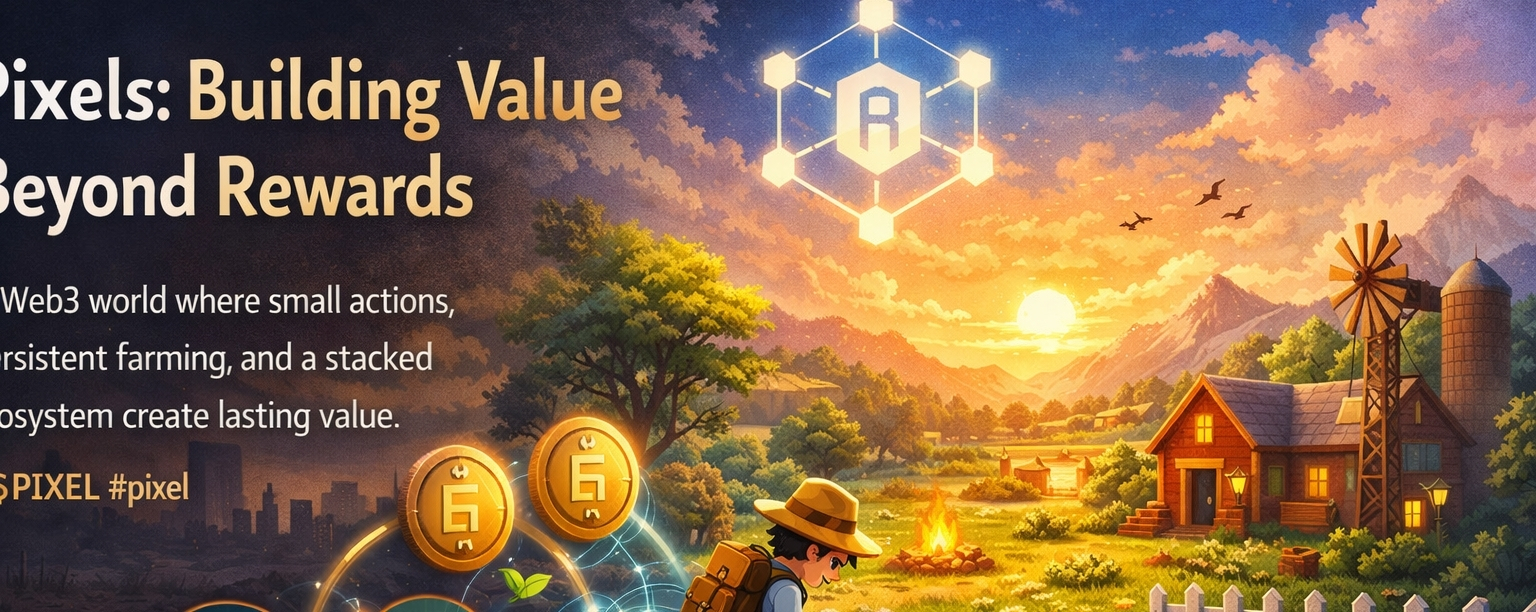
Pixels enters this landscape with a different framing. Rather than asking how to maximize rewards or enforce ownership, it appears to explore how small, consistent actions can accumulate into something that feels persistent. Built on the Ronin Network, it presents a casual, open-world environment centered on farming, exploration, and creation. On the surface, these mechanics are familiar and intentionally simple, but the project’s underlying claim is less about innovation in mechanics and more about the rhythm of interaction.
The idea being suggested is that a slower, more continuous form of engagement may create a different kind of attachment. Farming becomes less about optimization and more about routine. Exploration is less about discovery in a traditional sense and more about movement within a shared space. Creation hints at the possibility that players are not just consuming content but gradually shaping their presence within the world. The blockchain layer, in this context, functions as a record of continuity rather than a primary driver of behavior.
In practical terms, Pixels allows players to own in-game assets and interact within a shared environment where those assets have persistence. The use of the Ronin Network supports frequent, low-cost interactions, which is important for a game built around ongoing activity rather than isolated events. This reduces friction and allows the system to operate more like a continuous environment rather than a series of transactions. The technical design aligns with the project’s broader claim that engagement should feel natural rather than forced.
However, the effectiveness of this approach depends on whether routine can evolve into meaning. Repetition is a core part of many successful games, but it is usually supported by layers of progression, variation, or narrative. In Pixels, the simplicity of its mechanics raises questions about how far this model can extend. If actions remain largely unchanged over time, the sense of continuity may eventually give way to predictability. The project appears to rely on its social layer to offset this, suggesting that interactions between players can introduce variability and sustain interest.
This reliance introduces both potential and uncertainty. Social systems can create emergent experiences that are difficult to replicate through design alone, but they are also inherently unstable. The quality of interaction depends on the behavior and presence of other players, which can fluctuate. If the community grows and remains active, the world may feel dynamic. If it contracts, the same systems may feel empty. In this sense, Pixels is not just designing mechanics but also depending on collective participation as a core component of its structure.
The economic dimension of the project reflects a more restrained philosophy compared to earlier Web3 games. While assets are tokenized and ownership is emphasized, the absence of aggressive reward narratives suggests an attempt to reduce speculative behavior. This could help create a more stable environment, but it does not eliminate economic influence entirely. Even subtle incentives can shape how players interact, and the balance between organic participation and value-driven behavior remains delicate.
From a technical standpoint, building on Ronin provides efficiency and scalability, which are essential for maintaining a seamless experience. At the same time, this choice comes with trade-offs related to ecosystem dependence and long-term flexibility. A more specialized network can optimize performance, but it may also limit interoperability with broader systems. This raises questions about how assets and identities within Pixels might function beyond its immediate environment.
The design of Pixels seems to favor accessibility over complexity, which makes it approachable for a wide range of users. Casual players may find value in its low-pressure structure and ongoing sense of presence. However, this same simplicity may limit its appeal for those seeking deeper strategic or competitive experiences. The project appears to prioritize consistency over intensity, which is a deliberate but constraining choice.
What emerges from this approach is not a definitive solution but a different perspective on the problem. Instead of trying to make players stay through rewards or ownership alone, Pixels experiments with the idea that steady, low-intensity engagement might be enough to sustain a digital world. Some aspects of this approach feel grounded, particularly its focus on usability and continuity. Others remain open to question, especially regarding how the system will adapt as player expectations evolve and initial curiosity fades.
If the future of Web3 gaming depends less on what players can extract and more on what they are willing to maintain, then the real question becomes: can a blockchain-based world create a sense of quiet responsibility strong enough to keep people coming back even when there is nothing urgent to gain?