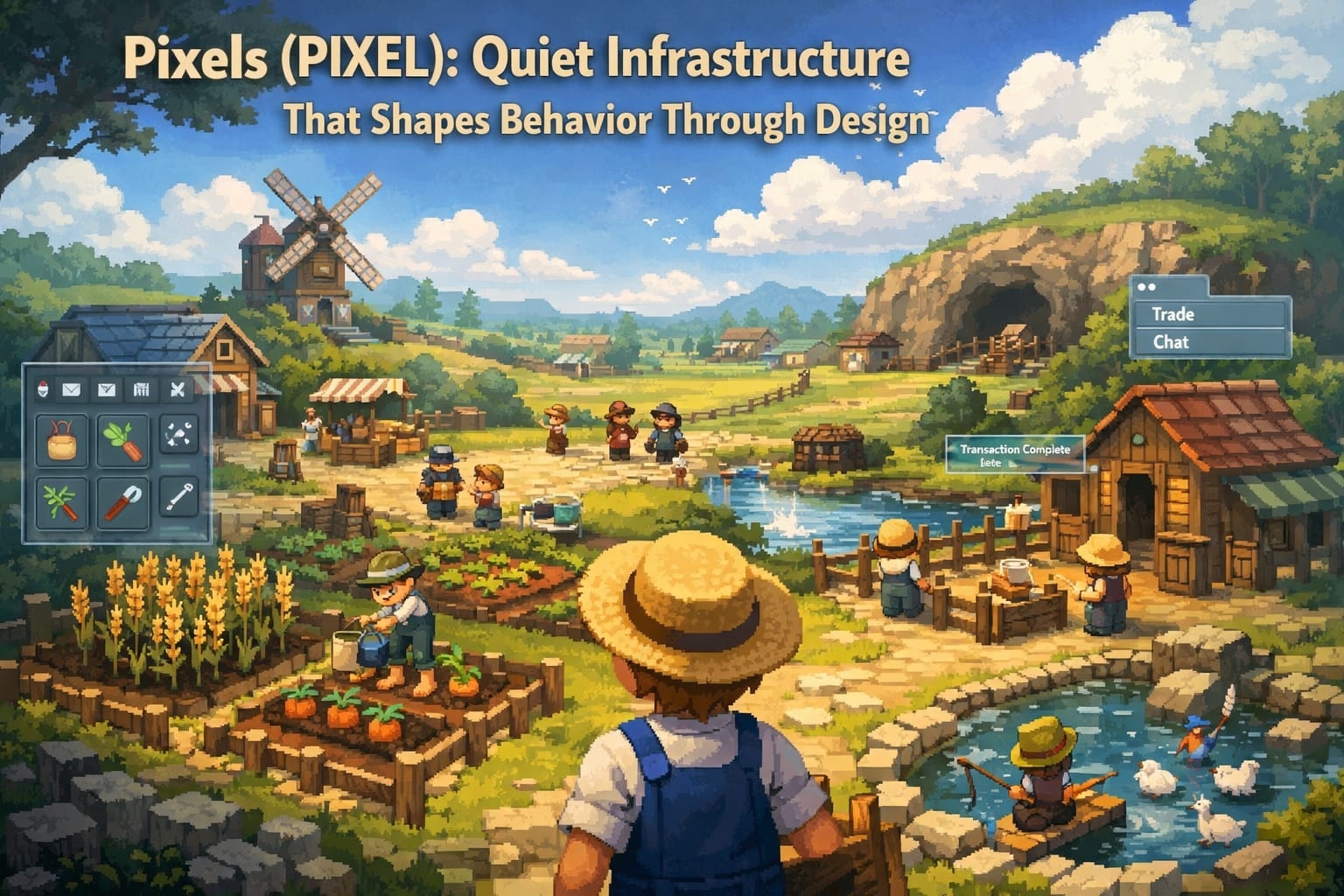
I’ve spent enough time looking at systems like Pixels to stop thinking of them as games in the usual sense. What holds my attention here isn’t the surface loop of farming or exploration, but the way those loops are structured to quietly coordinate behavior over time. The fact that it runs on Ronin matters, but not in a promotional way. It changes the texture of interaction in ways that are easy to miss if you only look at features instead of flow.
What I notice first is how little friction there is at the point of action. Transactions are fast and inexpensive, which removes the hesitation that usually sits between intention and execution in on-chain environments. That gap, small as it seems, tends to distort behavior elsewhere. When it disappears, users stop thinking in terms of “is this worth doing on-chain?” and start acting more continuously. The system begins to feel less like a series of discrete decisions and more like a persistent environment. That shift is subtle, but it has real consequences. It encourages repetition, and repetition is where most systems either stabilize or break.
Pixels leans into that repetition, but it does so without forcing urgency. The farming loop, for example, is not designed to maximize intensity. It is designed to normalize return. I find that important. Systems that rely on spikes of attention tend to create brittle engagement. Here, the cadence is slower and more predictable. Crops grow, resources accumulate, and progress unfolds in increments that don’t demand constant oversight. That shapes a different kind of user mindset. Instead of chasing outcomes, users begin to manage routines.
There’s a trade-off embedded in that choice. Lower intensity reduces the likelihood of burnout, but it also risks reducing perceived excitement. Pixels seems comfortable with that trade-off. It doesn’t try to compensate with spectacle. Instead, it builds a quiet feedback loop where actions reinforce themselves over time. I come back to it not because something dramatic is happening, but because the system has made returning feel like the natural continuation of something already in motion.
Ownership is present, but it’s not aggressively surfaced. That’s another design decision that stands out to me. In many Web3 environments, ownership is treated as the primary value proposition, often to the point where it overwhelms the underlying activity. Here, it feels more like a background condition. Assets exist, they matter, but they don’t constantly demand attention. This keeps the focus on interaction rather than inventory. The effect is that users engage with the system first and only gradually become aware of what they hold within it.
That ordering changes how value is perceived. When ownership is front-loaded, users tend to evaluate everything in terms of immediate return. When it’s deferred, they build a relationship with the system before they start measuring outcomes. Pixels seems to benefit from this. The value of an asset emerges from how it fits into daily behavior, not from how it is presented upfront. This makes the system feel less transactional, even though transactions are happening continuously in the background.
Another detail that often goes unnoticed is how constraints are used. The world is open, but not unlimited. Movement, actions, and progression all operate within boundaries that are rarely explained explicitly. These constraints do more than limit; they shape decision-making. When options are slightly restricted, patterns begin to form. Users learn what works not through instruction, but through repetition within those limits. Over time, this creates a kind of shared understanding that doesn’t need to be formalized.
For developers, this has implications as well. Building on top of a system like this is less about adding features and more about aligning with existing behavior. The infrastructure encourages extensions that feel native to its rhythm. Anything that disrupts that rhythm too aggressively risks being ignored, regardless of how technically sound it is. This is one of those second-order effects that doesn’t show up in documentation. The system quietly filters what kinds of contributions are viable.
The social layer is also worth paying attention to, not because it is heavily emphasized, but because of how it is integrated. Interaction between users is not treated as a separate feature. It emerges from shared participation in the same environment. When multiple users operate within the same constraints and loops, coordination starts to happen naturally. Trade, collaboration, and even competition arise as byproducts rather than objectives. This makes the social experience feel less forced and more situational.
There is also an interesting relationship between time and variation. The system doesn’t rely on constant novelty. Instead, it introduces small differences that play out over longer periods. This approach assumes that users will notice changes gradually, rather than reacting to them immediately. It’s a slower form of engagement, but it tends to be more stable. People adjust their behavior over time instead of chasing each new variation as it appears.
What I find most telling is what the system chooses not to optimize. It doesn’t maximize speed of progression, it doesn’t push constant rewards, and it doesn’t aggressively surface ownership. Each of these omissions reduces short-term intensity, but they also reduce volatility in user behavior. The result is a system that feels steady. That steadiness is not accidental; it’s the outcome of a series of decisions about what kinds of behavior are worth supporting.
From an infrastructure perspective, Pixels operates less like a product and more like an environment with rules that are consistently enforced. Those rules are not always visible, but they are felt through interaction. Over time, users adapt to them, and their behavior becomes more predictable. That predictability is valuable, not in a financial sense, but in a structural one. It allows the system to sustain itself without constantly needing to re-engage users through external means.
I don’t see Pixels as something that tries to impress. It doesn’t rely on moments of intensity or narratives of transformation. Instead, it builds a framework where small actions accumulate into something coherent. The experience is quiet, but it is also deliberate. Every design choice seems to point toward continuity rather than disruption.
After spending time with it, I find that the most important aspects are the ones that are easiest to overlook. The absence of friction, the pacing of loops, the subtle handling of ownership, and the consistent use of constraints all work together to shape behavior in ways that are not immediately obvious. These are not features in the traditional sense. They are conditions that define how the system is experienced day to day.
That, more than anything else, is what makes it worth studying. Not because it promises anything, but because it demonstrates how a set of design decisions can produce a stable pattern of interaction. And in systems like this, stability is often the hardest thing to achieve.