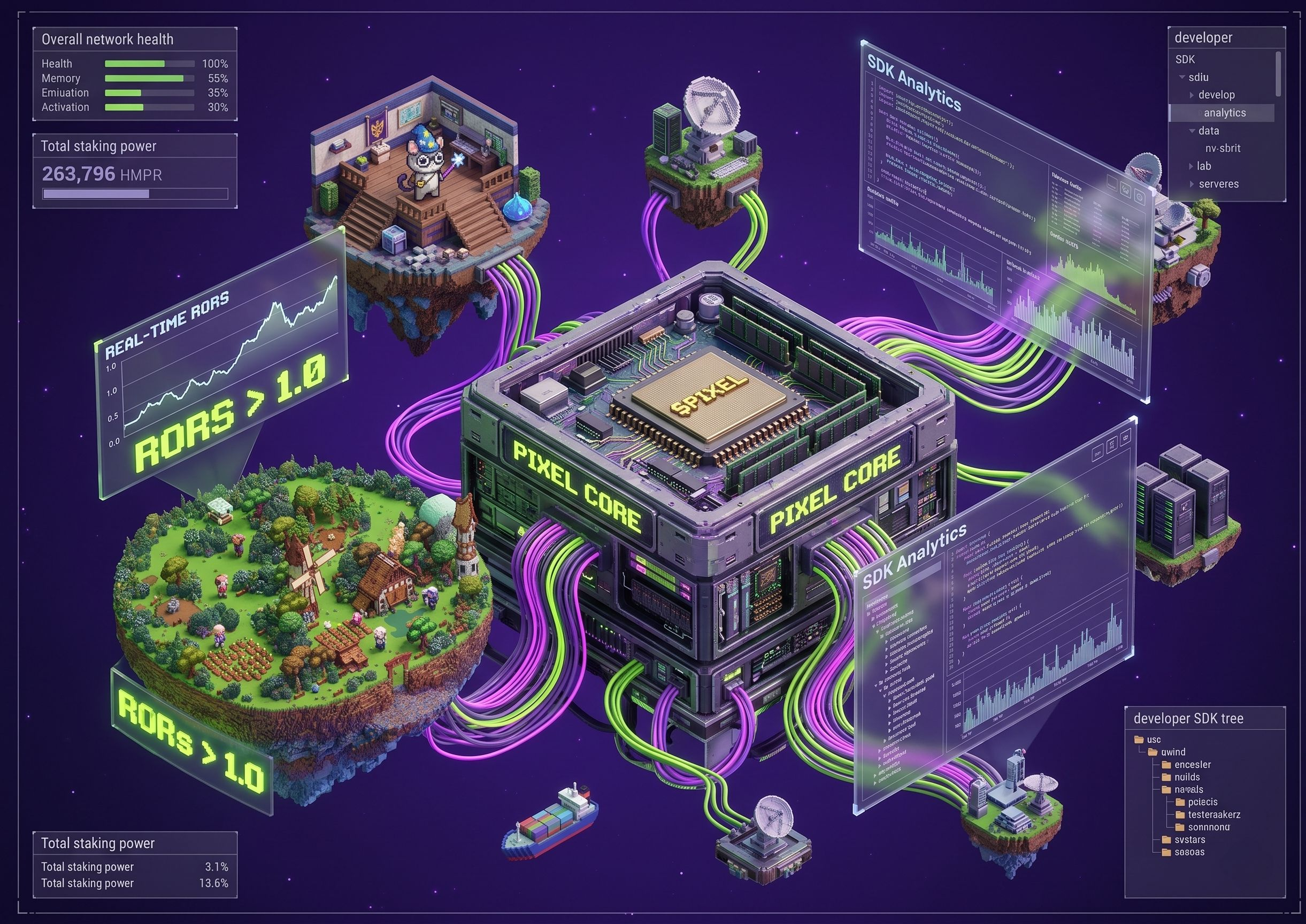
Most Web3 games struggle with a "leaky bucket" problem: they spend millions on user acquisition (UA) only to see players dump tokens and leave. After analyzing the Pixels Whitepaper, it’s clear they are building something different: a Closed-Loop Data Ecosystem.
The Events API: The Network’s "Central Nervous System"
The most underrated part of the PIXEL stack is the Pixels Events API. From a developer's perspective, this isn't just a logging tool. It’s a real-time behavioral filter. By streaming player data (crafting frequency, social interactions, session depth), the system builds a "Trust Score" for every wallet. This is the foundation of their Smart-Reward Targeting.
RORS vs. Traditional Emissions
While other projects talk about "inflation," Pixels talks about Return on Reward Spend (RORS).
The Logic: If $1 in $PIXEL wards doesn't generate > $1 in ecosystem value (via fees or data), the model recalibrates.
The Tool: The Stacked selection machine. Unlike a simple quest board, Stacked uses the API data to ensure rewards go to "Value Creators" rather than "Value Extractors" (bots).
Vertical Integration on Ronin
By leveraging the Ronin Network’s low-latency infrastructure, Pixels can afford to run these complex calculations off-chain and verify them on-chain. This vertical integration allows for the $vPIXEL (ERC-20c) mechanism a spend-only token that recycles liquidity without hitting the open market.
Final Verdict
Pixels is effectively building a "Decentralized AppsFlyer." If they can prove that their SDK can lower UA costs for partner games while maintaining a RORS > 1.0, $PIXEL s being a game token and becomes the reserve currency of Web3 gaming attention. The industry isn't just watching a game; it's watching a new standard for sustainable publishing.