
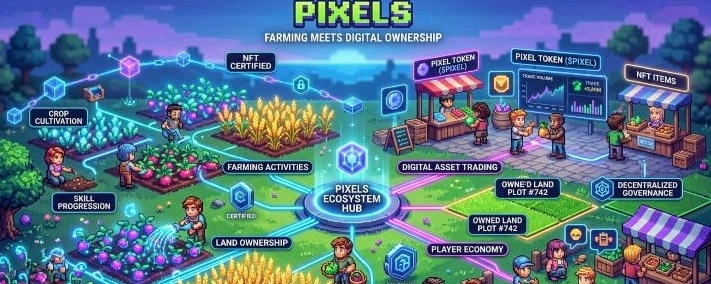
There is something quietly powerful happening inside Pixels, and if you’re not paying close attention, you might miss it entirely. At first glance, it looks simplea soft, colorful world where players farm, explore, and build at their own pace. But beneath that calm surface, something much deeper is unfolding, something that feels less like a game and more like the early shape of a new kind of digital life.
Built on the Ronin Network, Pixels doesn’t try to overwhelm you with complexity. It doesn’t shout about technology or force you to understand blockchain mechanics. Instead, it invites you in gently. You plant seeds, you walk through open land, you meet others doing the same. Time slows down. The noise of modern gaming fades away. And somewhere in that stillness, you begin to notice what makes this world different.
Ownership feels real here, but it doesn’t feel heavy. The items you collect, the land you shape, the progress you build—it all belongs to you in a way that traditional games never quite managed to deliver. Yet Pixels doesn’t turn that into a cold transaction. It keeps things human. It keeps things warm. It reminds you that behind every digital asset is a moment, a decision, a piece of time you chose to spend.
There’s also a quiet social layer that grows stronger the longer you stay. Players don’t just compete—they exist alongside each other. They trade, they observe, they return. The world feels lived in, not rushed. It feels like a place rather than a product. And that difference matters more than it seems, especially in a space where many projects focus too much on speed and speculation and not enough on experience.
The token at the center, $PIXEL, isn’t just a symbol of value. It becomes part of the rhythm of the world. It flows through actions, through effort, through participation. It doesn’t feel detached. It feels earned, connected to what you do rather than just what you hold. That subtle design choice changes everything, because it shifts the focus from quick gains to long-term presence.
What makes Pixels stand out is not just what it is, but what it refuses to become. It doesn’t chase trends aggressively. It doesn’t try to impress with noise or complexity. It builds slowly, almost patiently, like it understands that real ecosystems are not forced—they grow. And that growth is now starting to show in its expanding structure, often referred to as its stacked ecosystem, where layers of gameplay, economy, and community begin to connect in ways that feel natural rather than engineered.
There’s a certain emotion that comes with spending time in Pixels, something difficult to describe but easy to feel. It’s the sense that you’re early to something meaningful. Not in a loud, hype-driven way, but in a quiet, almost personal way. Like finding a place before it becomes crowded. Like understanding something before it becomes obvious.
In a world where digital experiences are often designed to capture attention as quickly as possible, Pixels does the opposite. It holds your attention by letting you breathe. And in doing so, it creates something raretrust. Not just in the system, but in the experience itself.
Maybe that’s why it stays with you, even after you log out. Not because of what it promises, but because of how it feels.
