

DeFi in 2026 is defined less by isolated apps and more by integrated financial systems. What used to be a collection of separate products for swapping, lending, or staking has matured into a broader ecosystem of platforms that help users move capital, earn yield, and manage risk more efficiently.
That shift changes how platforms should be evaluated. It is no longer enough to ask which protocol has the deepest liquidity or the lowest fees. The better question is which platforms create the clearest path for users to discover opportunities, make decisions, execute transactions, and keep capital productive.
How to Choose the Best DeFi Platform in 2026
Security and Track Record
Security remains the baseline. The strongest DeFi platforms combine transparent smart contracts, battle-tested infrastructure, and clear risk controls.
Liquidity and Capital Efficiency
For trading, liquidity reduces slippage. For lending and staking, capital efficiency determines how productively assets are used. Strong platforms make idle capital work harder.
User Experience
The best platforms reduce friction. They make complex on-chain actions easier to understand and simpler to execute.
Composability
DeFi works best when platforms connect. The most useful protocols plug into the broader ecosystem and allow assets to move across strategies.
Reputation and Staying Power
Protocols that survive multiple cycles and continue shipping tend to attract deeper trust, more integrations, and stronger network effects.
DeFi Platform Selection Guide
Choosing the right DeFi platform comes down to understanding your needs, evaluating trade-offs, and minimizing risk before committing capital.
Match the platform to your chain and assets
Check liquidity before trading
Test with small transactions first
Understand total costs, not just fees
Be cautious with new protocols
Best DeFi Platforms in 2026
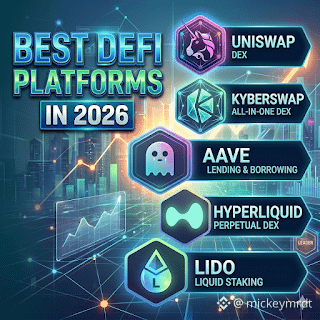
Each of the top DeFi platforms in 2026 plays a different role in the stack. Uniswap remains a core liquidity layer for on-chain trading. KyberSwap stands out for all-in-one execution across chains. Aave leads in decentralized lending and borrowing. Hyperliquid has become a major venue for on-chain perpetual trading. Lido remains one of the most important platforms for liquid staking. Understanding these roles makes it easier to choose the right protocol for the job.
1. Uniswap
Uniswap remains one of the foundational pieces of DeFi infrastructure. What began as a simple automated market maker has evolved into a highly flexible liquidity layer that supports a wide range of on-chain trading activity.
With v4, Uniswap expanded what a DEX can do through hooks, which allow developers to add custom logic at the pool level. Its singleton architecture also improves efficiency by consolidating pools into a more streamlined system.
Strengths: Deep liquidity, strong ecosystem, and programmable pool design
Limitations: Mainnet trading can still be expensive and newer hook-based designs may take time to mature
Best for: General on-chain trading, deep liquidity access, and developers building DeFi applications

2. KyberSwap
KyberSwap built around a simple idea: DeFi should happen in one connected loop, not across fragmented tools. Instead of acting as just another DEX interface, it functions as an execution layer that brings the entire user journey together, from finding opportunities to managing outcomes.
At its core, KyberSwap aggregates liquidity across multiple DEXs and chains to deliver the best possible swap rates and execution, with zero added fees. Instead of forcing users to navigate fragmented liquidity, the protocol handles routing and optimization in the background.
Beyond swapping, KyberSwap expands into a broader “Smart Finance Hub” where users can discover, analyze, execute, track, and optimize – all in one place with the best execution. This unified experience removes one of the biggest frictions in DeFi today.
Strengths: Best-rate aggregation, zero-fee swaps, seamless multi-chain execution, and a unified DeFi workflow
Limitations: Dependent on external liquidity sources and aggregator performance across connected venues
Best for: Traders and yield-focused users who want a complete DeFi workflow in one place, especially across multiple chains
3. Aave
Aave is one of the most established lending protocols in DeFi. It allows users to supply assets to earn yield or borrow against collateral in a non-custodial system, making it a core building block for on-chain capital management.
Aave's strength comes from turning idle assets into productive capital while keeping the experience relatively straightforward. Users can earn interest by supplying assets, unlock liquidity without selling by borrowing against collateral, and manage risk through mechanisms such as health factors and liquidation thresholds.
Strengths: Trusted lending infrastructure, broad asset support, and strong integration across DeFi
Limitations: Borrowing introduces liquidation risk and yields vary by asset and demand
Best for: Users who want to lend, borrow, or put idle assets to work without leaving DeFi
4. Hyperliquid
Hyperliquid has emerged as one of the most notable on-chain trading platforms for perpetuals and spot markets. It runs on its own decentralized Layer 1 and uses fully on-chain order books, giving traders a faster and more exchange-like experience than many earlier DeFi derivatives venues.
What makes Hyperliquid stand out is its focus on execution quality. Trades, funding, and liquidations happen on the Hyperliquid L1, and the platform is built for users who care about speed, depth, and a smoother derivatives trading experience on-chain.
Strengths: Strong perpetual trading experience, fully on-chain order books, and high-performance infrastructure
Limitations: More specialized than general-purpose DeFi platforms and better suited to active traders than passive users
Best for: Traders who want on-chain perpetuals and spot exposure with a faster, more professional trading experience
5. Lido
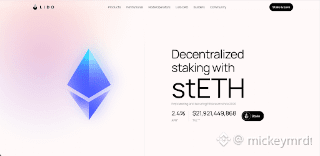
Lido remains one of the most important staking platforms in DeFi because it makes Ethereum staking liquid. Users can stake ETH through Lido and receive stETH, a liquid staking token that continues earning staking rewards while remaining usable across DeFi.
That model matters because it removes the traditional tradeoff between staking and flexibility. Instead of locking capital into a passive position, users can keep staked exposure while using stETH in other DeFi strategies. Lido has also continued to expand its staking architecture through modular infrastructure such as stVaults and staking modules.
Strengths: Liquid staking, deep ecosystem integrations, and one of the most widely used staking derivatives in DeFi
Limitations: Exposure to staking-specific smart contract, validator, and protocol risks
Best for: ETH holders who want staking rewards without giving up liquidity
Final Take
There is no single best DeFi platform in 2026 because each one solves a different problem. Uniswap is still a default choice for deep on-chain liquidity. KyberSwap stands out for all-in-one execution. Aave leads in lending and borrowing. Hyperliquid is built for high-performance on-chain trading. Lido remains a core platform for liquid staking.
The bigger takeaway is that DeFi is no longer a loose collection of experiments. It is becoming a connected financial stack. The strongest platforms are the ones that make that stack easier to access, easier to understand, and more useful in practice.