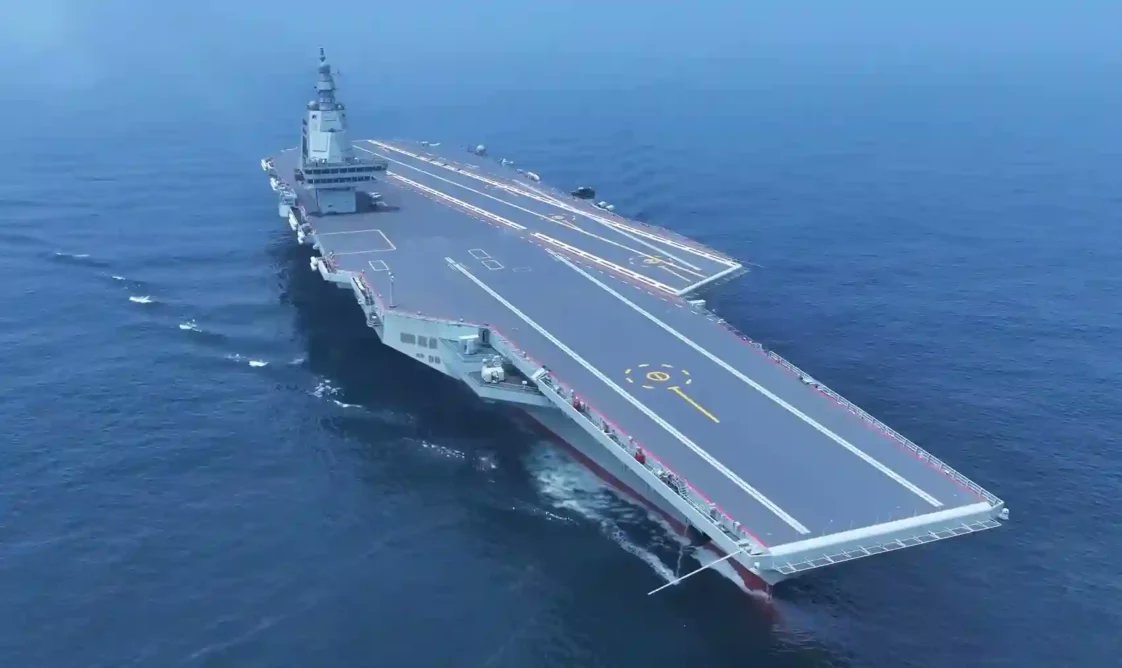
🚨 The Chinese navy is pursuing the construction of six aircraft carriers.
The People’s Liberation Army Navy is moving rapidly toward a strategic goal of operating six aircraft carriers by the 2030s, as part of Beijing’s efforts to expand its naval presence and establish itself as a global maritime power capable of operating far from its coastline.
China has already commissioned three aircraft carriers: Liaoning and Shandong, both using a ski-jump launch system, and the more advanced Fujian, which represents a major leap in capability thanks to its electromagnetic catapult system (EMALS), allowing the launch of heavier and more advanced aircraft, including the J-35 stealth naval fighter.
Despite this industrial progress, military analysts note that the real challenge is not shipbuilding itself, but developing an integrated operational system comparable to that of the U.S. Navy. China still lags in operational experience, crew training, carrier doctrine development, and critical capabilities such as sustained 24-hour flight operations, anti-submarine warfare, and airborne early warning operations from carriers.
The project reflects a broader transformation in China’s naval doctrine from “coastal defense” to a “blue-water navy” capable of operating on the high seas and protecting Chinese interests over long distances, particularly in the Indo-Pacific region.
Aircraft carriers are only part of a larger system known as a “carrier strike group,” which includes advanced Type 055 destroyers, multi-role frigates, nuclear attack submarines, and logistics support vessels, enabling sustained and protected operations at sea.
Beijing’s ambition is also linked to securing vital maritime trade routes, especially through the Strait of Malacca and the Indian Ocean, which are critical for China’s energy imports. Overseas facilities such as the Chinese naval base in Djibouti also play a key role in supporting long-range naval deployment.
At the same time, this naval expansion is raising concerns among the United States and its Asian allies, who view China’s growing carrier capabilities as a potential threat to the balance of power in the Indo-Pacific, particularly amid ongoing tensions in the South China Sea and around Taiwan.
However, the key challenge remains whether China can transform these assets into an effective combat force in real wartime scenarios, as issues remain in systems integration, command and control, inter-service coordination, and real-world operational testing.$SIREN