
Right now the market has that familiar split personality.
Bitcoin is doing what Bitcoin does — pulling liquidity inward, staying dominant, acting like the anchor. Meanwhile, most altcoins just drift. Not dead, not exciting either. Somewhere in between, where narratives struggle to stick and attention feels… selective.
And Web3 gaming? That’s been in a quiet phase.
Not gone — just deprioritized.
I’ve seen this pattern before. Attention doesn’t disappear in crypto. It rotates. It compresses into fewer places, then suddenly expands again when something actually holds it.
The last cycle burned a lot of people on gaming. Not because the idea was wrong — but because the implementation was.
Most Web3 games didn’t feel like games. They felt like dashboards with avatars.
You logged in, optimized your actions, extracted rewards, and logged out. It wasn’t play. It was maintenance. And once the token emissions slowed or prices dropped, the entire loop collapsed. Because the core assumption was flawed: users were there to earn, not to enjoy.
That model works… until it doesn’t.
And when it breaks, it breaks completely.
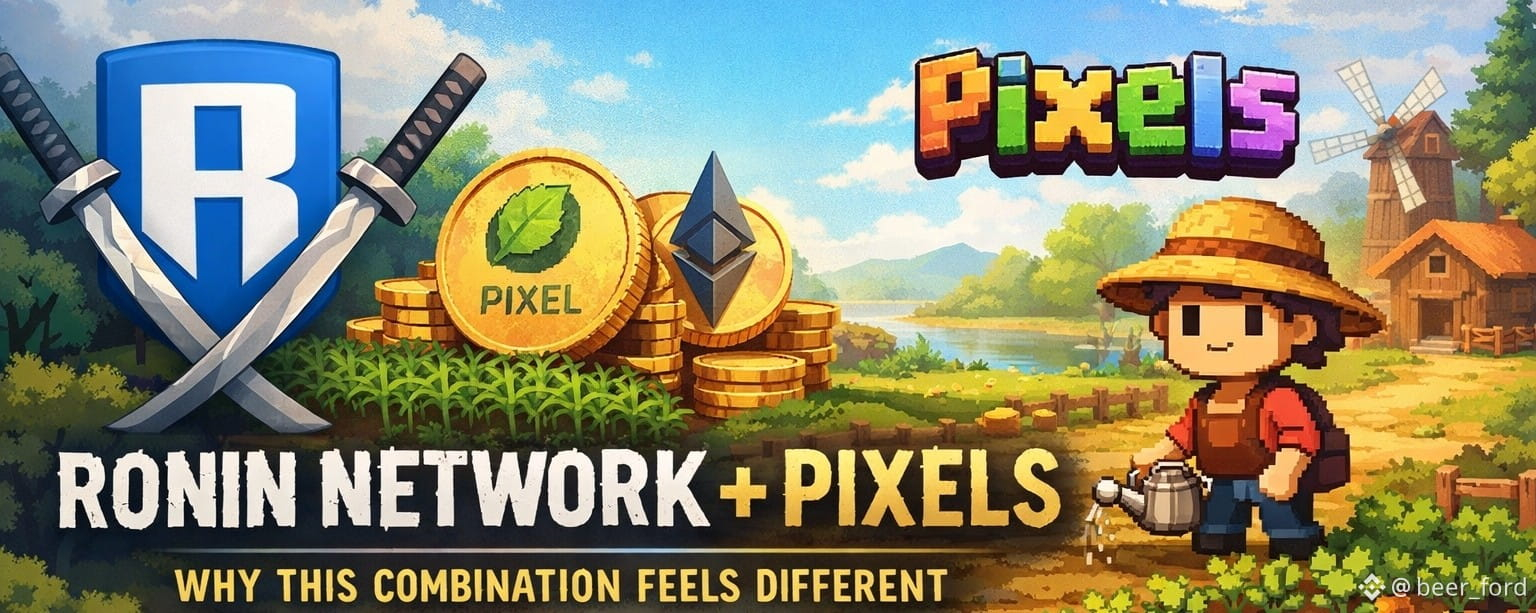
So when something like Pixels shows up — a farming game, pixel art, casual vibe — the natural reaction is skepticism.
We’ve seen this before too.
“Another farming sim with a token attached.”
“Another attempt to disguise yield farming as gameplay.”
It doesn’t immediately feel like innovation. If anything, it feels like regression.
But sometimes the surface-level simplicity is where the interesting stuff hides.
Because the difference with Pixels isn’t obvious in a feature list. It’s in how it feels when you actually engage with it.
You don’t log in thinking about APR.
You log in, plant crops, move around, interact, explore — and somewhere in the background, there’s an economy. But it’s not screaming at you. It’s not forcing every action to be financially optimized.
That alone is a shift.
In most Web3 games, the economy is the game. Here, the economy feels more like infrastructure — present, but not intrusive.
And that changes behavior in subtle ways.
Players don’t feel like they’re constantly calculating ROI. They’re just… playing. And when people play without thinking about extraction every second, retention starts to come from a different place.
That doesn’t mean the economy doesn’t matter. It does — maybe even more so.
The $PIXEL token isn’t just a reward drip. It’s integrated into actual gameplay loops — crafting, upgrades, progression, access. But importantly, it doesn’t dominate the experience. It supports it.
There’s also a clear separation happening between what needs to be on-chain and what doesn’t.
Most gameplay interactions are off-chain, which keeps things smooth and responsive. Nobody wants to wait for confirmations to water crops. But ownership, assets, and key economic elements still live on-chain, preserving that core Web3 value proposition.
That balance is harder to get right than it sounds.
Too much on-chain, and the game becomes friction-heavy. Too little, and it loses meaning as a Web3 system. Pixels sits somewhere in the middle — not perfectly, but intentionally.
And then there’s the part most people underestimate: infrastructure.
Launching a Web3 game on a new chain with no users is like opening a mall in the desert. You can build something great, but distribution becomes the real challenge.
This is where the Ronin ecosystem matters.
It already has a user base. It already has wallets, liquidity, and a history of players interacting with games. That reduces one of the biggest risks — cold start.
You’re not trying to convince people to adopt both a new game and a new ecosystem at the same time. You’re plugging into an existing flow of users who understand the basics.
That doesn’t guarantee success. But it removes a major point of failure.
And if you look at behavior instead of metrics, you start to see why this combination is interesting.
People are actually spending time in the game.
Not just logging in for rewards — but staying, returning, interacting. There’s a difference between “users” and “players,” and Web3 has struggled with that distinction.
Pixels seems to be leaning more toward the latter.
You can also see different player archetypes forming naturally.
There are casual players who just enjoy the loop — farming, exploring, socializing.
Then there are optimizers — the ones who figure out the most efficient ways to progress, maximize output, and understand the deeper mechanics.
You have landowners who treat assets more strategically, thinking about long-term positioning and utility.
And of course, speculators — because this is still crypto.
What’s interesting is that these roles aren’t rigid. Players move between them. Someone might start casually, then become more engaged, then eventually think about assets or tokens.
That fluidity matters.
In previous models, everyone was forced into the same behavior: extract rewards as efficiently as possible. Here, behavior feels more optional, more organic.
Still, it’s not without risk.
Token emissions are always a pressure point. If supply outpaces meaningful demand, the system weakens. And even with better design, sustaining long-term value in a game economy is incredibly difficult.
Retention is another question.
Early engagement is one thing. Keeping players interested over months — especially when traditional games are competing for attention — is a different challenge entirely.
And then there’s the broader skepticism.
A lot of players — especially outside crypto — still associate Web3 gaming with the failures of the last cycle. That reputation doesn’t disappear overnight.
So even if something is working, it has to overcome that historical baggage.
Which brings things back to the bigger shift that seems to be happening.
The move from “earn-first” to “experience-first.”
It sounds obvious in hindsight, but it’s something the space had to learn the hard way.
You can’t financialize something that isn’t inherently enjoyable and expect it to sustain itself. The foundation has to be the experience. The economy comes after.
Pixels seems to understand that — or at least, it’s moving in that direction.
And pairing that approach with a network that already has distribution gives it a different kind of starting point.
Not a guaranteed win.
But a more interesting experiment than most.
I’ve seen cycles where things like this get ignored at first — because they don’t look revolutionary enough. Then, slowly, attention shifts.
Not all at once. Just enough to matter.
This feels like one of those cases.
Not because it’s perfect.
But because it’s trying to solve the right problems.
And in this space, that’s usually where the signal starts — long before the narrative catches up.