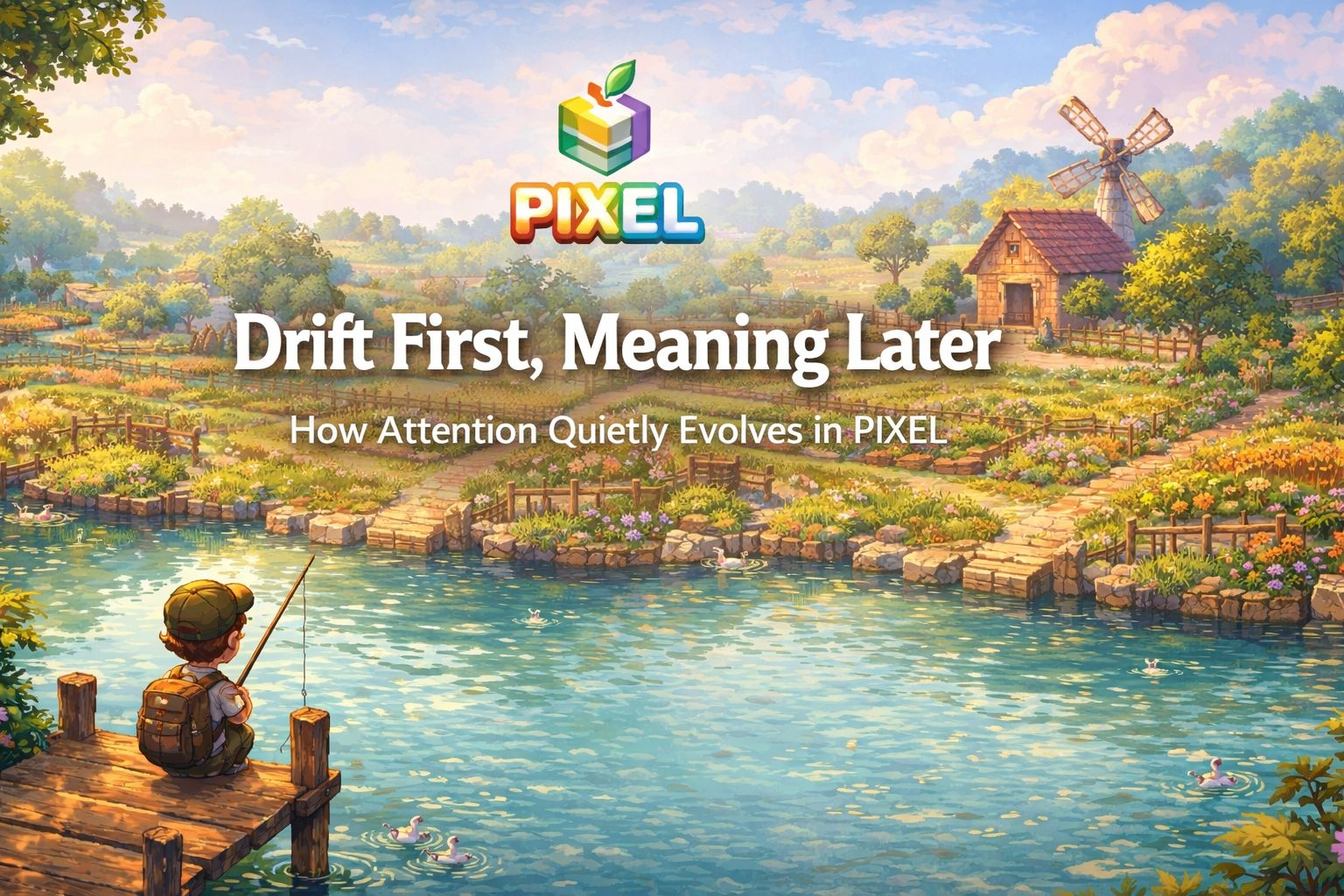
There are days in Pixels where nothing really begins.
You log in, not with intent, but with a kind of leftover momentum from yesterday. No clear plan, no structured goal just a soft pull to return. Your character appears where you last left them, and for a moment, you don’t move. Not because you’re deciding what to do next, but because there’s no pressure to decide at all.
Then, almost without thinking, you take a step.
That’s how most sessions start not with strategy, but with continuation. One small action leads to another, not because it’s optimal, but because it feels natural. You’re not solving anything. You’re not chasing anything. You’re just moving through something familiar, letting the rhythm pick up on its own.
It’s a different kind of engagement.
In most environments, especially in Web3, attention is treated like a resource under constant demand. There’s always something asking for it systems to optimize, decisions to make, timers to track, signals to follow. Even when you try to play casually, there’s a background pressure reminding you that you could be doing more, or doing it better.
Pixels doesn’t remove that instinct immediately.
At first, you bring it with you. You look for patterns to maximize, loops to refine, small advantages to stack. You scan your surroundings like there’s a “right” way to move through them. It’s almost automatic.
But here’s the quiet shift: nothing reinforces that behavior.
There’s no urgency pushing you forward, no constant feedback telling you you’re falling behind. If you pause, nothing breaks. If you wander, nothing punishes you. The system doesn’t rush to correct your pace.
And slowly, that changes how you pay attention.
Instead of scanning for the best possible move, you begin noticing what feels easy to do next. The difference is small at first, almost invisible. But over time, it becomes the default. You stop asking yourself what you should be doing, and start following what feels natural in the moment.
That’s where drift becomes something more than just aimlessness.
It becomes a way of interacting.
You begin to form habits, but they aren’t rigid. They’re shaped by repetition, not instruction. You return to certain areas more often, not because they’re the most rewarding, but because they’re familiar. You repeat certain actions, not out of necessity, but because they fit easily into your flow.
Other parts of the game remain untouched not ignored, just not chosen.
And that’s where something interesting happens.
Your attention starts to reveal its own preferences.
Without external pressure, you begin to see what you naturally gravitate toward. The way you move through the world becomes less about efficiency and more about inclination. Some sessions feel focused, almost narrow. Others feel open and scattered. Neither feels wrong.
They’re just different expressions of the same space.
Time behaves differently here too.
Short sessions don’t feel incomplete, because nothing was expected from them. You can log in, take a few actions, and leave without that lingering sense of “I should have done more.” At the same time, longer sessions stretch effortlessly. You don’t notice the passing of time in sharp segments. It blends together, one small choice flowing into the next.
You’re not managing time.
You’re inhabiting it.
And then, gradually, without any clear marker, something begins to change.
It doesn’t come as a realization. It comes as a quiet familiarity.
You start recognizing patterns you didn’t consciously learn. Certain paths feel smoother. Certain sequences feel more connected. You notice where your time tends to settle, where it drifts, where it gets slightly stuck.
Not in a frustrating way just in a way that makes you aware.
This is where perception deepens.
The game hasn’t changed. The actions are the same. The environment is the same. But your understanding of it becomes more layered. You begin to see the subtle structures underneath your own behavior the small trade-offs you’ve been making without realizing it.
You notice inefficiencies, but they don’t feel like mistakes.
They feel like options.
You can adjust them, refine them, or ignore them entirely. There’s no pressure to optimize, only the possibility to do so. That distinction matters more than it seems.
Because it keeps the experience intact.
You don’t lose the calm just because you’ve become more aware. If anything, the calm becomes more intentional. You can still drift when you want to. You can still move without thinking. But now, when you choose to focus, it comes from understanding, not obligation.
Both states exist side by side.
You might spend one session barely paying attention, moving through familiar loops on instinct alone. Then, in another session, you notice something small a better way to move, a smoother sequence, a slight shift in timing.
It doesn’t transform everything.
It just adjusts your perspective.
And that adjustment lingers.
What’s interesting is that these changes don’t feel urgent. They don’t demand to be applied immediately. You can sit with them, return to them later, or let them fade if they don’t fit how you want to play.
Nothing is forcing your attention into a specific shape.
It’s evolving on its own.
That’s a rare quality in digital environments. Most systems try to guide attention aggressively, shaping it through incentives and feedback loops. Pixels takes a quieter approach. It creates a space where attention can settle, drift, sharpen, and soften without being constantly redirected.
And over time, that changes how you relate not just to the game, but to your own habits within it.
You start to notice when you’re acting out of routine versus when you’re acting out of intention. You become aware of how easily attention can narrow, and how naturally it can expand again when nothing is constraining it.
There’s no lesson being taught.
Just a pattern being experienced.
By the time you notice it clearly, it already feels normal.
Logging in without a goal no longer feels like a lack of direction. It feels like an open starting point. Repetition no longer feels like something to escape. It feels like something you can reshape at your own pace.
And awareness doesn’t interrupt that flow.
It sits quietly within it.
In the end, nothing dramatic happens.
The game doesn’t suddenly reveal something new. There’s no moment where everything clicks into place. Instead, there’s a softer realization—one that doesn’t arrive all at once.
That attention, when it isn’t being pushed, doesn’t disappear.
It changes.
It becomes more selective, more personal, more reflective of how you actually want to spend your time. It stops reacting and starts settling. And in that space, even the smallest actions begin to feel different not because they’ve changed, but because the way you arrive at them has.
Not forced.
Not directed.
Just… chosen.