
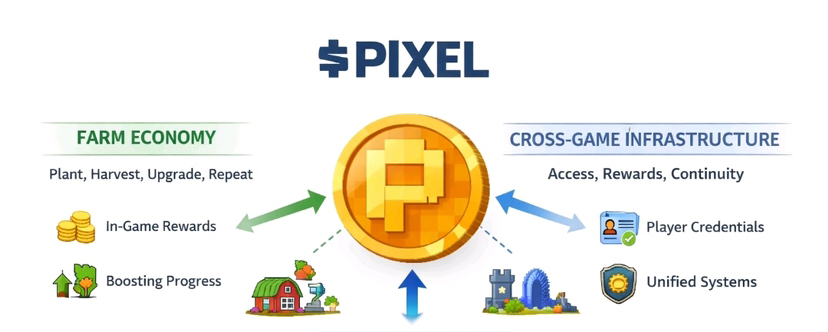
I kept thinking about Pixels as a farm economy for longer than I probably should have. Plant, wait, harvest, upgrade, repeat. That frame is easy to hold because the surface behavior supports it. You see crops, tools, land, energy, speed. You see a token moving around that seems to help the loop move faster. Simple enough. But after a while that explanation starts feeling a little too neat, especially once the ecosystem stops looking like one contained game and starts behaving more like a place that wants players to stay, return, and carry their habits across different environments.
That is where my view of $PIXEL has started to shift. Not all at once. More like noticing that the token may matter less as a pricing tool inside one farming loop and more as a way of organizing retention across multiple loops. That sounds abstract, but the experience is not abstract at all. People feel it in very ordinary ways. They come back because progress still feels connected. They keep paying attention because time spent in one place does not fully reset when attention moves somewhere else. The system starts remembering them, even if it does not say so directly.
And that is where the word infrastructure starts creeping in, almost by accident.
A lot of game tokens fail because they only make sense inside a narrow moment of use. You need them here, for this item, for this upgrade, during this event. Once that moment passes, the token becomes awkward. It still exists, but its role gets thinner. What seems more interesting with $PIXEL is the possibility that its function is slowly moving away from pure transaction and toward behavioral continuity. Not just helping users do things, but helping the ecosystem decide which kinds of users remain legible and valuable across games.
That is a different job.
When I say legible, I mean the system can still recognize what kind of participant someone is. Not just that they exist, but that their prior activity can still mean something somewhere else. In most digital systems, this is where things quietly break. Data exists, but it does not travel well. A record is there, but another environment does not know how to use it, or does not trust the conditions under which it was created, or simply does not care. That gap matters more than people admit. Information sitting in a database is not the same as information being usable in another decision.
This is where the article topic gets more interesting than it first looks. Because a cross game retention layer is not really about storing activity. It is about making prior behavior count again under new rules.
That sounds easy until rules actually matter.
A credential, in simple terms, is not just a piece of data. It is a claim. It says this player did something, earned something, qualified for something, belongs somewhere. Verification is the process of checking whether that claim can be trusted. An attestation is just a formal version of that, a signed statement that says something about a user or action is supposed to be true. But even if you verify the claim, you still have another problem. What happens next is a decision. Access is a decision. Reward eligibility is a decision. Priority treatment is a decision. Distribution is a decision too, even when it looks automatic on screen.
That is why proof and consequence should not be treated as the same thing. A system can verify something and still disagree on what should happen because of it.
I think this is where most smooth looking ecosystems reveal their rough edges. They feel frictionless while activity stays local. One game, one economy, one set of assumptions. But the moment another game or another platform has to rely on the same history, hidden judgment appears. Which actions count. Which wallets count. Which behaviors were authentic. Whether paid acceleration should be interpreted as commitment or merely spending. Whether an old user deserves better positioning than a new one. Suddenly the token is not just moving value. It is sitting near the point where administrative choices get enforced.
That enforcement layer is rarely visible to players, but they feel it anyway. They feel it when eligibility changes without a clear reason. When one platform recognizes effort and another does not. When they have to prove themselves again after already spending time, money, and attention in the same broader ecosystem. Repeated verification is tiring in a very human way. It makes people feel less like participants and more like applicants.
So if Pixel is becoming cross game retention infrastructure, the real test may not be whether it keeps buying speed inside a farm loop. It may be whether it helps trust travel without turning every transition into a new manual review. Can one game inherit enough confidence from another to make rewards or access defensible. Can history remain meaningful after context changes. Can the system scale without collapsing into endless exceptions and quiet favoritism.
Because scale is where these designs usually get exposed. The bigger the network gets, the more often one system has to rely on decisions made somewhere else. That is when old records stop being neutral. They become evidence. They become claims about who should receive what next. And once distribution depends on those claims, the token is no longer just part of an economy. It is part of an administrative process, whether the project wants to describe it that way or not.
Maybe that is the deeper shift here. Not from game token to bigger game token. Something stranger than that. From pricing in game actions to helping coordinate whether prior actions should still matter when players move. That is not as easy to market, and probably not as easy to measure either. But it feels closer to what actually determines whether an ecosystem keeps its people.
I do not think this guarantees anything. Systems can remember badly. They can over reward stale behavior. They can confuse spending with loyalty. They can make proof portable while making judgment even less transparent. That risk stays there. Still, I keep coming back to the same thought. The important question may no longer be whether Pixel supports activity inside Pixels. It may be whether it can carry enough meaning between environments without that meaning falling apart on contact.