
Most people still analyze @undefined like it is just another Web3 farming game with crafting, grinding, and token rewards.
That misses the real design.
The real innovation in Pixels is not simply crafting, staking, or earning.
It is the way the system uses interdependency, behavioral filtering, and reward routing to separate real participation from pure extraction.
And that changes everything.
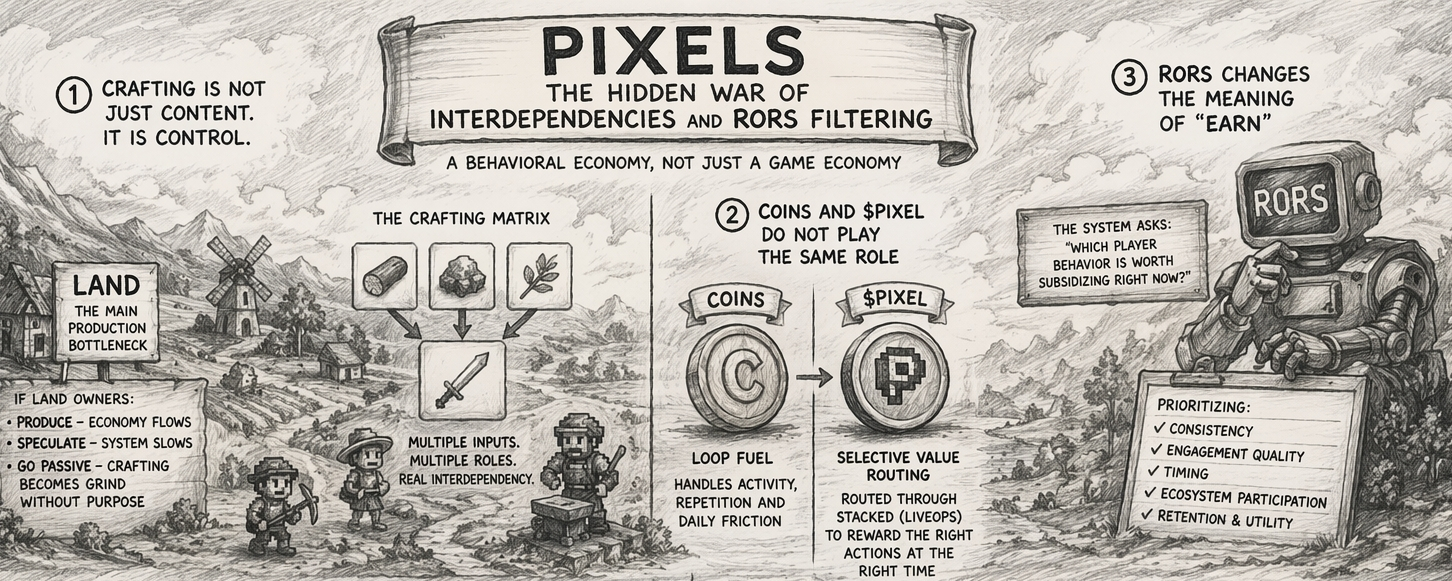
1. The crafting system is not just content. It is control.
A lot of blockchain games fail because the economy is too simple:
Do action → get token → sell token.
Pixels moved away from that by building a more layered economy where progress depends on multiple inputs, multiple loops, and multiple roles.
On paper, that looks like a player-driven economy.
But the deeper reality is this:
complexity alone does not create a healthy economy.
It only works when players actually depend on each other in a meaningful way.
That is where the first big tension appears.
LAND is still the main production bottleneck
The economy may look broad, but much of the production base still ties back to LAND.
That creates a structural problem:
If land owners produce, the economy flows
If land owners mainly speculate, the system slows down
If production weakens, crafting becomes grind without real purpose
So the real question is not whether Pixels has crafting.
The real question is whether the economy can keep its production core active, not passive.
Because without active producers, even the best crafting tree becomes an illusion of depth.
2. COINS and $PIXEL do not play the same role
This is where many people misunderstand the system.
Not all rewards inside Pixels mean the same thing.
COINS = loop fuel
COINS handle activity, repetition, and daily friction.
They keep players moving through the economy without forcing every action to be rewarded in immediate onchain value.
That matters, because it lets the system scale player activity without turning every click into token emissions.
$PIXEL = selective value routing
This is the deeper layer.
Pixel is not just handed out evenly for effort.
It is routed more carefully through LiveOps and task systems.
This is where Stacked becomes important.
Stacked, built by the Pixels team, is not just a rewards engine. It is a rewarded LiveOps system that helps direct incentives toward the behaviors the ecosystem actually wants to encourage.
That means the economy is not simply rewarding action.
It is rewarding the right action at the right time.
And that is a huge difference.
3. RORS changes the meaning of “earn”
A lot of players still think effort alone should determine rewards.
But Pixels seems to operate closer to a model of Return on Reward Spend, or RORS.
In simple terms:
the system is asking,
“Which player behavior is worth subsidizing right now?”
That is a much more advanced model than standard P2E.
Instead of rewarding raw volume, the system can prioritize:
consistency
engagement quality
timing
ecosystem participation
behaviors that strengthen retention and utility
So the hidden shift is this:
Pixels may not be rewarding time. It may be filtering for presence.
That is a very different economic philosophy.
It suggests that the future of Web3 gaming is not “play more, earn more.”
It is closer to:
participate better, unlock better value.
4. Staking is bigger than passive yield
Another underrated part of the ecosystem is staking.
A lot of people still view staking as just a way to earn more rewards.
But in the Pixels ecosystem, staking points toward something more strategic:
capital allocation as ecosystem curation.
When players stake $PIXEL, it is not only about yield.
It also signals where attention, support, and ecosystem value should go.
That matters even more as token utility expands beyond simple farming loops.
This is the bullish part many people overlook:
If token utility keeps deepening across experiences, systems, and LiveOps, then $PIXEL becomes more than a reward token. It becomes infrastructure for deciding what deserves growth inside the ecosystem.
5. The real challenge is not emissions. It is fun.
This is the hardest part.
Complex economies are exciting at first because they create mastery, strategy, and social coordination.
But over time, complexity can also become friction.
That means Pixels has a real long-term challenge:
Can it keep the system deep without making it feel like work?
Because if the economy becomes too opaque, too concentrated, or too dependent on insiders understanding hidden reward logic, then regular players may stop seeing a path forward.
And if players stop believing the system is navigable, they disengage.
That is the line Pixels has to manage:
enough complexity to create real economic depth
enough clarity to keep the game fun
enough utility to make progression matter
enough sustainable rewards to prevent extractive behavior from dominating
Final thought
What makes @undefined interesting is not that it copied the old P2E model with better graphics.
It is that it is trying to build a system where rewards are earned through alignment, not just activity.
That is much harder to build.
But if done well, it is also much more scalable.
The biggest insight here is simple:
Pixels is not just building a game economy. It is building a behavioral economy.
And that is exactly why it deserves more serious attention.