
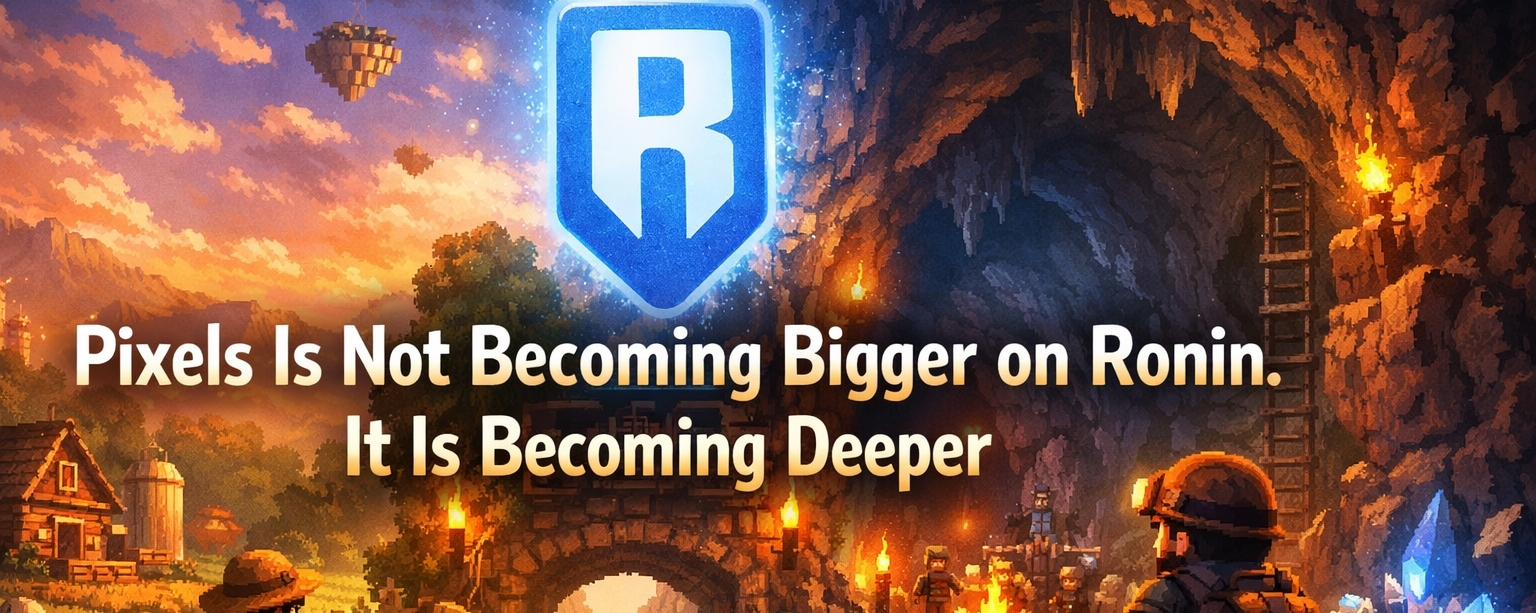
What interests me about Pixels is not that Ronin makes it cheaper to play. That part is easy to understand, and honestly, a little boring. The deeper shift is that Ronin changes the emotional logic of the game.
Without a chain like Ronin, a Web3 game often feels like it has to justify every action with a token event, every habit with a payout, every login with some immediate economic return. That usually makes the world feel thin. Players are not living inside it. They are working it. What I see happening with Pixels is different. Ronin gives the game room to breathe, which lets Pixels care more about repetition, routine, and social position. That is a much more interesting foundation.
That is why the recent direction of Pixels matters. The game is not trying to become infinitely larger. It is becoming more structured. Land is limited. Reputation has real consequences. Guilds matter. Access is layered. In my view, that is not just a gameplay update. It is a change in identity. The game is moving away from the logic of open-ended extraction and toward the logic of a lived-in world.
That shift only works if the underlying chain can handle low-friction behavior without demanding constant speculation in return. Ronin helps with that. It makes the boring parts cheaper, which is important, but more importantly it makes the social parts sustainable. That is what lets Pixels treat trust as a mechanic, not a slogan.
I think that is the real story here. Ronin is not merely lowering costs for Pixels. It is changing the kind of pressure the game is under. And once that pressure changes, the game can stop acting like a machine for extracting attention and start acting like a place where status, memory, and belonging actually matter.
That is a much rarer design choice than it first appears.