
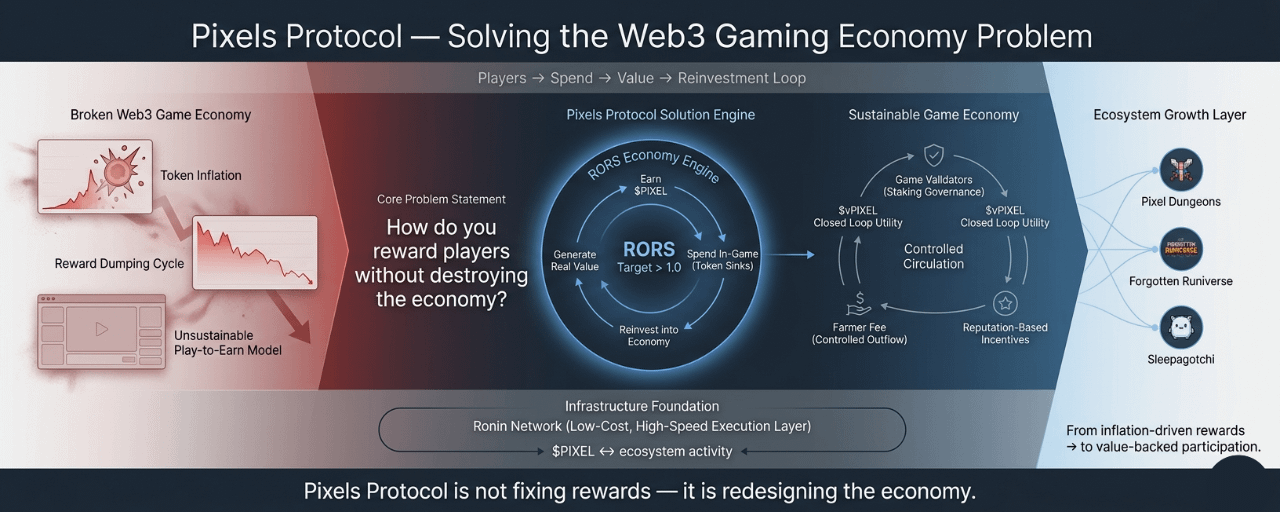
There’s one question every Web3 gaming project struggles with.
How do you reward players, without destroying your own economy?
Most projects fail here. They hand out tokens, users sell them, and the system slowly collapses under inflation. It’s a cycle we’ve all seen.
But after digging into Pixels Protocol, it’s clear they’re not ignoring this problem. They’re building directly around it.
This is where PIXEL tokenomics starts to stand out.
At the center of Pixels Protocol is one key concept: RORS (Return on Reward Spend).
This isn’t just another fancy metric. It’s the foundation of their entire economy.
RORS measures how much value the ecosystem generates compared to how much PIXEL is distributed as rewards. In simple terms, it answers one question:
Is the system earning more than it’s giving away?
Right now, the main Pixels game operates around a RORS of 0.8, while Pixel Dungeons performs even better. The long-term goal is clear — push RORS above 1.0.
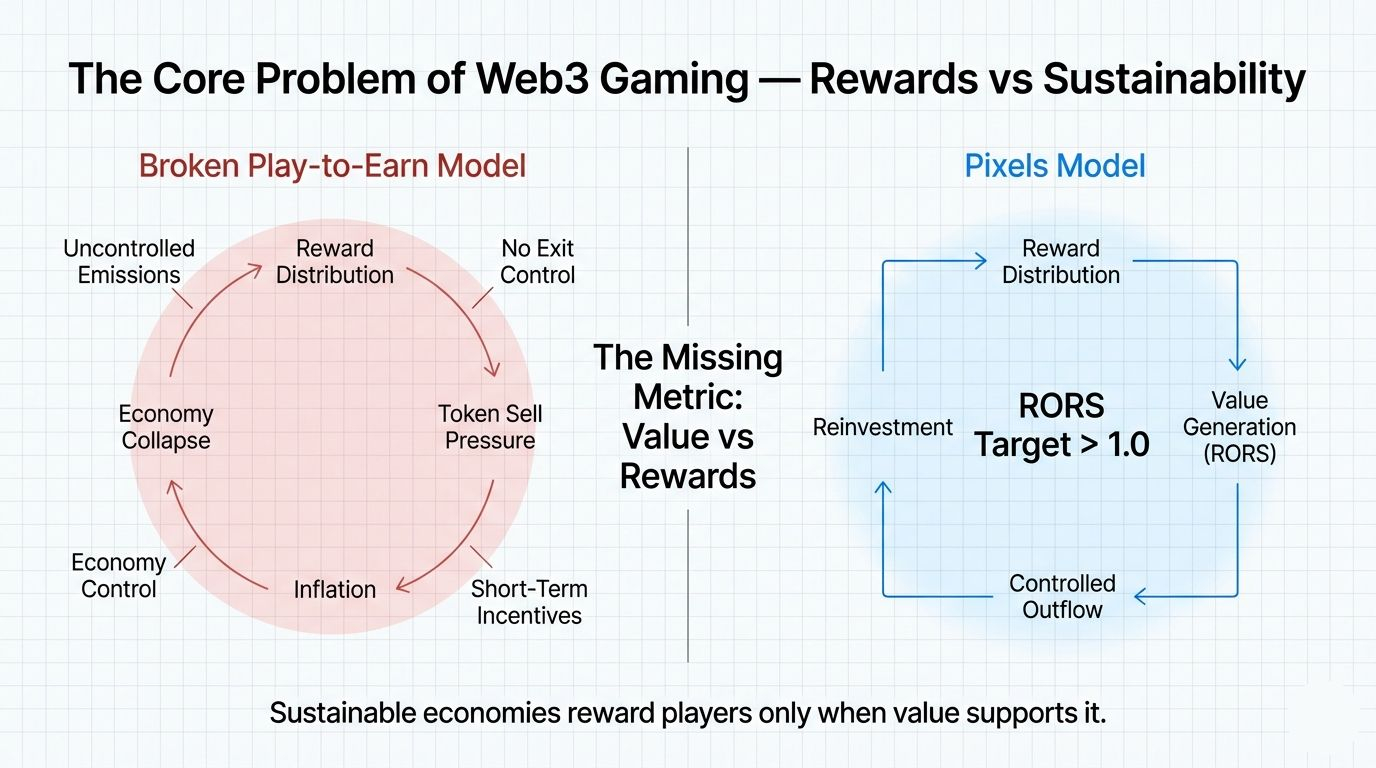
Once that happens, every reward paid out is backed by equal or greater value flowing back into the system.
That’s how you move from an inflationary model to a sustainable one.
And this is exactly what most Web3 gaming projects are missing.
Now here’s where Pixels Protocol gets practical.
It’s not enough to generate value. You also have to control how fast value leaves the system.
Pixels does this using something called the Farmer Fee.
When players withdraw PIXEL, they face a fee that ranges from 20% to 50%. At first glance, this might seem aggressive. But the logic behind it is solid.
The fee is tied to your Reputation Score.
If you’re a long-term player contributing to the ecosystem, your fee drops. If you’re just farming rewards and exiting quickly, you pay more.
This creates a natural filter.
It rewards commitment.
It discourages extraction.
And most importantly, it slows down the constant sell pressure that kills token economies.
Another major issue in Web3 gaming is liquidity leakage.
Players earn tokens… and immediately move them out of the ecosystem.
Pixels solves this with $vPIXEL (ERC20c).
$vPIXEL is backed 1:1 by PIXEL, but it works differently. You can’t withdraw it. You can only use it within the ecosystem.
That means spending, upgrading, staking, or interacting with partner games.
This design keeps economic activity inside the network instead of letting value disappear into external markets.
It’s a simple mechanism, but extremely important.
Because a healthy game economy depends on circulation, not constant exits.
Pixels Protocol doesn’t just control the economy — it gives players a role in shaping it.
Through Game Validators and Staking, users who stake PIXEL can influence which games receive token emissions.
This is more than just governance.
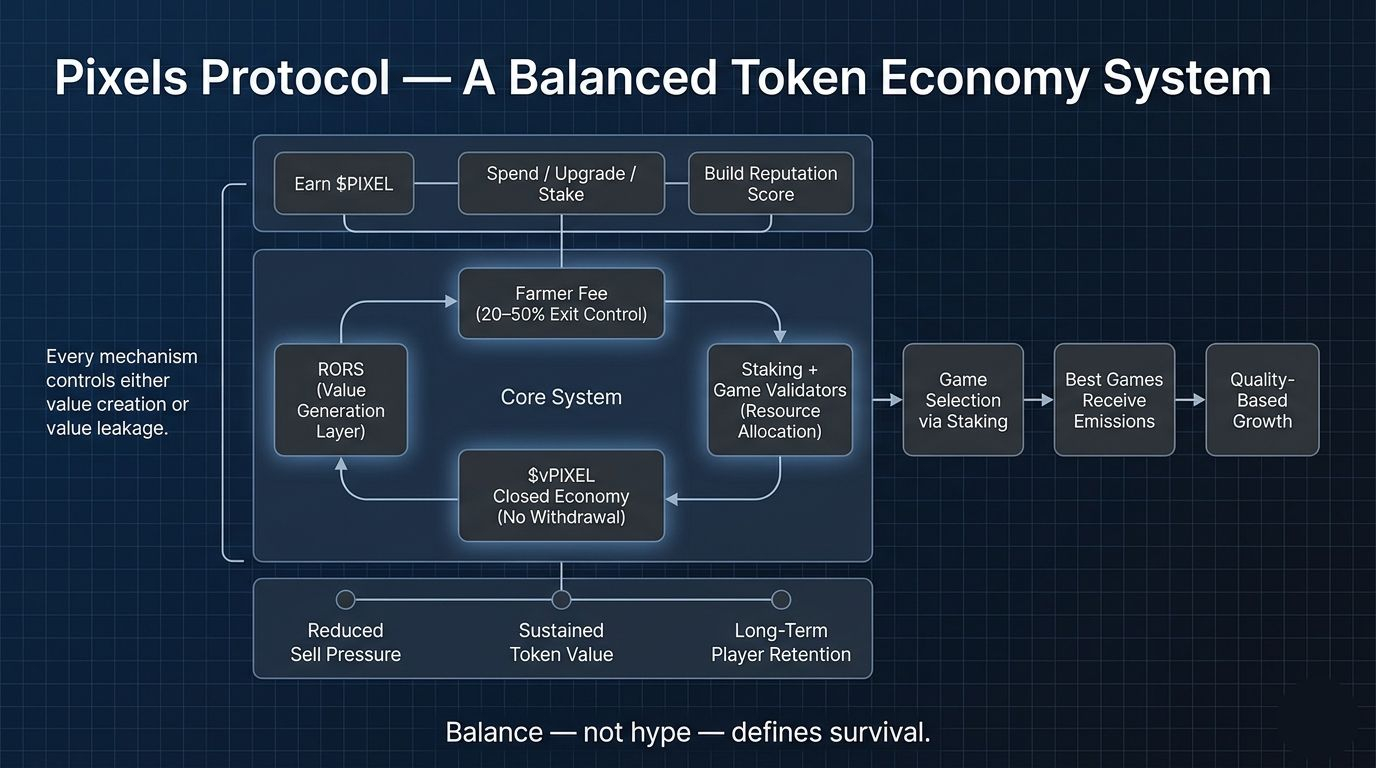
It’s a way to direct resources toward the best-performing and most engaging games in the ecosystem.
If a game is good, it gets support.
If it’s weak, it gets less attention.
Over time, this creates a natural selection process where quality games rise to the top.
And because the community is involved, decisions are not purely centralized.
When you connect all these pieces, the strategy becomes clear.
RORS ensures rewards are backed by real value.
The Farmer Fee controls how fast tokens leave.
$vPIXEL keeps activity inside the ecosystem.
Staking and Game Validators guide growth.
Individually, these features are strong.
Together, they form a system designed for long-term sustainability.
That’s what makes Pixels Protocol different from typical play-to-earn models.
It’s not just about earning.
It’s about building an economy that can survive.
The success of Web3 gaming depends on solving one core issue — balance.
Players need incentives.
But the system needs stability.
Pixels Protocol is one of the few projects actively working toward that balance using structured tokenomics.
It’s still early, and execution will be key. But the direction is clear.
Instead of chasing short-term hype, Pixels is focusing on long-term mechanics.
And in Web3, that’s usually where the real value is built.
