
There is something quietly powerful about a world that doesn’t rush you, doesn’t demand your attention with flashing lights or endless noise, but instead invites you to stay a little longer. That is where beginsnot as a game trying to impress, but as a world that slowly earns your curiosity. Built on the foundation of the , it doesn’t shout about technology. Instead, it lets you feel it through experience.
At first glance, it feels simple. You step into an open land where crops grow, paths stretch into the unknown, and small decisions shape your journey. But beneath that calm surface is something deeper, something carefully designed to blend creativity, ownership, and connection into a living environment. This is not just about planting seeds or collecting resources. It is about building a rhythm, a personal story that evolves with every action you take.
What makes this world stand out is how natural everything feels. There is no pressure to compete, no urgency to win. You are free to explore at your own pace, discovering hidden corners, meeting other players, and slowly shaping a space that feels like your own. The act of farming becomes more than a task; it becomes a form of expression. Each field you grow, each item you create, reflects your decisions, your time, your presence.
And yet, this calm experience is quietly connected to something bigger. Because it lives on the Ronin Network, every action carries weight beyond the screen. The things you build, the items you collect, they belong to you in a way that feels real. Ownership here is not just a concept—it is part of the design. Without overwhelming you with technical complexity, the game introduces a new kind of relationship between player and world, where effort translates into something lasting.
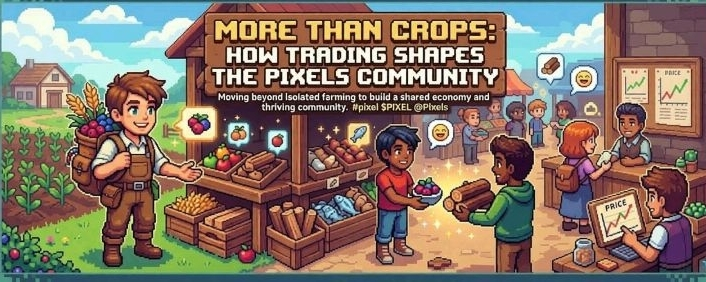
There is also a human element that runs through everything. This is not a lonely space. It is a shared world where stories overlap, where players meet not through competition but through collaboration. You might trade resources, visit another player’s land, or simply exist in the same environment, quietly influencing each other’s journeys. It creates a sense of community that feels organic, not forced.
The beauty of Pixels lies in its restraint. It does not try to be everything at once. Instead, it focuses on doing a few things well—creating a space that feels alive, accessible, and meaningful. It removes the noise often associated with modern games and replaces it with something softer, yet more lasting. A place where time feels slower, but more valuable.
There is a subtle shift happening in the gaming world, and Pixels stands right at the center of it. It represents a move away from fast consumption and toward thoughtful engagement. A move from playing for moments to building something that stays. It shows that games can be both simple and deep, both relaxing and significant.
In the end, Pixels is not just about farming or exploring. It is about belonging to a world that grows with you. A world that remembers your actions, reflects your creativity, and quietly rewards your presence. It does not demand attentionbut once you enter, it becomes difficult to leave.And that might be its greatest strength.
