
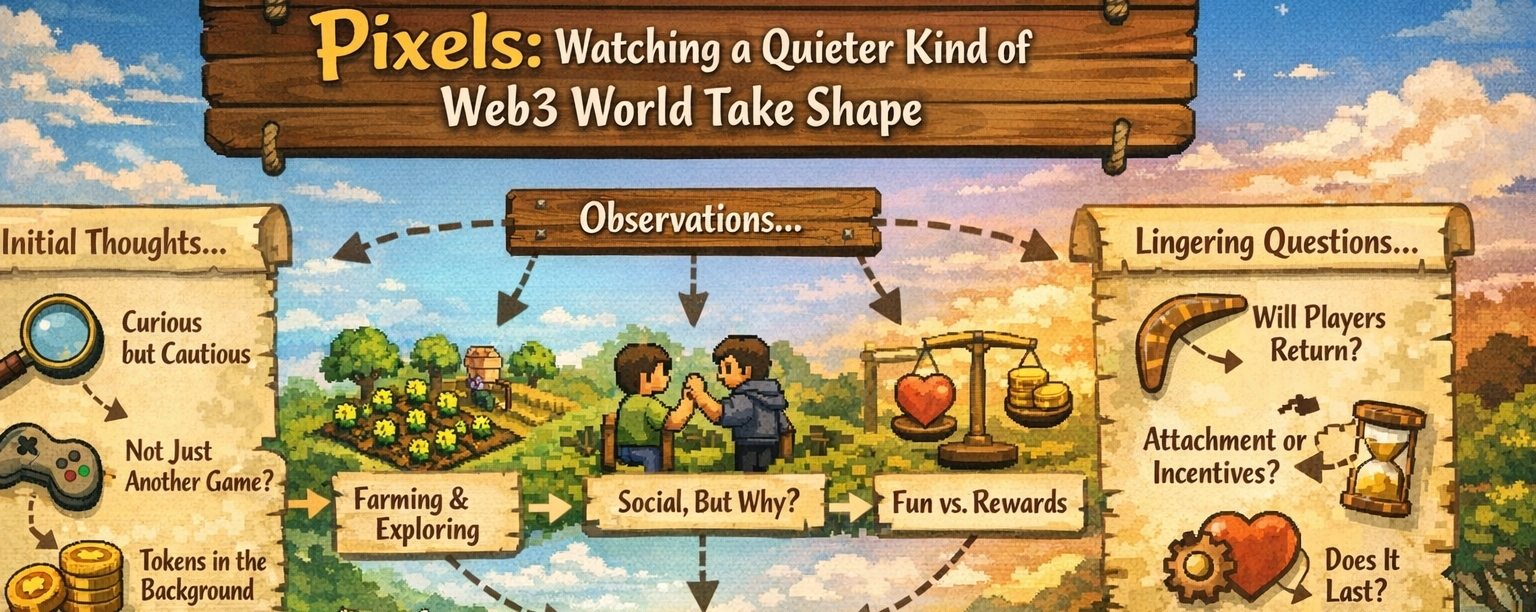
I’m watching Pixels the way you check in on something without fully committing to it yet. Not with excitement, not with skepticism either—just a quiet kind of curiosity. I’ve been noticing how often things in this space start to blur together after a while. The same ideas, slightly rearranged. The same promises, just worded differently. So when something like Pixels shows up, I don’t really focus on what it claims to be. I pay more attention to how it feels.
Pixels runs on the Ronin Network, but that part almost fades into the background if you let it. What’s more visible is the game itself—farming, wandering around, interacting with other players, slowly building something over time. It’s simple in a way that feels intentional. Not stripped down, just… unhurried. Like it’s not trying to impress you immediately.
And maybe that’s what makes me pause.
Because a lot of Web3 games don’t feel like that. They feel like they want you to understand the economy first. The token, the rewards, the systems—everything is explained upfront, almost like the gameplay is secondary. Pixels doesn’t completely avoid that—it has its own token, the PIXEL token, and clearly there’s an economy behind everything. But it doesn’t push that to the front right away. You can just… play, at least at first. Plant something, harvest it, walk around, see what others are doing.
That difference is small, but it changes the tone.
Still, I keep circling back to the same question: why do people stay? Not why they join—but why they come back after a few days, or weeks, when the novelty fades a bit. Is it because the game loop actually feels good? Or because there’s some kind of value tied to staying active?
I don’t think Pixels fully answers that yet. And maybe it’s not supposed to, not this early. But the tension is still there. You can feel it under the surface—the balance between making something enjoyable and making something that sustains an economy. One pulls toward simplicity and comfort, the other toward structure and optimization. It’s hard to tell which one will win over time.
The social side of Pixels is interesting too. There’s something nice about seeing other players moving around, sharing space, doing their own thing. It makes the world feel a bit more alive. But even that comes with a question in the back of my mind. Are these interactions meaningful on their own, or are they just part of a larger system that rewards activity? Sometimes it’s hard to separate the two in Web3.
What I do appreciate is that Pixels doesn’t feel loud. It doesn’t try to overwhelm you with features or big claims. It feels more like something you ease into rather than something that demands your attention. That’s rare enough to notice.
But being quiet doesn’t automatically make it better. It just makes it harder to judge quickly.
I guess that’s where I’ve landed for now. I’m not convinced, but I’m not dismissing it either. It feels like one of those projects that could slowly grow into something people genuinely enjoy—or just as easily drift into being another system people engage with for reasons that aren’t really about the game itself.
So I keep checking in. Not expecting a big shift, just watching how it develops. Whether it becomes a place people actually care about, or just another space where activity is driven by incentives more than anything else.
For now, it’s just… there. Growing quietly. And I’m still trying to figure out what that really means.