

 At one point, I stopped looking at Pixels as just a game and started seeing it as a system where capital actively moves inside the ecosystem.
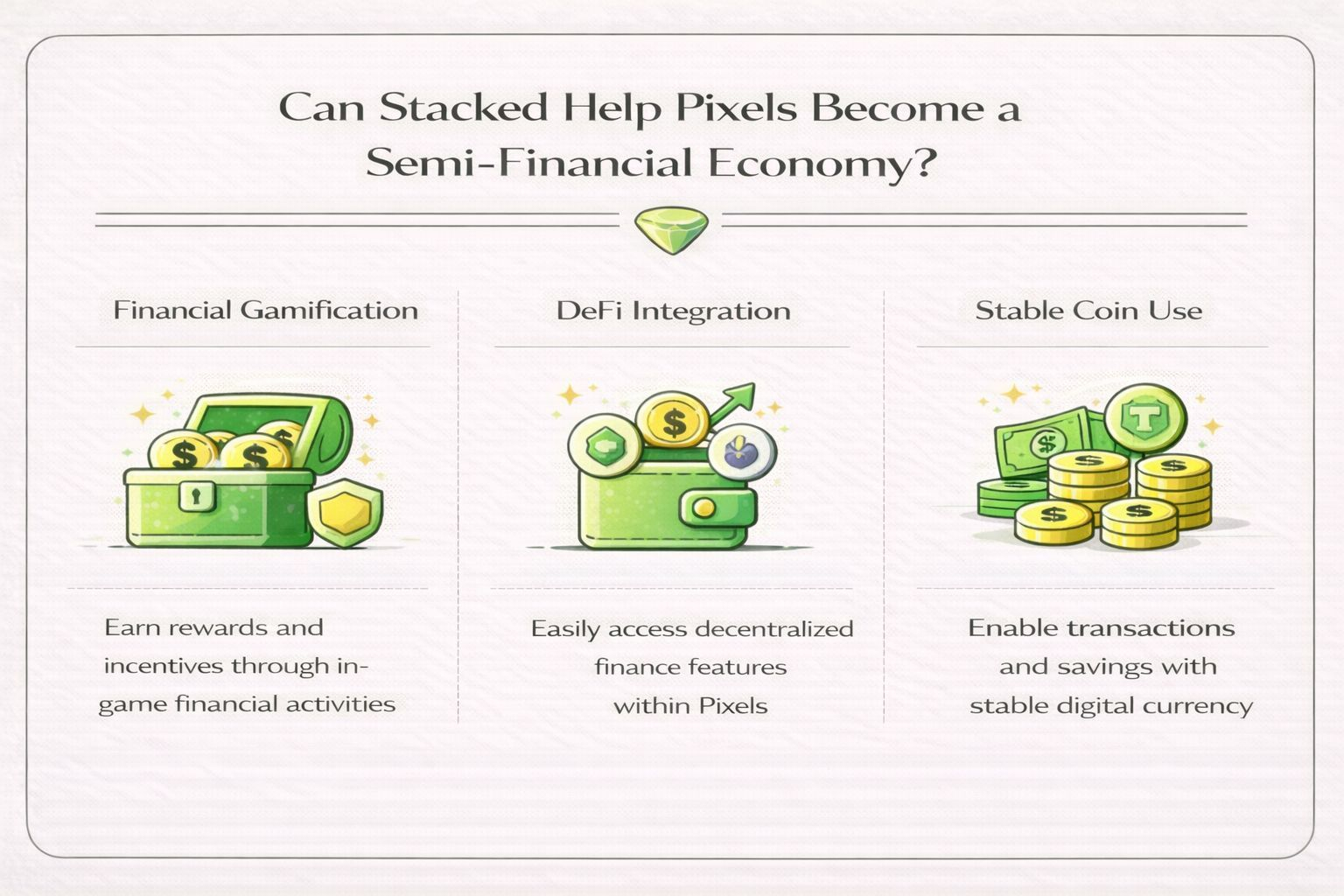
That made me ask: if Stacked keeps evolving in the right direction, could Pixels become a semi-financial economy?
In my view, yes—but not in the traditional DeFi sense.
Pixels is not a place where users primarily come to farm yield, provide liquidity, or interact with financial products like they would in a pure DeFi protocol. But with Stacked operating underneath, the way value is created, distributed, and retained starts to look much more like a financial system than a simple game economy.
What stands out most to me is how Stacked changes the meaning of rewards.
In many older Web3 games, rewards were mostly treated as a user retention expense. More rewards meant more players stayed. Fewer rewards meant users left.
But Stacked shifts that model.
Rewards are no longer just emissions—they begin to function like managed capital flows.
The focus is no longer only on how much is distributed, but on who receives it, when they receive it, and why they receive it.
To me, that is a major structural change.
Because once rewards are treated like capital allocation, the system starts following financial logic.
Another reason this feels important is the real economic scale behind it.
Systems powered by Stacked have reportedly contributed more than $25 million in revenue for Pixels.
That means this incentive layer is not just theoretical—it is already coordinating value at a scale large enough to produce measurable business impact.
When a system can optimize tens of millions of dollars based on player behavior and participation, it stops feeling like a simple game mechanic and starts looking more like financial infrastructure.
I also think one of the strongest financial parallels is this:
In finance, success is not defined only by how much money enters a system, but by how well that money stays, circulates, and compounds.
Stacked appears to be doing exactly that.
Instead of value being emitted, farmed, and immediately drained, incentives are structured to improve retention.
TVL grows stronger.
User retention improves.
LTV increases.
These are classic financial concepts—but now they are showing up inside a game economy.
That is why I see Pixels moving toward a semi-financial model.
Not fully finance.
Not purely gaming.
But something in between.
A system where gameplay remains visible on the surface, while capital management operates underneath.
Another part I find especially interesting is how Stacked helps separate these two layers more clearly:
The experience layer — where players farm, build, trade, and explore.
The financial layer — where incentives are regulated, value is retained, and capital is distributed efficiently.
Once those layers are separated, the ecosystem becomes much stronger.
Gameplay no longer carries all the pressure of generating economic value.
And financial systems no longer need to directly interfere with gameplay to function.
To me, that structure looks very similar to real-world economic systems—where the frontend experience and backend capital coordination operate differently, but remain deeply connected.
That said, Pixels is still not a complete financial economy—and honestly, it probably should not become one.
If incentives lean too heavily toward finance, the system risks falling into familiar Web3 problems: farming behavior, bot abuse, mercenary users, and reward extraction.
That is why I think the real strength of Pixels lies in staying semi-financial.
Enough financial structure to optimize value and sustainability.
But enough gameplay integrity to keep behavior healthy and purpose-driven.
There is also a bigger possibility ahead.
If Stacked expands further through APIs or SDK infrastructure, this financial layer may no longer remain exclusive to Pixels.
It could become an incentive engine for multiple ecosystems.
And once value coordination moves beyond a single game, it starts becoming something much larger than game design—it becomes economic infrastructure.
If I had to summarize it simply:
Stacked does not turn Pixels into a pure financial protocol.
But it does move Pixels beyond being just a standalone game.
It creates a middle ground where gameplay generates activity, while Stacked manages capital flow.
And to me, that is the clearest definition of a semi-financial economy.
Not because it looks like DeFi.
But because it begins to operate according to financial logic—inside a game.