
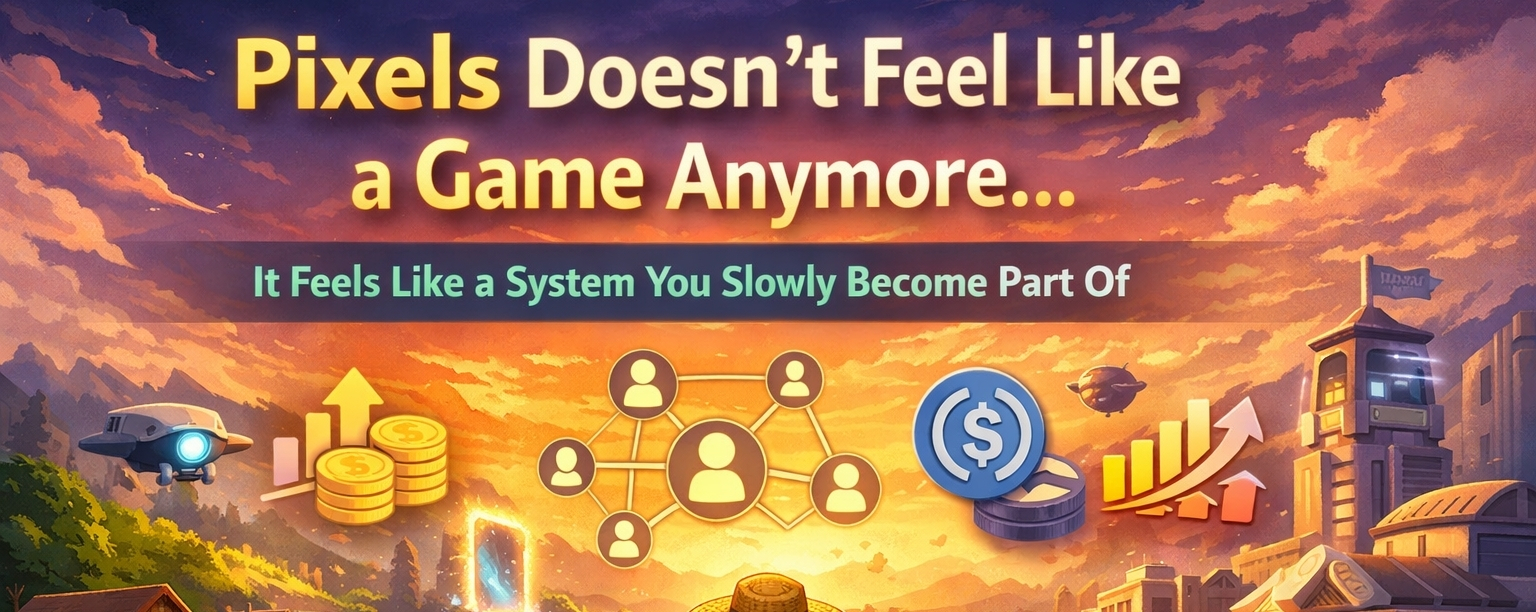
I didn’t expect a simple farming game to stay in my head like this. At first, Pixels felt easy to understand. You jump in, plant crops, craft a few items, earn some rewards it’s a loop we’ve all seen before. Nothing confusing, nothing that makes you stop and think too much. But the more time I spent inside it, the more that “simple game” feeling started to fade. It began to feel like I wasn’t just playing… I was participating in something that had its own logic, its own structure.
What really stood out to me wasn’t the gameplay itself, but what’s happening underneath it. From the outside, everything looks familiar, almost basic. But once you slow down and actually observe how things work, you realize the focus isn’t just on keeping players busy it’s on maintaining balance. Not gameplay balance, but economic balance. And that’s where Pixels starts to feel different from most games in this space.When I looked deeper, two core problems became very clear. First, there was constant reward flow tokens coming in but not enough meaningful ways to spend them. Second, there wasn’t a strong reason for players to stay long-term. Starting was easy, but staying didn’t feel necessary. And when both of these things happen together, the system slowly loses depth. It looks active from the outside, but inside, it starts to feel empty.What’s interesting is that Pixels doesn’t seem to be ignoring this. In fact, it looks like they’ve started redesigning the system around these exact issues. And you can feel it in the small changes. For example, expansion is no longer just a free upgrade path. You can grow your space, but it costs more as you go. That alone changes how you think as a player. Growth becomes something you plan, not something you just keep doing endlessly.
Then there’s item durability. Earlier, once you crafted something, it would stay with you for a long time. Now, items wear down as you use them. That small shift changes the entire loop. You’re not just producing anymore you’re maintaining, replacing, staying active. Demand doesn’t die anymore, it keeps coming back. And when you combine that with inventory limits, it becomes even clearer. You can’t just hoard everything. You have to make decisions, manage space, keep things moving.
When you connect all of this together, the system starts to feel alive. It’s no longer just “earn and stack.” It becomes a cycle create, earn, upgrade, use, and repeat. That loop feels more natural, more sustainable. It doesn’t end, it keeps resetting itself in a way that makes sense.
The real shift, though, starts showing in the newer phase of Pixels. This is where it stops feeling like a solo experience. You’re not just farming on your own anymore players are forming groups, building connections, working together. And that changes everything. It’s no longer just about what you can earn individually. It’s about how you fit into a larger system.
Because real economies don’t grow through isolated players. They grow through networks. And Pixels is slowly moving in that direction. You can feel it in how tasks are structured, how rewards are shared, and how progress is linked to group activity. There’s a sense that you’re part of something bigger, even if it’s still evolving.
Exploration also feels different now. It’s not just repetitive grinding anymore. There’s a push toward discovery new areas, new experiences, a reason to move beyond your routine. But what stood out to me is how access to these experiences works. It’s not completely open. You have to spend, choose, and decide where your time and resources go. That makes participation itself valuable.
Even events don’t feel random. They’re clearly designed to keep players engaged over time. Not in a forced way, but in a structured way. You log in, there’s something happening, something to do and it pulls you back in without feeling too aggressive.
One thing I think Pixels is handling better than most is the social side. A lot of Web3 games feel empty, even when they’re full of players. You’re technically surrounded by others, but it still feels like you’re playing alone. Here, there’s an effort to change that. Small features interactions, communication, shared activities start to make the world feel more connected.And that connection matters more than people think. Because if players don’t feel involved, they don’t stay. Rewards alone aren’t enough. Pixels seems to understand that, and it’s slowly building that human layer alongside everything else.Another interesting shift is how the system is starting to react to player behavior. It’s not just fixed rewards anymore. The way you play your activity, your consistency seems to influence what you get back. That adds a level of depth that most systems don’t have. It feels less predictable, but more real.At the same time, onboarding feels smoother. New players aren’t pushed into complicated setups right away. They can just play, understand things, get comfortable first. That makes a huge difference. It removes that initial friction that usually scares people away.Looking at where Pixels stands right now, it’s clear that things are becoming more structured. The economy feels more controlled, rewards feel more intentional, and the system overall feels more layered. It’s no longer just about earning tokens it’s about how everything connects.
And that’s where the perspective shifts.Because at this point, calling Pixels “just a game” doesn’t really make sense anymore. It feels more like a mix of economy, social space, and evolving system all working together. Not perfectly, but in a way that shows clear direction.Still, one question hasn’t gone away.No matter how well-designed the system is, everything depends on the player. If people start feeling like they’re only here for rewards, the experience can lose its meaning. Long-term engagement doesn’t come from systems alone it comes from habit, interest, and a genuine reason to return.And that’s something no design can fully guarantee.What Pixels is doing right now isn’t about chasing hype. It’s about building something that can last. Something that can evolve, adjust, and improve over time. And honestly, that’s what makes it worth paying attention to.So maybe the real question isn’t whether it will work or not.Maybe the real question is much simpler:Can something this structured, this carefully designed, become a natural part of how people choose to spend their time?Because if it can…Then Pixels isn’t just a game anymore.It’s the early version of something much bigger. 🚀