
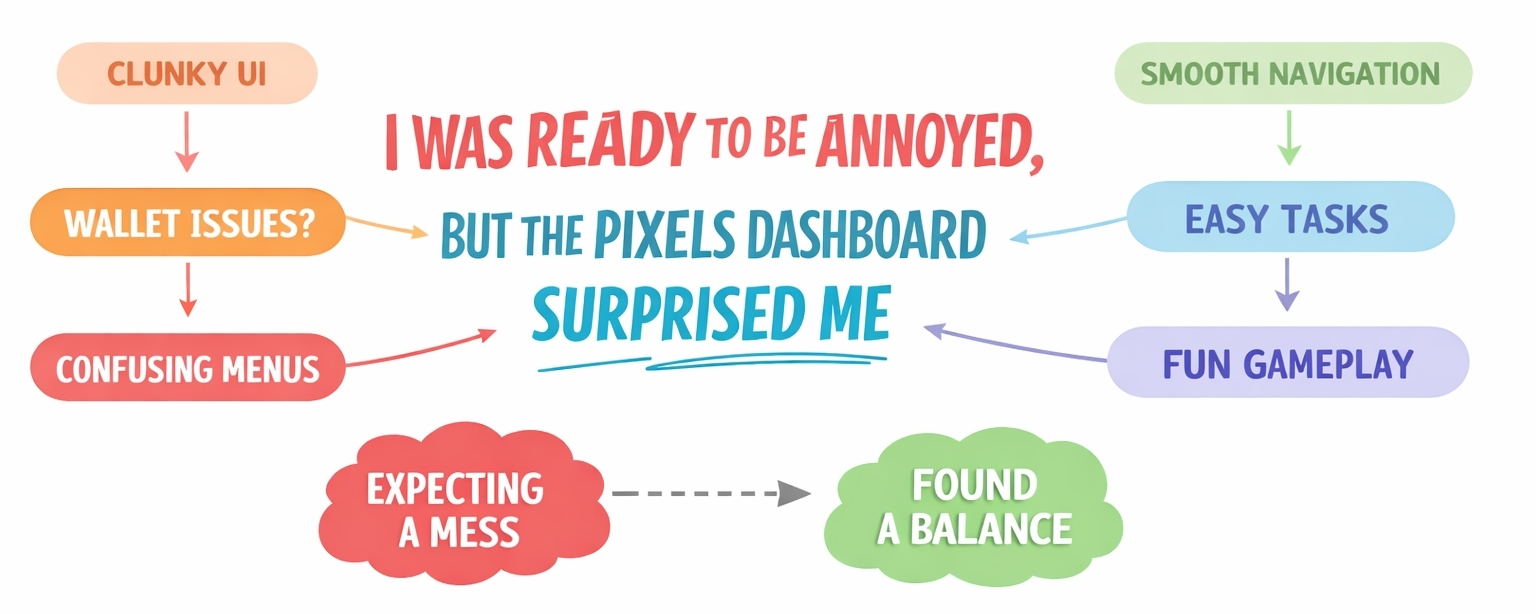
i have gone into enough WEb3 games with the same quiet fear. not fear of losing tokens, honestly, but fear of lOsing patience. The interface is usually where that feeling starts. A wallet prompt appears too early. Menus hide the thing I actually need. something fails, nothing explains why, and I am left wonDering if I made a mistake or the system did.
so when I opened @Pixels , I was not expecting comfort. I was expecting one more pretty game with a dasHboard that made me worK harder than the gameplay itself. My first reaction was almost defensive. i was ready to be irritated.
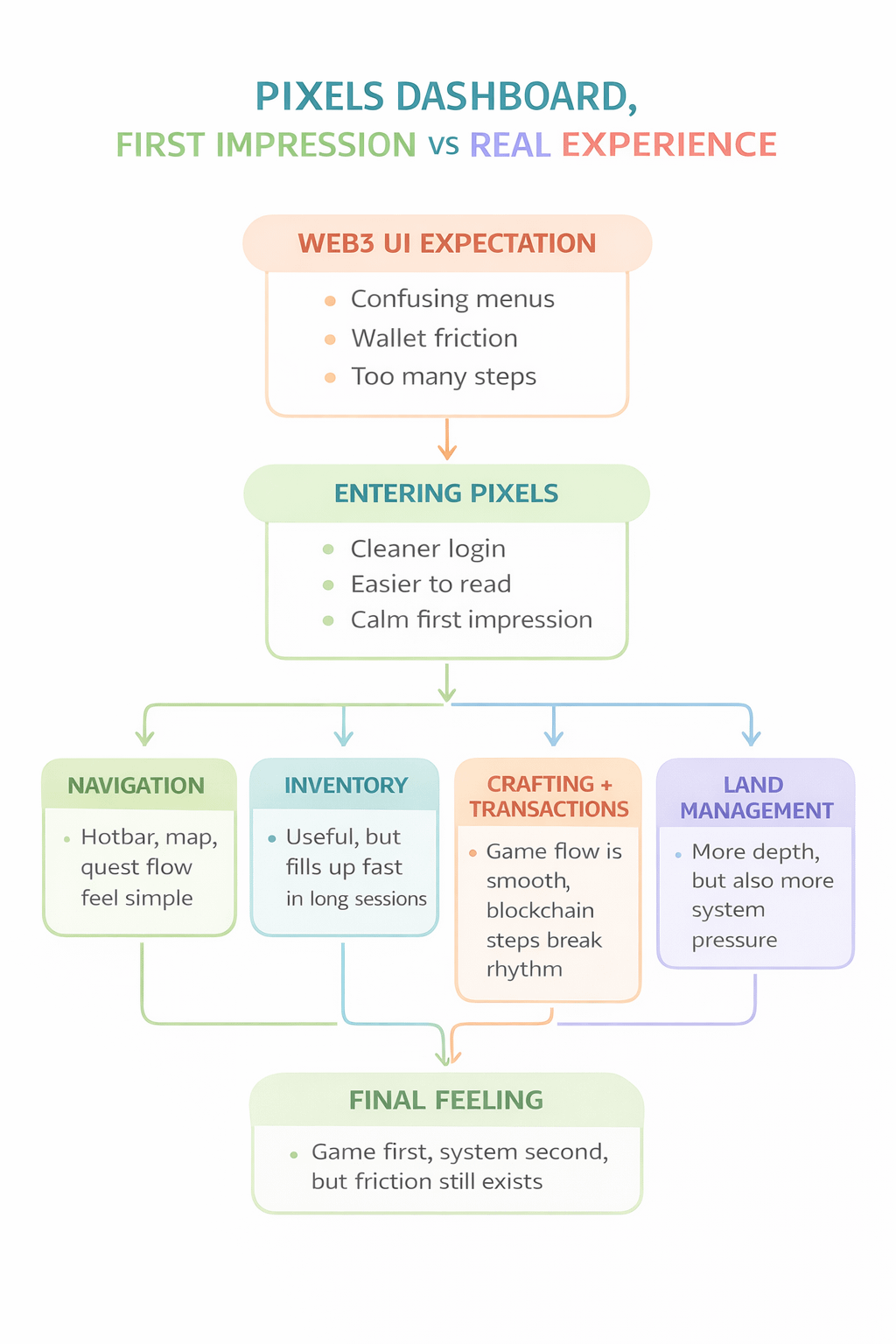
What caught me off guard was that Pixels did not hit me with chaOs right away. the entry flow felt lighter than I expeCted. because Pixels sits on Ronin, I assumed it would push me straight into a wallet-first experience and make that the whole personality of the game. Instead, the start felt more approachable. that matters.... i think people underestimate how much emotional daMage a bad first minute can do.
The visual style helped too..... i liked that it felt playful without becoming messy. some Web3 dashboards try so hard to look advanced that they stop being usable. pixels does not have that problem most of the time. i could look at the screen and undeRstand the mood immediately. It felt like a game first. That is a small win, but a real one...
once I got moving, the navigation made a good impression on me. The hotbar is simPle. the map is easy to read. the quest and task information usually sits where I need it instead of getting in my face everY second. I did not spend my session hunting for basic functions, and in this genre that is honestly a compliment. these sound like basic things, and yet they are usUally the first things to go wrong.
I also liked how the game lets the core loop breathe. moving around, checking tasks, switching tools, opening inventory, these actions felt familiar quite fast. I did not feel liKe I had to relearn gaming just because a blockchain layer existed underneath. that is important to me. Good UI should stay cLose to instinct.
still, I had a few moments where the cracks shoWed.
inventory was one of them. In the early and middle part of a session, I could feel the usual tension between farming freedom and item clutter. tools, seeds, crafting pieces, task items, random drops, it all builds up fast. i would get into a nice rhythm, then stop because I had to sort space again. It was not a disaSter. It was just the kind of repeated interruption that sloWly chips away at the calm feeling the game creates. The crafting and transaction side felt even more mixed. inside the game, the flow is fairly readable. I can tell what I want to make, where I need to go, and what resources matter. but the moMent the blocKchain side comes closer, the mood changes. that uncertainty is jarring. I stop thinking like a player and start thinking like someone double-checking a system. even when the process works, the feeling chaNges. I become careful instead of immersed.
I felt something similar with land management. I actually respect Pixels for not making land ownership feel manDatory from the first minute. new players can still play, learn, and find a rhythm without feeling instantly excluded. That is a smart choice. But once land enters the picture in a bigger way, the interface starts carrying more responsibility. it is not just about play anymore. It becomes about organiZation, planning, yield, and setup. I can see why some people enjoy that. i can also see why others would start feeling liKe they are managing a dashboard more than liVing in a world.
to be honest, I do not think this is only a Pixels issue. I think this is a genre problem that Pixels handles better than most, but still cannot fully escape. web3 games are always trying to combine two different mental states. Games want flow. BlocKchain systems want confirmation. games want ease. Wallet logic wants caution. those two moods do not naTurally like each other.
What Pixels gets right is that the game part often wins during the core loop. when I am farming, moving, checking tasks, or doing ordinAry play, the interface usually stays out of my way. That is a real strength. For new players, that makes the game less scary. for longer sessions, it helps reduce fatigue. For landowners or deeper econoMy players, though, I think the extra layers will still feel hEavier over time.
my honest takeaway is pretty balanced. I think Pixels has one of the more thoughtful interfaces I have seen in a WeB3 game. the dashboard and surrounding UI do a lot of quiet work to make the experience feel less hSstile, less noisy, and more playable. that deserves credit......
at the same time, I still felt the friction in small but real ways. inventory interruptions add up. System-heavy actions break the mood. Some parts feel smooth because they are built like a game, while others still feel like the blocKchain has stepped intO the room and asked me to slow down.
Even so, I kept playing... That is probably the clearest praise I can giVe. not because the interface is perfect, but because it usually helped me stay in the world instead of pusHing me out of it. i still found myself keeping a separate tab open now and then, just to check details faster, and I thinK that says everything. pixels got me comfortable enough to stay, but not so seamless that I forgot I was still naviGating a WEb3 system underneath the soil.