
I have looked at enough Web3 gaming projects to become careful whenever rewards are the first thing being advertised.
Most of the time, that story sounds exciting at the beginning and weakens once you look closer.
A lot of reward systems do not really build loyalty.
They just attract short-term behavior, inflate activity for a while, and slowly teach users to extract value instead of contribute to the game itself.
That is why Pixels became more interesting to me only after I spent time understanding the bigger direction behind it.
What caught my attention was not the simple idea of a farming game.
It was the fact that the team seems to understand a problem that many GameFi projects never solved.
If rewards are not connected to real player behavior, real retention, and real ecosystem value, they usually become a liability.
That is where I think the Pixels story starts to become more serious.
Pixels may look simple from a distance because it began as a social, casual farming game, but the deeper structure is more thoughtful than that.
The project keeps coming back to a practical idea that I think matters a lot: fun has to come first.
That sounds basic, but crypto gaming has repeatedly shown that many teams forget it.
If the game is not enjoyable on its own, rewards only delay the weakness.
They do not fix it.
And once rewards become the only reason people stay, the economy starts serving extractive behavior instead of meaningful participation.
What made me pay attention is that Pixels does not seem to frame rewards as something to distribute blindly.
The more interesting part is how the ecosystem is trying to become more selective and more data-aware about incentives.
Instead of assuming every user should be rewarded in the same way, the model appears to move toward understanding which behaviors actually help the game grow in a healthy way.
That is a much better question.
Not how do we give out more rewards, but what kind of reward actually improves retention, spending quality, participation, and long-term ecosystem health.
That shift in thinking matters.
Too many Web3 games reward volume without asking whether that volume is useful.
A system can look active and still be weak underneath.
It can have users, transactions, and daily activity, yet still be building habits that damage the economy over time.
That is exactly why the Stacked angle stands out to me.
I do not see Stacked as just another extra product attached to Pixels.
I see it more as the Pixels team trying to turn hard lessons from live game economies into infrastructure.
That part feels important.
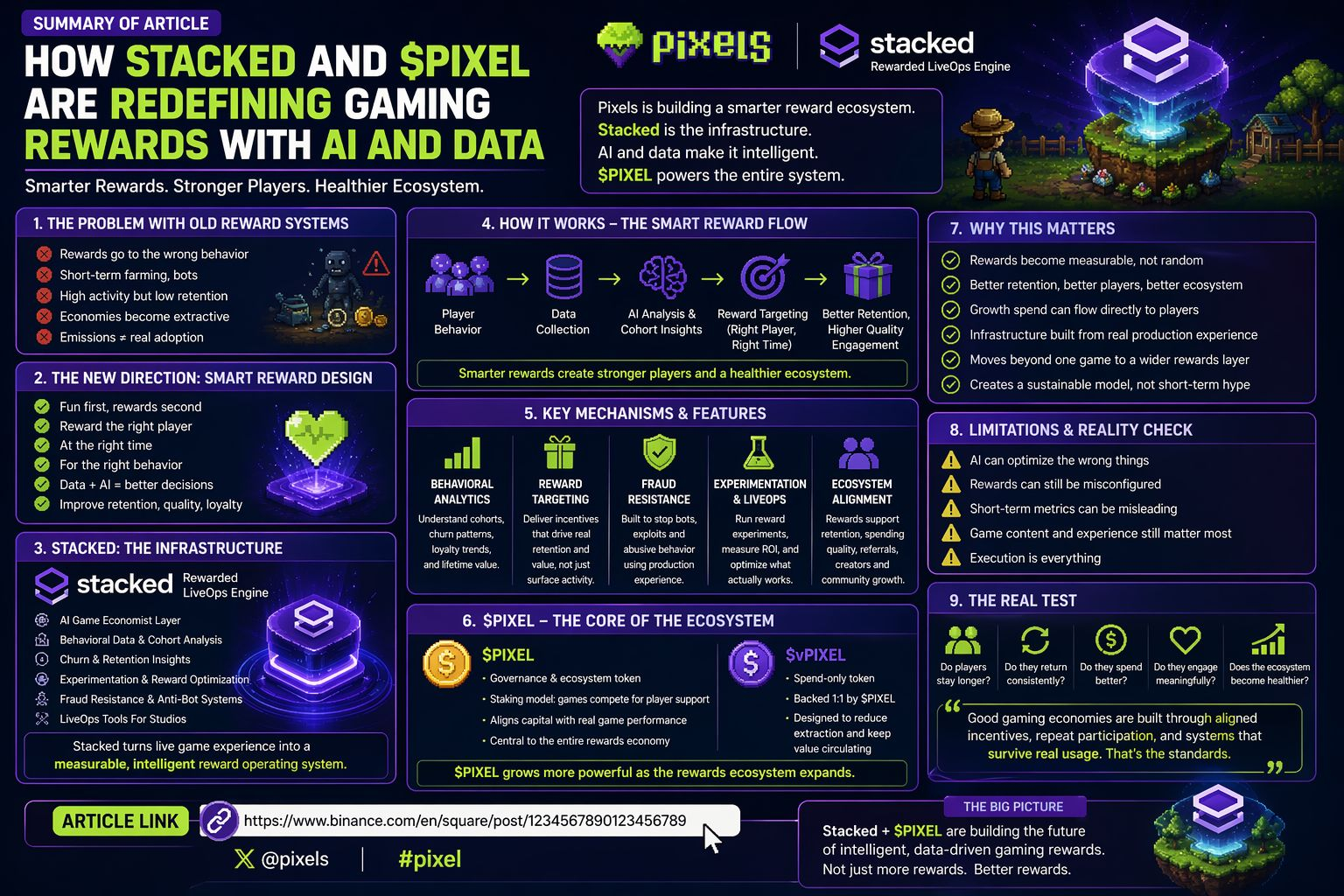
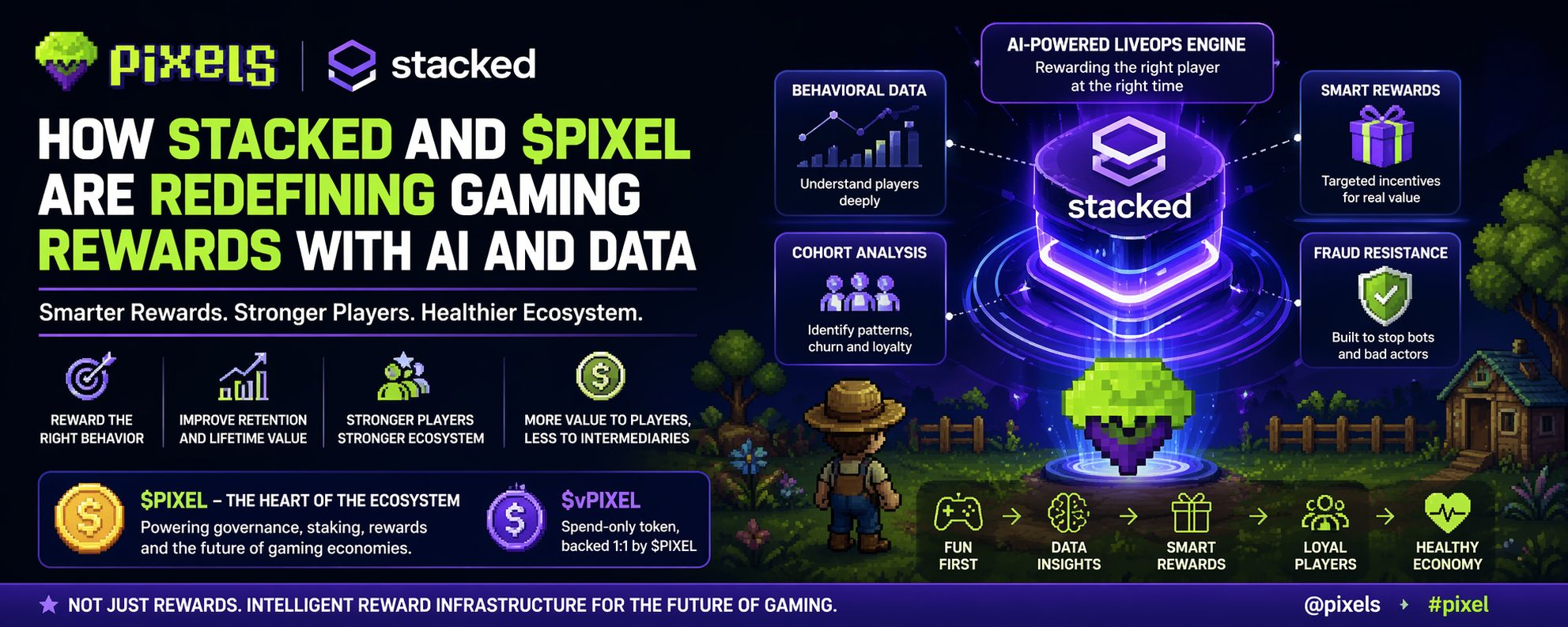
Stacked is being positioned as a rewarded LiveOps engine with an AI game economist layer, and that changes the conversation.
Now the question is not just whether players get rewards.
The question becomes whether rewards are being given to the right users, at the right moment, for behavior that actually improves the health of the ecosystem.
That is a more mature way to think about game incentives.
It also fits the reality of modern game economies better.
Studios do not just need users.
They need users who stay, return, spend with intention, participate socially, and deepen the network instead of draining it.
If a system can help identify churn patterns, analyze user cohorts, and improve reward timing, then rewards stop being random giveaways and start becoming part of a measurable operating system.
That is where the role of data becomes more interesting than the usual token narrative.
The idea is not to make rewards louder.
It is to make them smarter.
And honestly, I think that is where a lot of crypto gaming should have gone much earlier.
Another reason I find this ecosystem worth watching is the way Pixel fits into the broader design.
A token becomes more meaningful when it has a role inside a larger behavioral system rather than existing only as a speculative symbol.
If the ecosystem expands from one game into wider reward infrastructure, then pixel starts to matter in a different way.
It becomes connected not only to one in-game loop, but to a broader rewards and loyalty layer.
That is a more durable direction than treating token emissions as the main attraction.
The same applies to the wider economic framing around staking, participation, and ecosystem support.
What interests me here is not the promise of rewards by itself.
It is the attempt to connect incentives with accountability.
If rewards are producing real value, the ecosystem should be able to see it in player behavior.
Players should stay longer.
They should return more consistently.
They should participate in ways that strengthen the network.
Creators and referrals should bring in better engagement, not empty traffic.
Social activity should support progression, not just inflate numbers.
That is a much harder standard, but it is also the right one.
I also think the “redirect ad spend toward players” idea is more important than it first sounds.
Gaming studios already spend heavily to acquire users, but a lot of that money disappears into platforms and intermediaries.
If part of that value can move directly to players who actually engage meaningfully, that creates a very different relationship between growth and rewards.
But again, that only works if the system is measured properly.
Otherwise, it becomes another version of inefficient spending.
That is why I keep coming back to the operational side of this.
The strongest part of the Pixels and Stacked direction is not that it sounds ambitious.
It is that it seems grounded in production experience.
There is a big difference between building reward logic in a slide deck and building it inside real game environments where users exploit weak assumptions quickly.
Fraud resistance, anti-bot thinking, player behavior data, and reward optimization are not small details.
They are the difference between a system that survives real usage and one that collapses the moment incentives go live.
At the same time, I do not think any of this should be treated like automatic success.
A more advanced reward system can still be misused.
AI can still optimize the wrong signals.
A game can still lose momentum if content becomes repetitive or if the economy starts pushing users toward behavior that feels artificial.
Even good infrastructure cannot save a weak player experience forever.
That is why I think some caution is healthy here.
The idea is strong, but execution is still what matters most.
For me, the real test is simple.
I would not judge this ecosystem by noise, short-term excitement, or token attention alone.
I would judge it by whether user quality improves over time.
Do players stay because the game loop remains enjoyable.
Do rewards create better habits instead of extractive ones.
Do creators, communities, and referrals generate deeper participation.
Does the ecosystem become healthier, not just busier.
Those are the signals that matter.
That is why @Pixels holds my attention more now than it did at first glance.
Not because it promises rewards.
Because it seems to be asking a better question about rewards.
And in Web3 gaming, that difference matters more than people think.
If Stacked and $PIXEL can help turn incentives into something more measurable, more selective, and more sustainable, then this becomes more than a game economy story.
It becomes a case study in whether crypto gaming can finally learn how to reward behavior without damaging the system it is trying to grow.