
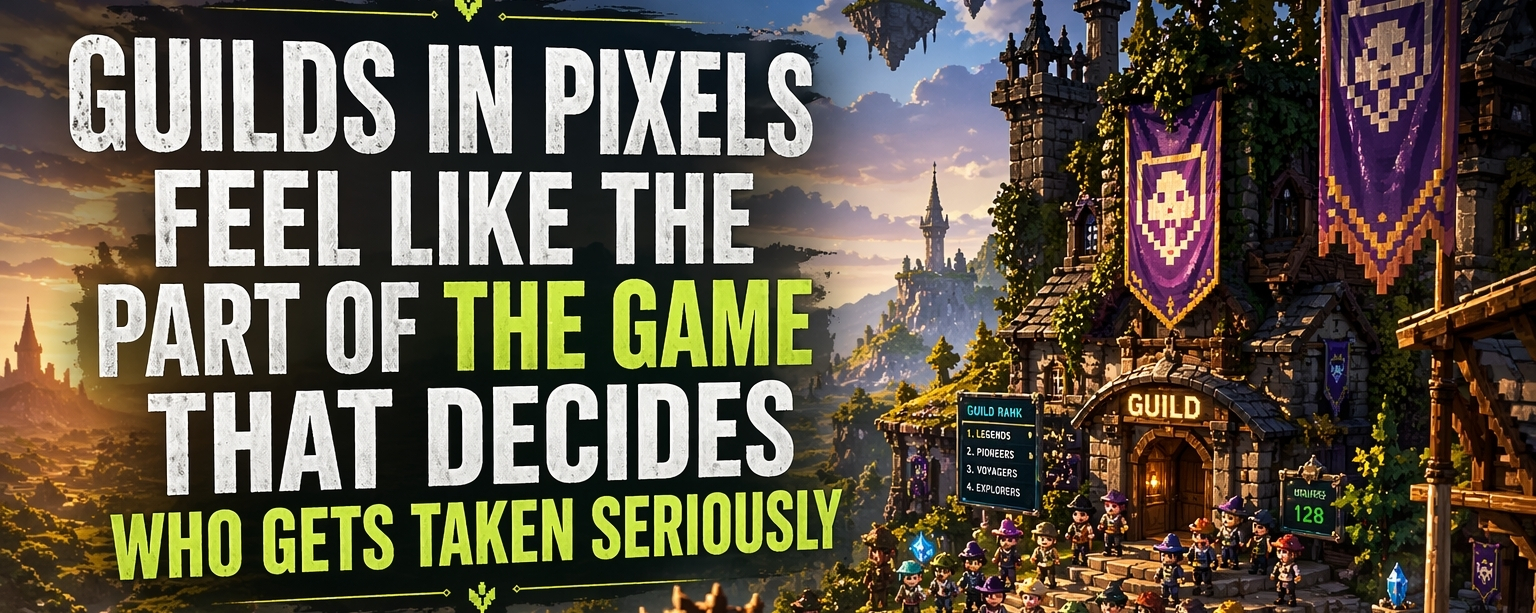
What keeps pulling me back to Pixels is not the farming loop or the open world dressing. It is the way the game quietly teaches you that being alone is expensive. You can play it as an individual, of course, but the moment guilds enter the picture, the real shape of the game becomes clearer. Progress is no longer just about effort. It is about belonging, trust, and access.
That is why I do not see guilds as a simple social feature. To me, they look much closer to a governance primitive. They decide who gets land, who gets a role, who gets included, and who gets left outside the better opportunities. That may sound like a minor design choice, but it changes the entire logic of the game. A guild is not just a group chat with rewards attached. It is a small institution with rules, hierarchy, and control over scarce things.
I think that is where Pixels becomes more interesting than most Web3 games. It is not trying to make every player equal. It is building a world where coordination itself becomes power. And once that happens, the guild stops being a feature you join for convenience and starts becoming the place where the real game is negotiated.
That is the part I find most telling. In Pixels, the question is not only what you can do. It is who is around you when you do it, and whether that group has the structure to turn effort into advantage. That is a governance problem, not just a gameplay one.
And in my view, that is exactly why guilds matter. They are the hidden layer where Pixels decides how value is organized, who gets trusted, and who gets to shape the world instead of just moving through it.