
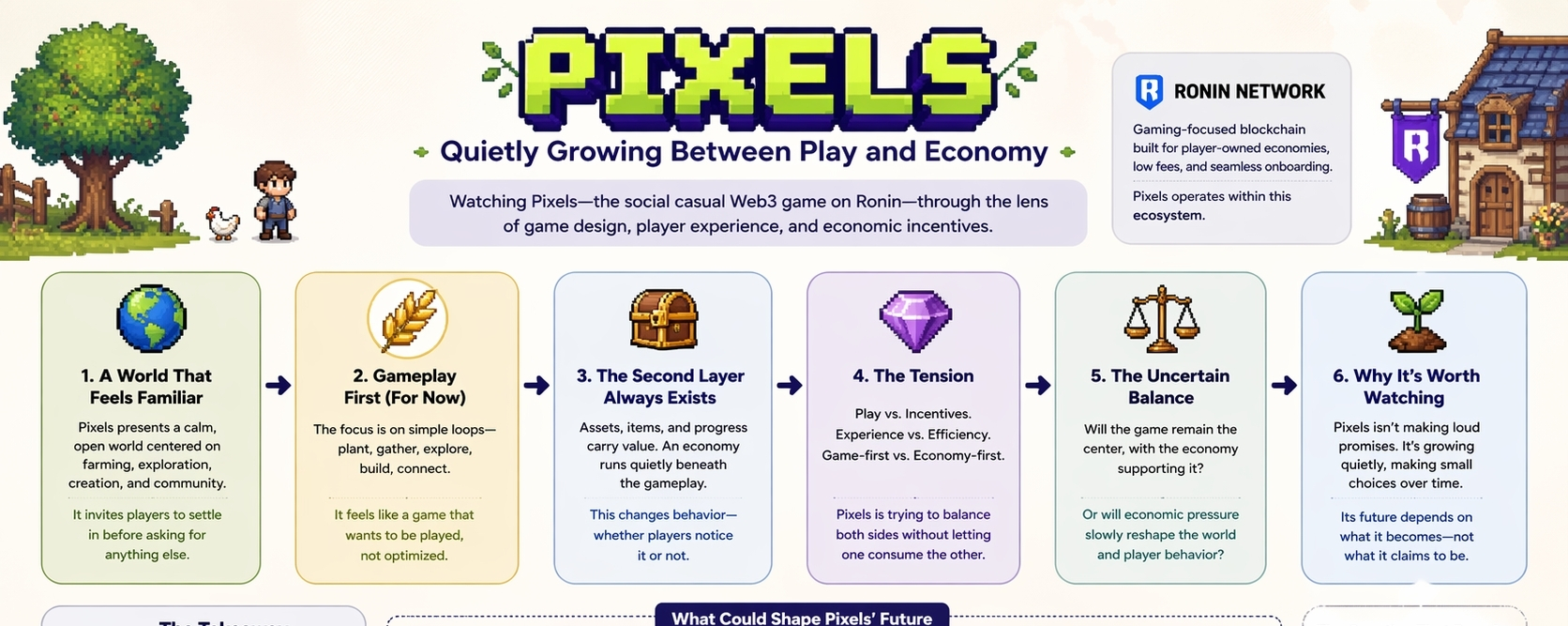
I’ve been watching Pixels for a while now, the way you watch something quietly take shape rather than burst into view. Not with excitement, exactly—more with curiosity. I’m noticing the way it carries itself, how it doesn’t seem in a hurry to prove anything. In a space where things often arrive already claiming significance, that kind of restraint stands out.
Pixels lives on the Ronin Network, which already tells you something about the kind of world it’s stepping into. Ronin has its own rhythm, its own expectations—built around games, around ownership, around the idea that players are part of an economy whether they think about it or not. So Pixels doesn’t begin from scratch. It inherits that structure, that quiet pressure underneath everything.
But when you actually look at the game, it feels… softer than you’d expect.
It’s about farming, wandering around, gathering things, building, talking to others. Nothing especially loud or complicated. You plant something, you wait, you come back. You explore a little, maybe find something useful, maybe not. It has that slow, almost comforting loop that doesn’t demand too much from you. And I think that’s what caught my attention. It feels like it wants you to settle in before it asks anything else.
That’s not something I see often here.
A lot of projects seem to start from the opposite direction. They begin with systems—tokens, rewards, mechanics that need to function—and then try to wrap a game around them. You can feel it when you play. The world exists, but it feels secondary, like it’s there to support something else. Pixels doesn’t completely escape that feeling, but it doesn’t lean into it either. It holds back a little.
Still, I can’t ignore what’s sitting underneath.
Because even if the surface feels calm, there’s always that second layer in Web3 games. The part where time, items, and progress start to carry value beyond the game itself. And once that layer is there, it changes how people behave. You stop just playing—you start thinking. About efficiency, about outcomes, about whether what you’re doing is “worth it.”
I keep wondering how Pixels will deal with that over time.
Right now, it feels like you can just exist in it. Walk around, tend to your crops, do small things without thinking too hard about optimization. But I’ve seen how quickly that can shift. All it takes is a bit of pressure—more players, more attention, more focus on the economy—and suddenly the tone changes. What felt relaxed starts to feel strategic.
And when that happens, something subtle gets lost.
What I find interesting is that Pixels seems aware of this, at least a little. It doesn’t push the economic side to the front. It doesn’t constantly remind you that what you’re doing has value outside the game. Instead, it keeps returning to simple things—growth, exploration, creation. It’s almost like it’s trying to protect the feeling of being a game, even while existing inside a system that could easily pull it in another direction.
Whether that’s intentional or just temporary, I’m not sure.
Because there’s always a point where these projects have to decide what they really are. You can only stay in that middle space for so long. Eventually, the balance tips. Either the game stays at the center, and the economy supports it quietly—or the economy takes over, and the game becomes a way to keep it moving.
Pixels hasn’t made that choice obvious yet.
And maybe that’s why I keep coming back to it—not to play constantly, not to analyze every detail, but just to check in. To see if it still feels the same. To notice if the small, quiet parts are still there, or if they’ve started to fade.
I don’t think it’s trying to be groundbreaking. It doesn’t feel like it wants to redefine anything. If anything, it feels like it’s trying to be something simpler—a place people might actually want to spend time in, without needing a reason beyond that.
But in this space, even that is uncertain.
So I keep watching. Not expecting it to prove anything, and not assuming it will fail either. Just paying attention to how it changes, how it responds to the pressures around it. Because sometimes, what matters isn’t what a project says it is—but what it slowly becomes when no one’s really looking.