

There’s a familiar kind of frustration that doesn’t look dramatic from the outside. You’re standing in a queue, maybe at a bank or a government office, watching the line barely move. No one explains the rules. Some people get processed quickly, others are told to come back tomorrow. A few seem to bypass the system entirely. You start to realize the problem isn’t just inefficiency—it’s the quiet feeling that the system doesn’t operate the same way for everyone.
The more I look at Web3 gaming, the more I notice a similar pattern beneath the surface. Everything is designed to appear transparent, structured, and fair. Ownership is emphasized, participation is open, and rewards are visible. But once you spend enough time inside these ecosystems, a different reality emerges—one shaped less by what is promised and more by how the system actually behaves over time.
Pixels positions itself as something calmer, almost deceptively simple. Farming, exploration, creation—familiar loops that don’t rely on aggressive monetization or overwhelming mechanics. At first glance, it feels like a correction to the chaos of earlier Web3 games, which often prioritized extraction over experience. But simplicity, in systems like these, is rarely neutral. It either hides complexity… or reveals it more honestly.
The more I think about Pixels, the more it feels like a quiet test of whether Web3 can sustain something beyond short-term incentives. Most projects in this space were built around a predictable cycle: attract users with rewards, inflate activity, then struggle to maintain value once emissions outpace demand. It wasn’t a design flaw—it was a structural one. When a system rewards participation primarily through financial output, it eventually teaches users to optimize for exit, not engagement.
Pixels appears to be pushing against that, but not in an obvious way. Its integration with Ronin Network reduces friction, making the experience smoother. But infrastructure alone doesn’t create sustainability. It only removes excuses. The real challenge lies deeper—in how value is distributed, how effort is perceived, and how long a player is willing to stay before questioning the system itself.
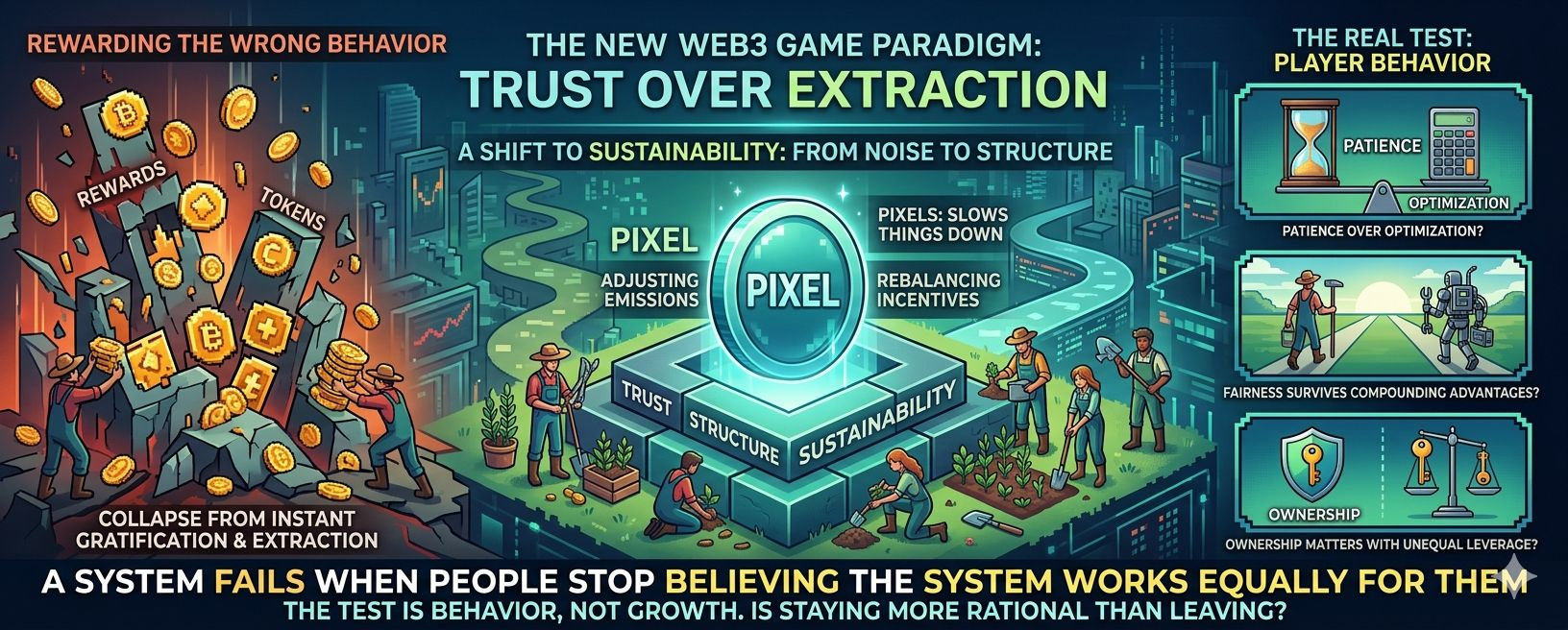
Recent adjustments around PIXEL tokenomics reflect this tension. Emission rates are being refined, reward structures are being reconsidered, and there’s a visible attempt to slow down the kind of inflation that quietly destroys in-game economies. On paper, this is responsible design. But in practice, it introduces a difficult trade-off: the more you stabilize the system, the less immediately rewarding it feels.
And this is where most projects lose their balance. Players say they want sustainability, but they react to short-term incentives. Developers say they want fairness, but they often rely on early adopters to bootstrap the system. Somewhere between these two forces, the idea of “equity” starts to blur.
Pixels doesn’t escape this contradiction—it just handles it more subtly. Land ownership, for instance, creates a sense of permanence and control. It allows players to build, produce, and establish presence. But it also introduces hierarchy. Those who entered earlier, or who understand the system more deeply, accumulate advantages that compound over time. This isn’t necessarily unfair—it’s structurally inevitable. But it raises an uncomfortable question: at what point does progression become exclusion?
The social layer complicates this further. Pixels encourages interaction, not just as a feature, but as part of progression. This creates a softer, more organic experience compared to purely transactional games. But even here, incentives quietly shape behavior. When collaboration is rewarded, it can become strategic rather than genuine. When community becomes a mechanism, it risks losing its authenticity.
What stands out about Pixels is not that it solves these issues, but that it doesn’t aggressively pretend to. There’s a restraint in how it evolves—a willingness to adjust rather than declare perfection. This is rare in a space where most projects rely heavily on narrative, branding, and the illusion of certainty.
But restraint is not the same as strength. In a market driven by attention, subtle systems often struggle to survive. Players are conditioned to respond to intensity—high yields, rapid progression, visible gains. A slower, more balanced system risks being perceived as underwhelming, even if it is structurally healthier.
So the real tension isn’t just inside Pixels—it’s between Pixels and the expectations of its own audience.
Can a system built on patience compete in an environment addicted to acceleration?
Can fairness be maintained when efficiency naturally creates inequality?
Can ownership feel meaningful if its advantages are unevenly distributed?
And perhaps most importantly—can a game remain a game when financial logic is always present in the background?
These are not abstract questions. They define whether a system like Pixels becomes a lasting environment or just another phase in a repeating cycle.
Because the uncomfortable truth is this: most Web3 projects don’t fail because they lack innovation. They fail because they underestimate human behavior. They assume users will act rationally, long-term, and cooperatively—when in reality, most will optimize for immediate advantage the moment the system allows it.
Pixels seems aware of this, at least to some extent. Its design choices suggest an attempt to slow users down, to anchor value in time rather than speed. But awareness doesn’t guarantee success. If the incentives are even slightly misaligned, the system can drift in ways that no initial design can fully control.
And yet, there’s something quietly significant about what Pixels represents. Not as a breakthrough, but as a recalibration. A shift away from loud promises toward quieter experimentation. A recognition that sustainability is not a feature—it’s a continuous negotiation.
The outcome is still uncertain. It could evolve into a genuinely stable ecosystem, or it could gradually inherit the same pressures that reshaped every system before it. That uncertainty isn’t a weakness—it’s the reality of building something that interacts with both economics and human behavior.
But here’s the part that actually matters, the part that often gets overlooked:
If Pixels succeeds, it won’t be because of its token, or its mechanics, or even its network.
It will be because it managed to align perception with reality.
Because it created a system where effort feels meaningful, where progression feels fair enough, and where staying feels more rational than leaving.
And if it fails, it won’t be dramatic. There won’t be a single breaking point. Just a slow shift—where players stop believing the system works the same way for them as it does for others.
Just like that line outside the office.
Still moving.
Still functioning.
But no longer trusted.
