
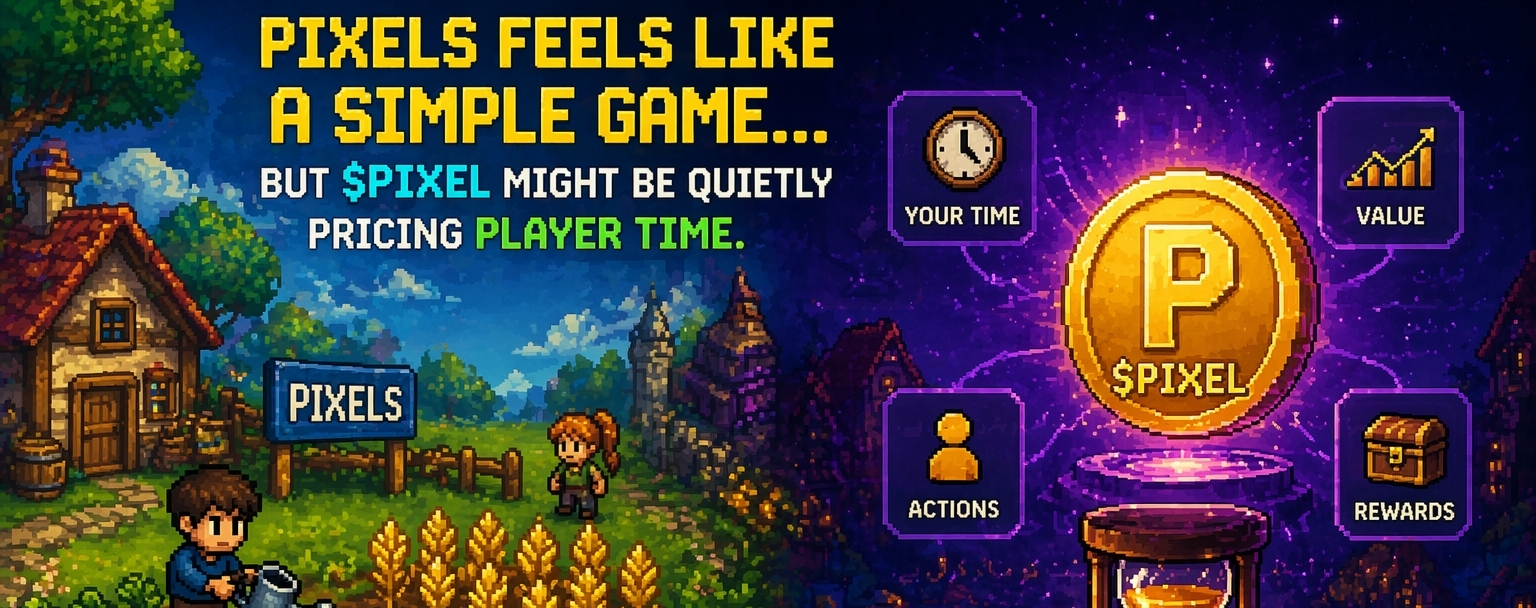
At first glance, Pixels looks like just another relaxing farming and exploration game.colorful landscapes, casual mechanics, and a soothing loop of planting, harvesting, and crafting. It invites players in with simplicity. No pressure, no complexity.just play.
But beneath that calm surface, something more sophisticated may be unfolding.
What if Pixels isn’t just a game… but a system that quietly assigns value to how players spend their time?
The Illusion of Simplicity Games like Pixels are designed to feel effortless. You log in, tend to your farm, gather resources, maybe interact with other players.and log out satisfied. There’s no obvious “grind” in the traditional sense.
But every action you take.every crop harvested, every item crafted, every minute spent exploring.is part of a larger loop. And that loop is not random.
It’s structured.
Time as the Core Currency
In traditional games, time is often exchanged for progress. In Web3 games like Pixels, time may be something more: a measurable, monetizable input.
The $PIXEL token sits at the center of this ecosystem. While it appears as a reward layer, it may also function as a pricing mechanism.subtly determining how much different activities are “worth.” Farming might yield steady but lower.value returns
Exploration could unlock rarer, higher.value opportunities
Crafting might convert time into more efficient outputs
Each path offers a different rate of return on time invested.
Players aren’t just playing.they’re allocating time across activities, almost like managing a portfolio.
Hidden Value Layers
What makes this system intriguing is that the valuation isn’t always visible.
Unlike traditional economies where prices are explicit, Pixels may operate through implicit pricing:
Drop rates
Energy systems
Resource scarcity
Task efficiency These elements quietly shape how valuable an action is, without ever stating it directly.
Over time, players begin to notice patterns: “Is farming still worth it?” “Why does crafting feel more profitable today?” “Is exploration being rewarded more this week?”
These questions hint at something deeper—the game may be dynamically adjusting how it values player behavior.
Players as Economic Agents
In this light, players aren’t just gamers. They become participants in a living economy.
Every decision.whether to farm, trade, or explore.is an economic choice. And collectively, player behavior may influence how the system evolves.
If too many players farm, returns might diminish.
If fewer players explore, rewards there might increase.
It’s not just gameplay.it’s feedback.
The Quiet Shift
What makes Pixels fascinating is how it hides this complexity behind a casual interface.
There are no charts, no obvious signals, no flashing indicators of “optimal strategy.” Instead, players learn through experience. They feel the shifts before they fully understand them.
And that’s the genius of it. The game doesn’t force you to think like an economist .but it subtly turns you into one.
Final Thought
Pixels may feel like a simple escape, but it could be something far more innovative: a system where time, behavior, and value are constantly interacting beneath the surface.
The next time you log in and plant a crop or craft an item, consider this:
Are you just playing…
or are you participating in a quietly evolving economy that’s learning how to price your time?