
Look, I’ve seen this movie before.
A Web3 game shows up, promises rewards, everyone rushes in… and for a while it feels like free money. Then emissions slow down, people quietly leave, and what’s left? Empty land and a token chart nobody wants to open anymore.
So yeah, when Pixels started getting traction, the obvious question wasn’t “is this fun?”
It was: is this just another farm-and-dump cycle in disguise?
Because let’s be real—most of this space didn’t fail because games were boring. It failed because the economy underneath was shallow. People weren’t playing. They were extracting.
Big difference.
---
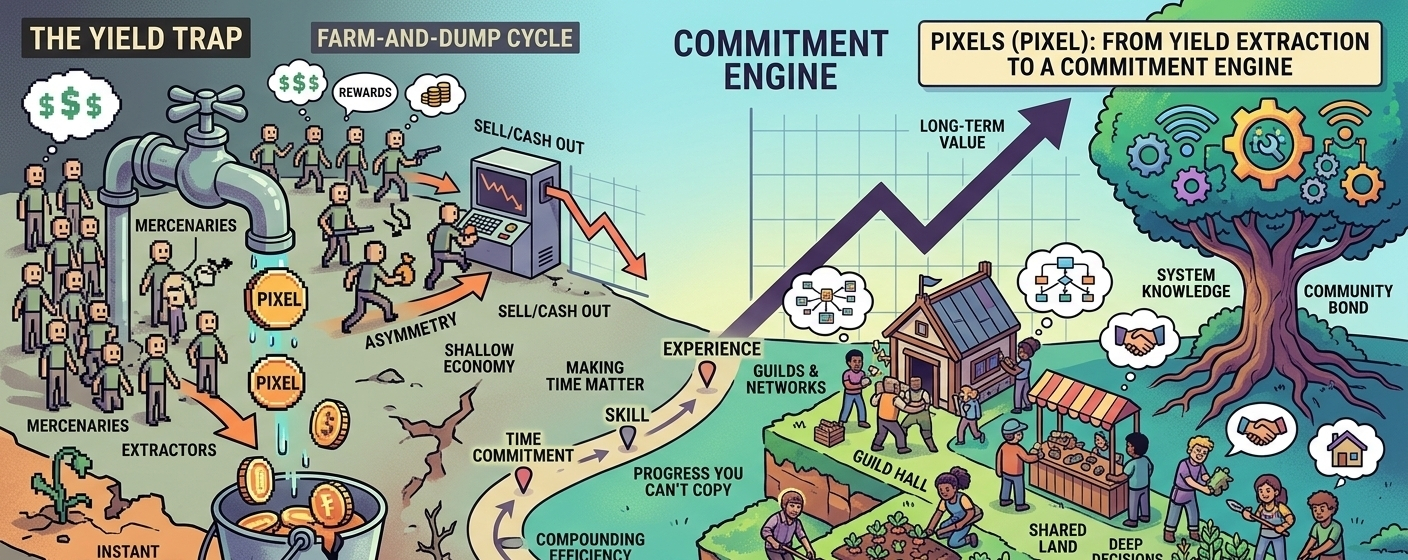
Start with the uncomfortable part. The yield trap.
There’s always this invisible equation running in the background:
Player shows up if the reward feels bigger than the effort. Simple.
If the numbers look good, you don’t attract players—you attract mercenaries. They move fast, optimize everything, squeeze the system… and disappear the second it stops paying.
I’ve seen this pattern repeat so many times it’s almost predictable.
Pixels? It wasn’t immune. Early on, you could clearly see the behavior—people clustering wallets, running tight loops, doing the same actions over and over. Not because it was fun. Because it paid.
That’s where things start to crack.
Because once people smell extraction, the whole thing starts feeling less like a world and more like a temporary liquidity event. That’s the legitimacy problem nobody likes to admit out loud.
---
Now here’s where it gets interesting.
Instead of throwing more rewards at the problem (which usually makes things worse), Pixels started shifting the structure itself. Quietly.
Not more content. Not more “stuff.”
Something deeper.
Call it commitment design, or honestly, just common sense done right.
Most teams think adding new maps or skins will keep people around. It doesn’t. That’s just surface-level noise. Players consume it fast and move on.
Pixels started focusing on something else entirely—making time actually matter.
Not in a fake “grind more, earn more” way. That doesn’t work long-term.
I’m talking about progress you can’t copy.
Because here’s the thing people don’t talk about enough—if I can join late, spend more money than you, and catch up instantly… why would you ever stay loyal?
You wouldn’t.
So Pixels started layering systems where:
You get better because you’ve done it longer
You understand the system in ways a new player just doesn’t
Your setup becomes more efficient over time
And suddenly, progress isn’t linear anymore.
It compounds.
That’s a big shift.
Now you’re not just playing—you’re building something that someone else can’t just buy their way into overnight.
---
And yeah, let’s address the awkward part. The asymmetry.
Pixels didn’t start perfectly. No one does.
There were early advantages. Token distribution wasn’t perfectly balanced. Some players got ahead faster than others. People noticed. Of course they did.
This is where most projects mess up. They try to “explain it away” with marketing.
Nobody buys that.
Pixels didn’t try to talk their way out of it. They adjusted the system instead.
They slowly pushed value away from pure token rewards and toward actual in-game productivity. So yeah, early players still have an edge—but it’s not permanent. It’s not locked in forever.
That matters.
Because if early advantage becomes untouchable, new players won’t even try. The system freezes.
Pixels avoided that. Not perfectly. But enough to keep the door open.
---
Now let’s talk about the part that actually decides whether this survives or not.
Why don’t people leave?
Seriously. That’s the only question that matters once the hype fades.
Pixels builds this in layers.
First—time.
The longer you play, the better you get. Not just in numbers, but in understanding. You figure out patterns. You optimize your setup. You stop wasting moves.
That kind of efficiency doesn’t come from money. It comes from experience.
Leave the game, and you lose that edge.
Simple.
---
Second—people.
This part gets overlooked all the time.
Guilds, shared land, coordinated systems—this isn’t just “community.” It’s economics.
Your output actually depends on who you’re connected to.
So leaving isn’t just logging out. You’re walking away from a network that made you more effective.
That’s not easy.
---
Third—and this one’s big—what you own actually does something.
Most Web3 assets are just… sitting there. You hold them and hope someone pays more later.
Pixels is trying to shift that.
Your land produces. Your items improve how you play. Your resources feed back into your own system.
That changes everything.
Because now your assets aren’t just things you own—they’re tools you use.
And if they’re useful, you don’t want to let them go.
---
Let me put it another way.
Early on, people were renting presence in Pixels.
They showed up, took what they could, and left. No attachment. No reason to stay.
Now? The system is slowly pushing toward something else.
You earn your place over time.
Through decisions. Through mistakes. Through figuring things out.
And once you’ve done that… it’s not so easy to walk away.
---
Now, I’ll be honest—it’s not perfect.
There are still risks.
If rewards start dominating again, people will go right back to extraction mode. I guarantee it.
If new players come in only for yield, the same cycle could repeat.
If assets stop being useful and go back to pure speculation… yeah, that’s a problem.
This isn’t “solved.” It’s managed.
Big difference.
---
But the direction? That’s what matters.
Pixels isn’t trying to win by paying people more.
It’s trying to make leaving feel like a bad decision.
Not because you’re locked in. Not because you can’t exit.
Because you don’t want to.
And that’s where it gets real.
---
At the end of the day, the value here isn’t just the token. It’s not the land either.
It’s everything players have built along the way.
The choices they made.
The systems they figured out.
The people they connected with.
Stack all that together… and yeah, you can leave.
But you’re not just cashing out.
You’re walking away from something that took time to become yours.
And honestly? That’s the first time a lot of these games have even come close to getting it right.
