
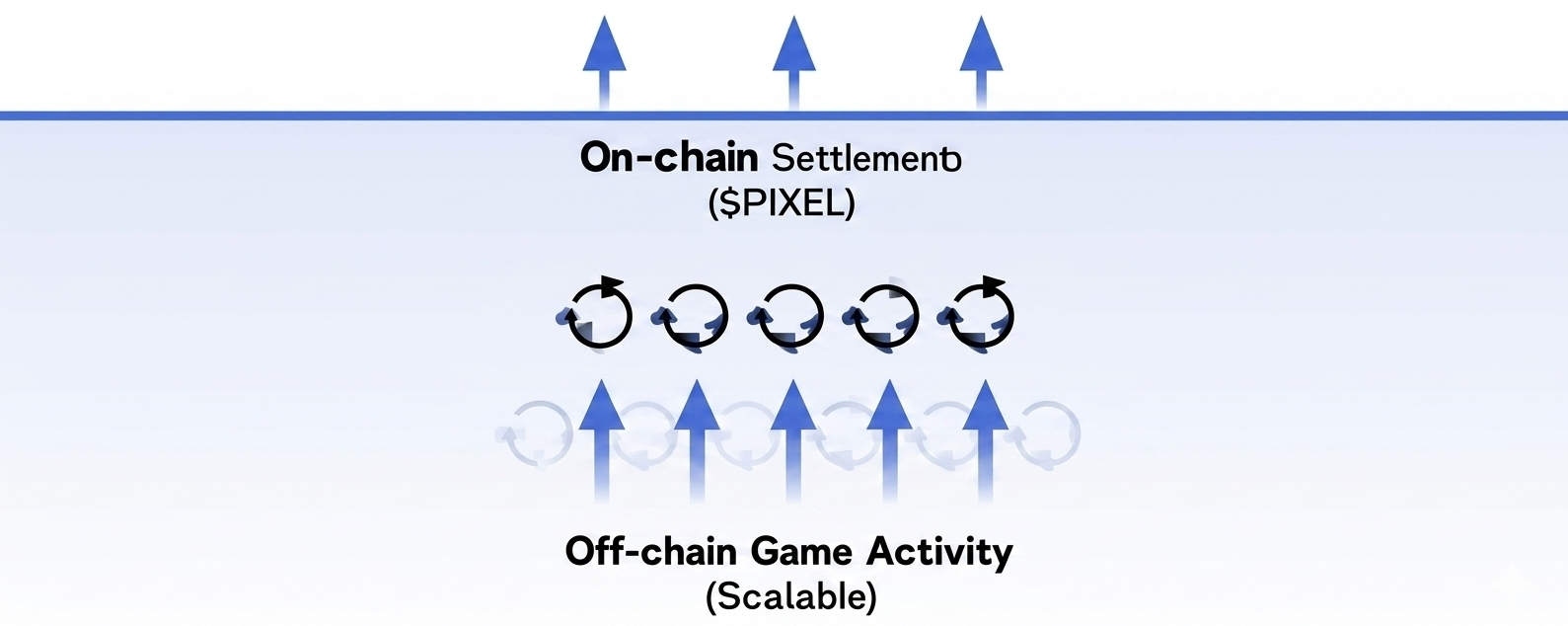
At surface level, Pixels feels expansive. You can farm endlessly, craft continuously, run loops for hours. Activity doesn’t appear capped. The world feels open.
But expansion inside a game isn’t the same as expansion inside its economy.
The more I watch @Pixels , the more it feels like two systems are running in parallel.
The first is off‑chain activity. Farming cycles, crafting routines, daily engagement. These loops can scale almost infinitely. More time equals more repetition. There’s no immediate hard stop.
The second system is settlement. The moment value transitions into $PIXEL , the environment changes. Now you’re inside Ronin. Recorded. Final. Constrained.
That boundary matters.
Off‑chain activity can expand without friction. On‑chain settlement cannot. Emissions, validator limits, reward routing, economic balance — all of these introduce structural ceilings. No matter how efficiently one player optimizes, the total value passing through that settlement layer is governed by system‑level constraints.
This reframes how $PIXEL behaves.
Instead of acting purely as a reward token, it begins to resemble access to a limited settlement channel. Not every action inside the game crosses that boundary. Most remain local, circulating within Coins or internal loops. Only certain moments convert into on‑chain consequence.
That conversion point is where competition intensifies.
If total settlement capacity is effectively capped — whether by design, emissions control, or economic balancing — then players aren’t expanding the pie through effort alone. They are redistributing access within it.
Optimization, in that context, doesn’t grow supply. It shifts position.
This creates a subtle but important dynamic. Players who refine loops aren’t necessarily increasing total rewards in the ecosystem. They are improving their probability of capturing a share of what is already allocated. Activity scales, but settlement remains bounded.
And bounded systems behave differently than growth systems.
In pure growth models, more players and more time naturally expand value. In constrained models, growth increases competition for fixed bandwidth. That tension often goes unnoticed until friction appears.
There is also a behavioral consequence.
When players recognize implicit ceilings, behavior compresses. Exploration declines. Efficiency rises. The game feels tighter. Not necessarily worse — just more optimized. Systems that operate under constraint tend to reward predictability over experimentation.
If that dynamic stabilizes, $PIXEL could benefit from structured demand. If it becomes too restrictive, activity may continue while settlement stagnates — a divergence that markets eventually price in.
The long‑term question isn’t whether Pixels can attract activity. It already does.
The real question is whether the constrained settlement layer can scale proportionally with participation — or whether it remains intentionally narrow to preserve economic balance.
Because in layered systems, expansion below the ceiling is easy.
What matters is what survives above it.