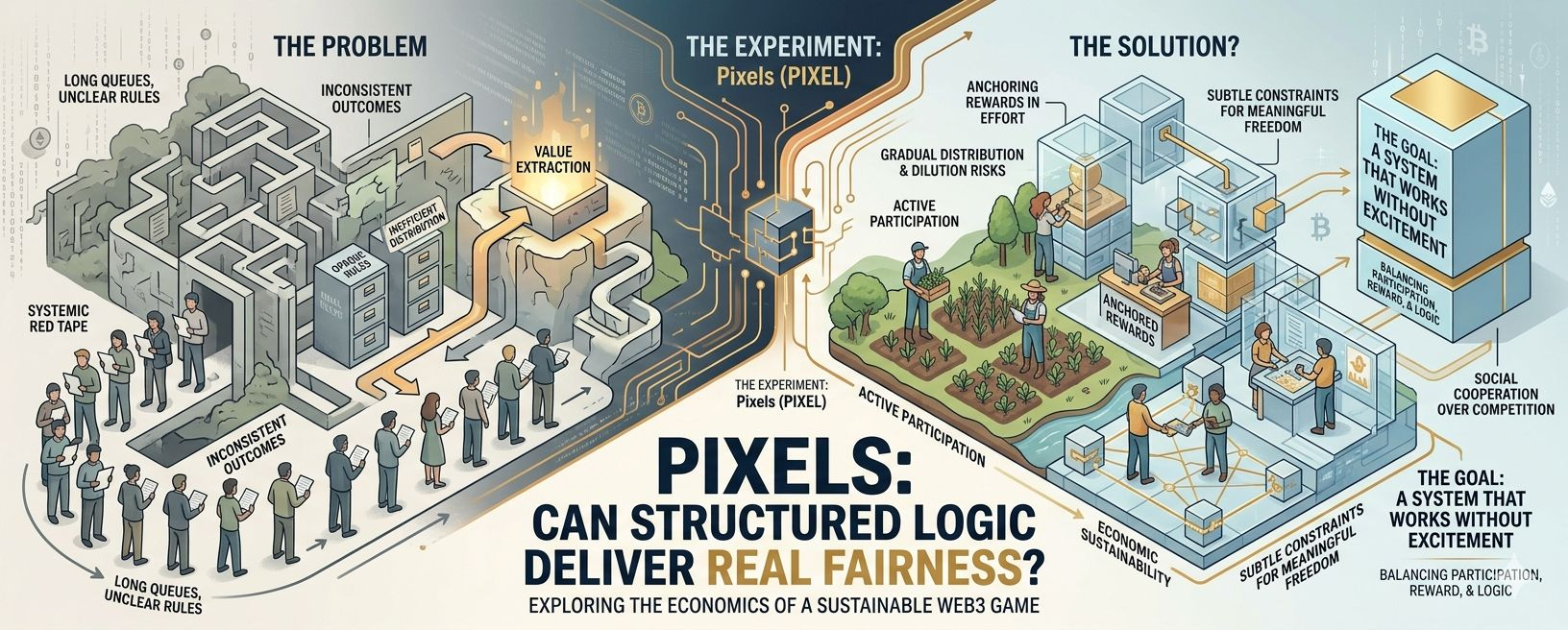

There’s a certain kind of frustration most people don’t even question anymore. You stand in a long queue, maybe at a government office or a bank, watching files move from one desk to another. Some people get processed quickly, others wait endlessly, and no one can clearly explain why. The system exists, the rules exist, yet the outcomes feel inconsistent. Effort doesn’t always translate into results, and participation doesn’t guarantee fairness. Over time, people stop expecting clarity—they just learn to navigate the chaos.
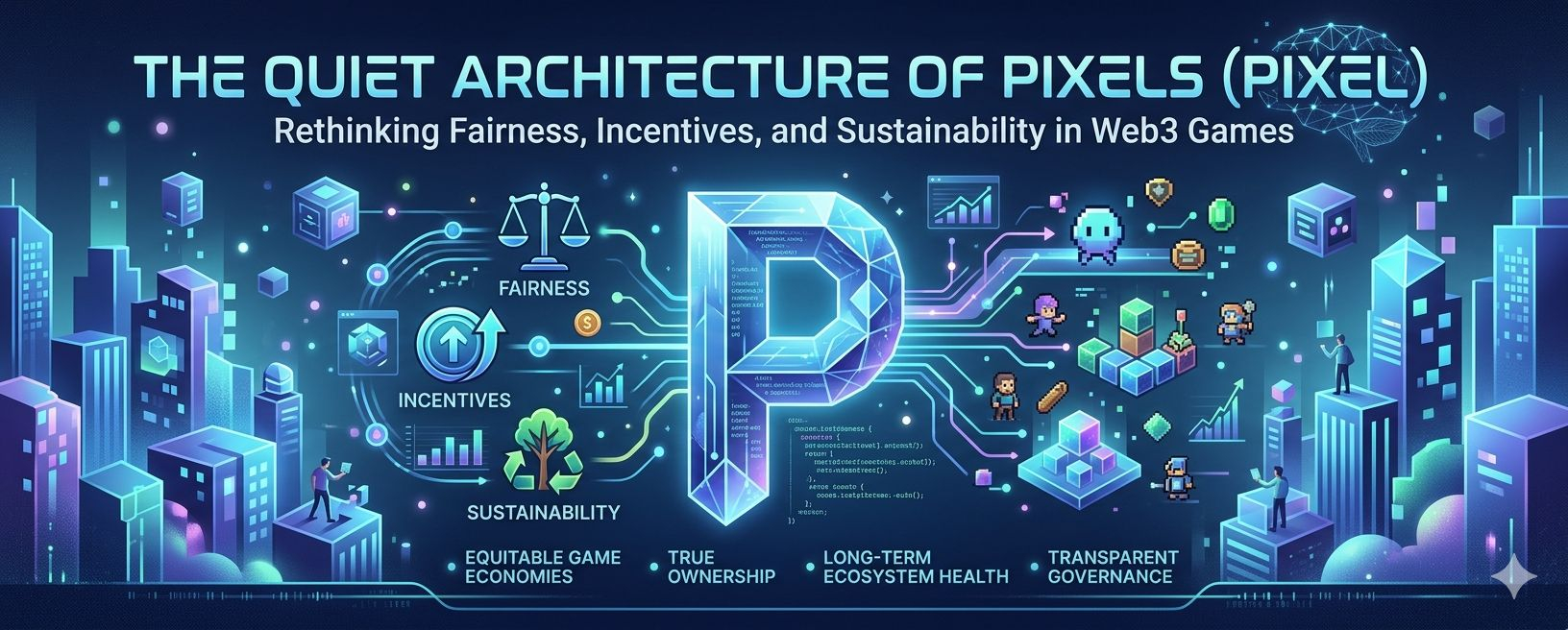
The more I look at projects like Pixels (PIXEL), the more that familiar pattern starts to feel relevant again—but in a digital form that’s far more subtle. On the surface, Pixels presents itself as a calm, open-world farming game. You plant, you craft, you explore. It feels simple, almost nostalgic. But beneath that simplicity, there’s a system trying to answer a much harder question: how do you design an economy where participation, reward, and sustainability don’t fall into the same traps we see everywhere else?
Most Web3 games never really solve this. They simulate activity, but not meaning. Rewards are distributed, but not always earned in a way that feels structurally fair. Early users benefit disproportionately, inflation creeps in quietly, and what starts as a “game” often becomes a race to extract value before the system destabilizes. The industry tends to cover this with branding—better graphics, stronger narratives, louder announcements—but the underlying mechanics often remain fragile.
Pixels seems aware of this tension. Not in a loud or declarative way, but in how it structures its economy. The gradual increase in circulating supply, now hovering around a mature range, isn’t just a statistic—it reflects a shift in how control and distribution evolve over time. When a system moves from tightly held tokens to broader circulation, it theoretically becomes more “fair.” But fairness here isn’t straightforward. Wider distribution can reduce manipulation, but it can also dilute incentives. It raises a quiet question: does spreading ownership actually strengthen a system, or just make its weaknesses less visible?
What stands out in Pixels is its attempt to anchor rewards in activity that resembles real effort, not just speculative positioning. Farming, crafting, and resource management aren’t just gameplay loops—they act as economic filters. You don’t just hold an asset; you interact with a system. That distinction matters. It shifts value from passive ownership toward active participation.
But even that comes with tradeoffs.
If rewards are tied too closely to activity, the system risks becoming labor-like rather than play-like. At what point does engagement turn into obligation? And if the rewards are adjusted to prevent inflation, does the experience start to feel restrictive instead of rewarding? These are not design flaws—they’re inherent tensions in any system trying to balance fun, fairness, and financial logic.
Another thing I keep noticing is how Pixels leans into its social layer, but not in the way most platforms do. It doesn’t aggressively push competition or dominance. Instead, it creates an environment where cooperation and coexistence feel more natural. That sounds ideal, but it raises another question: can a system sustain long-term engagement without strong competitive pressure? Or does it risk becoming too passive over time?
The Web3 space often assumes that more freedom automatically leads to better outcomes. Pixels challenges that assumption, at least partially. By introducing subtle constraints—whether through resource limits, reward balancing, or progression pacing—it acknowledges something many projects ignore: completely open systems tend to collapse under their own weight. Structure isn’t the enemy of freedom; sometimes it’s the only thing that makes freedom meaningful.
Still, there’s a deeper layer that’s harder to ignore. Even if Pixels builds a more balanced internal economy, it doesn’t exist in isolation. External market forces, player expectations, and speculative behavior will always influence how the system is perceived and used. A well-designed economy can still be distorted by external incentives. So the real question becomes: how much control can a system truly maintain once it’s exposed to open markets?
There’s also the issue of perception versus reality. From the outside, Pixels can look stable, even mature. Metrics improve, systems stabilize, participation grows. But stability in Web3 is often temporary, not absolute. It’s less about reaching a final state and more about continuously adapting to shifting conditions. The moment a system stops adjusting, it starts becoming vulnerable again.
What makes Pixels interesting isn’t that it has solved these problems—it hasn’t. It’s that it seems to recognize them. There’s a difference between a system that hides its weaknesses and one that quietly designs around them. Pixels feels closer to the latter, even if the outcome is still uncertain.
And maybe that’s the point most people overlook.
We tend to evaluate projects based on outcomes—price, growth, adoption. But systems like Pixels are better understood through their intent and structure. Not what they promise, but how they behave under pressure. Not how they look at their peak, but how they adjust when things start to strain.
So the real question isn’t whether Pixels will succeed in the traditional sense. It’s whether it can maintain coherence as it scales. Can it keep rewards meaningful without making them extractive? Can it balance participation without turning it into labor? Can it remain flexible without losing structure?
Because in the end, every system—digital or real—faces the same underlying challenge. It’s not about creating perfect rules. It’s about creating rules that people can trust, even when outcomes aren’t always in their favor.
And if Pixels manages to get even part of that right, it won’t just be another Web3 game quietly competing for attention.
It will be something far more difficult to achieve—
a system that doesn’t rely on excitement to survive,
but on the quiet, persistent logic of something that actually works.