

I’ve been noticing something small, but it keeps repeating. Systems that feel figured out stop being rewarding. Not immediately but gradually. Once behavior becomes predictable the value starts leaking out of it.
At first predictability feels good. You know what to do. You know what you’ll earn. There’s comfort in that loop. But in crypto especially inside something like Pixels predictability quietly becomes a cost.
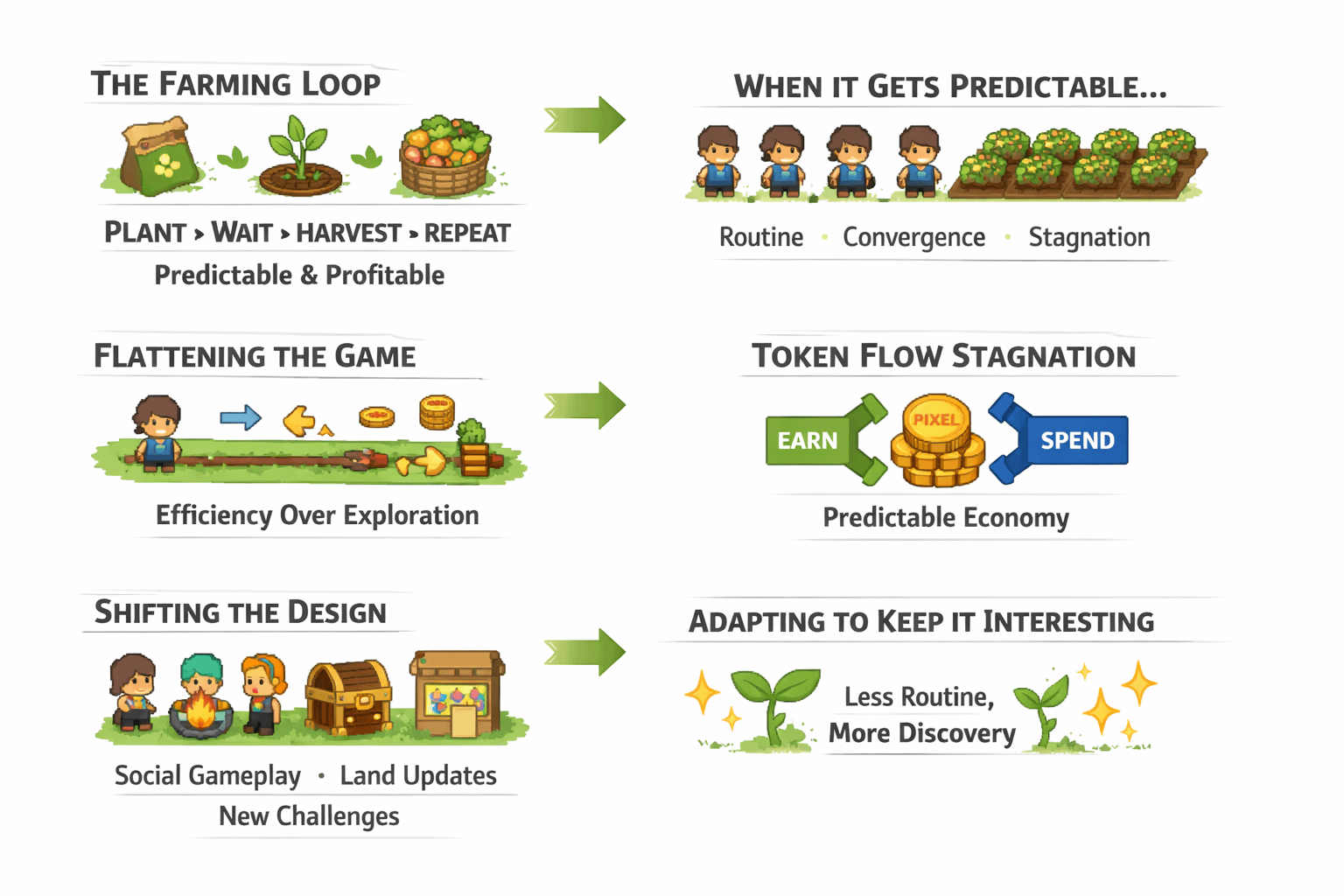
I didn’t think about it this way when I first got into Pixels. Back then the farming loop felt clean. Plant, wait, harvest, repeat. It made sense. The more consistent I was, the more I earned. It felt almost fair.
But over time I started seeing patterns. Not just in my own behavior but in everyone else’s. The same crops. The same routes. The same optimization paths. It wasn’t collaboration it was convergence.
And that’s where things shifted.
Pixels didn’t break. It just became easier to predict. Resource gathering turned into routine instead of decision making. Progression felt less like exploration and more like execution. Even land ownership which should feel strategic started reflecting the same logic across players.
When everyone plays correctly, the system starts flattening.
I think that’s where the hidden cost shows up. The game rewards efficiency but too much efficiency removes variation. And without variation, the economy starts behaving in ways that feel fragile.
You can see it in how $PIXEL tokens move inside the game. Earning becomes tied to repetition. Spending becomes predictable. And once both sides are predictable, the balance doesn’t just stabilize it stagnates.
What makes it more interesting is that Pixels isn’t ignoring this. If anything, it feels like the design is slowly reacting to it. Small changes in rewards. Adjustments in how land is used. More emphasis on social gameplay and collaboration.
It’s subtle but it’s there.
On Ronin the game has access to a larger more active player base. That should help. More players means more variation, at least in theory. But I’m not fully convinced that scale alone fixes predictability.
Because new players don’t always behave differently. They often learn from existing patterns. They copy what works. And suddenly, the same loops just expand instead of evolve.
That’s where I start questioning the long term balance.
Is the system sustainable if most rewards come from doing the same optimized actions? Or does it slowly depend on new players entering and repeating those same loops? And if that’s the case, is it really a game economy or just a rotating structure of participation?
I’ve also noticed how social features try to break this pattern. Visiting other lands. Coordinating with players. Sharing resources. These are the moments where unpredictability comes back. Where behavior isn’t fully optimized.
But they still feel optional. And as long as the core earning loop stays predictable, most players will default to it.
That’s just how incentives work.
What makes Pixels interesting right now is that it sits right in the middle of this tension. It’s not a broken system. It’s a system that’s becoming understood. And in crypto, being understood is sometimes the beginning of decline, not success.
Short-term, predictability attracts users. It lowers friction. It makes earning feel accessible. But long-term, it can quietly drain the system of depth.
And I’m not sure the market fully prices that in.
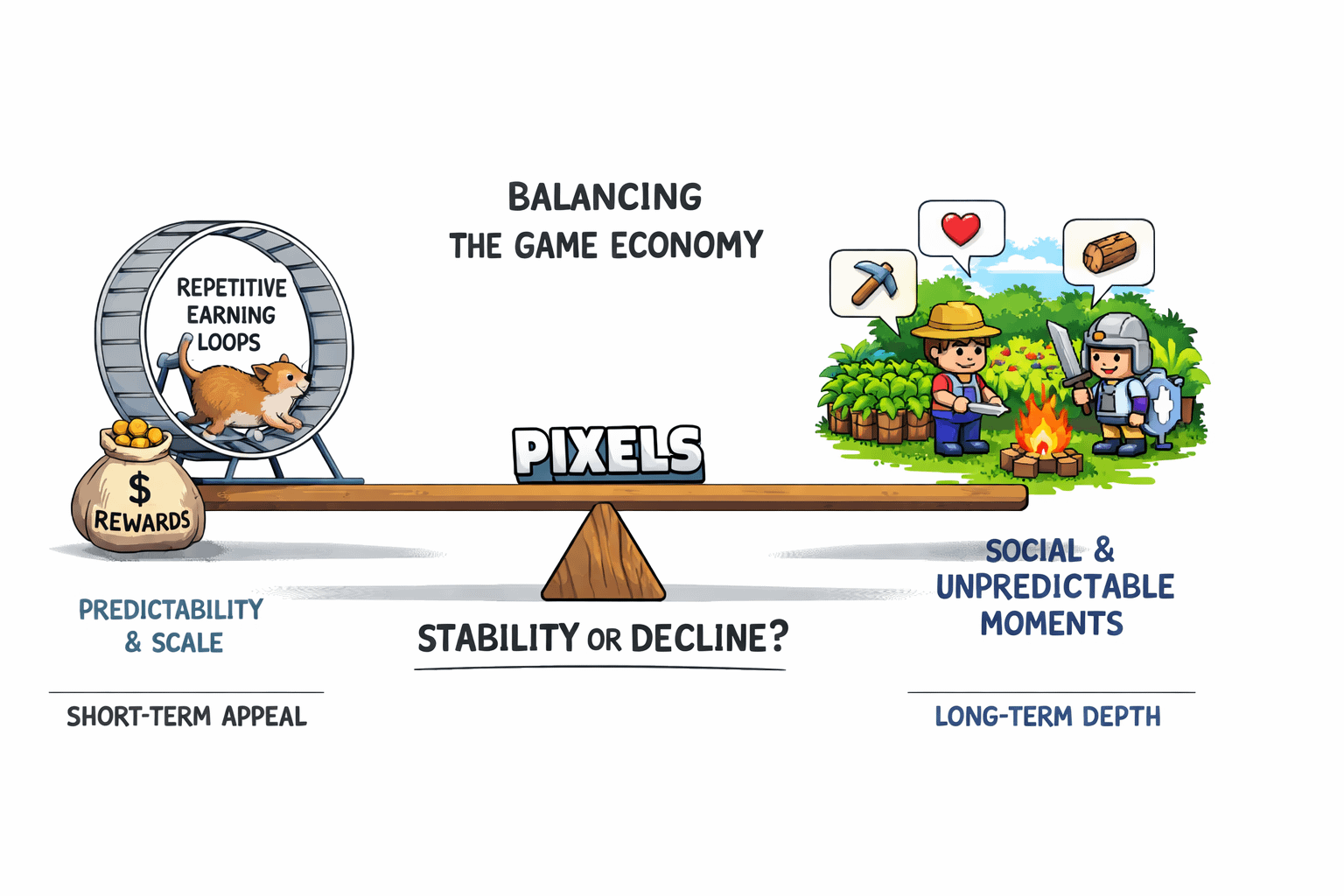
We often talk about transparency and fairness in Web3 games. Pixels delivers on that more than most. You can see the loops. You can understand the economy. Nothing feels hidden.
But maybe that’s the trade off.
Because when everything is visible, everything becomes optimizable. And when everything is optimizable, behavior stops being human. It becomes mechanical.
That’s where the real question sits for me.
Is @Pixels evolving fast enough to stay ahead of its own predictability? Or are players slowly solving the system faster than it can adapt?
I don’t think there’s a clear answer yet.
And maybe that’s the point.
Because if the cost of predictability is real, then the next phase of Pixels isn’t about adding more content or rewards. It’s about reintroducing uncertainty without breaking trust.
That’s not easy to design.
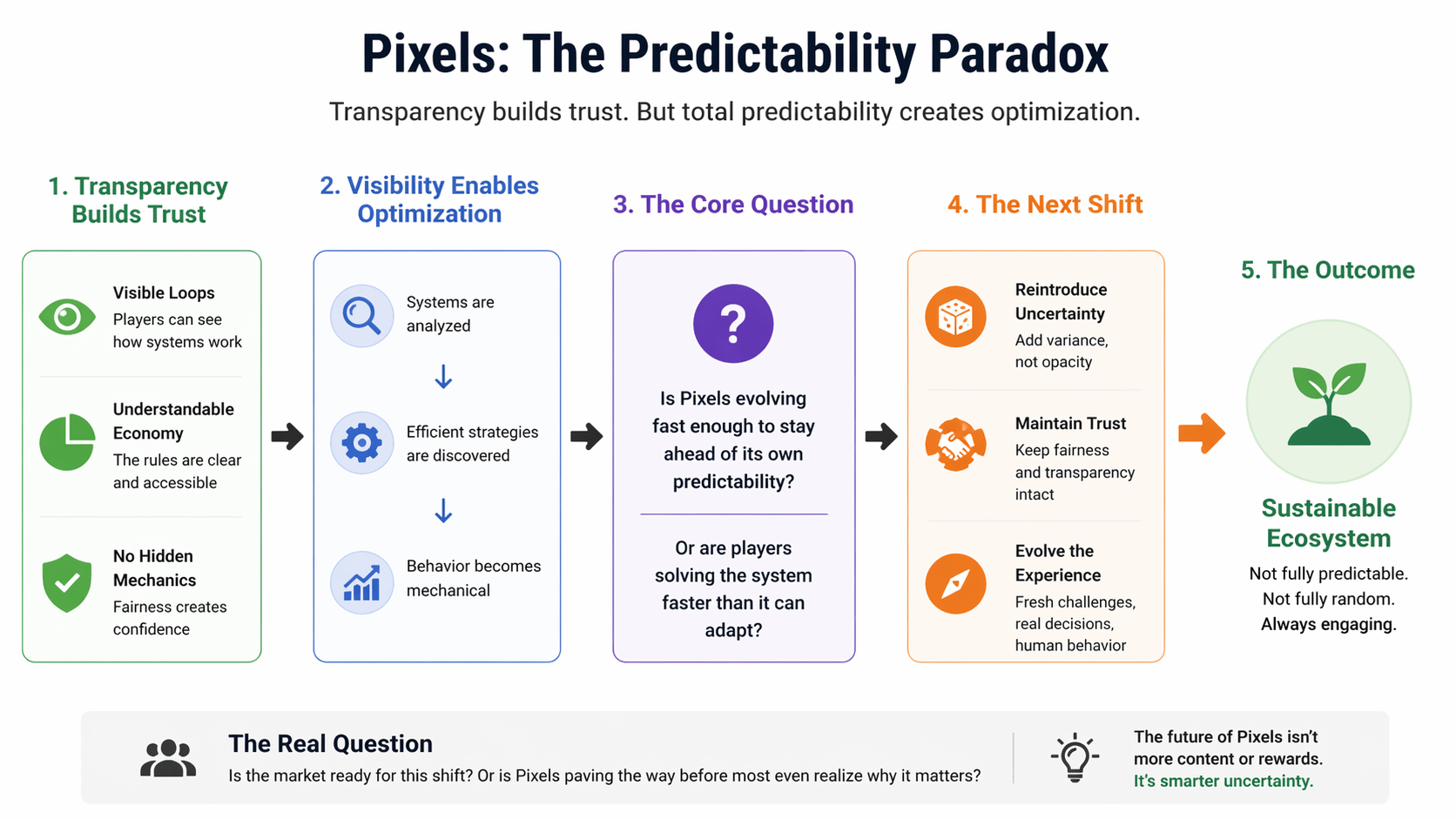
And I keep wondering if the market is actually ready for that kind of shift or if Pixels is quietly moving there before most people even realize why it matters.