
There’s a small government office not far from where I live where people line up early in the morning, hoping to get a basic document processed. The process itself isn’t complicated. What makes it frustrating is something else entirely. The rules are unclear, the system feels inconsistent, and outcomes often depend less on what you’ve done and more on when you arrived, who you know, or how long you’re willing to wait. Everyone participates, but very few feel like they’re actually in control of the process.
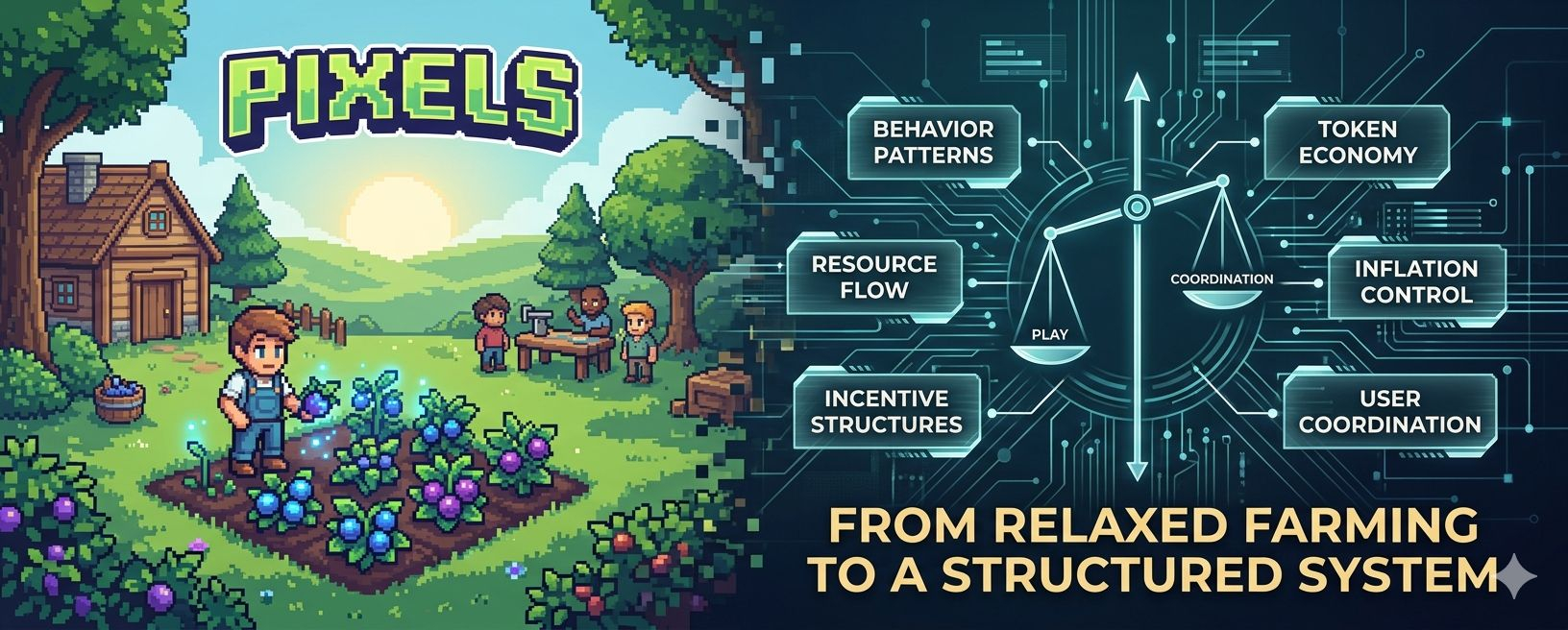
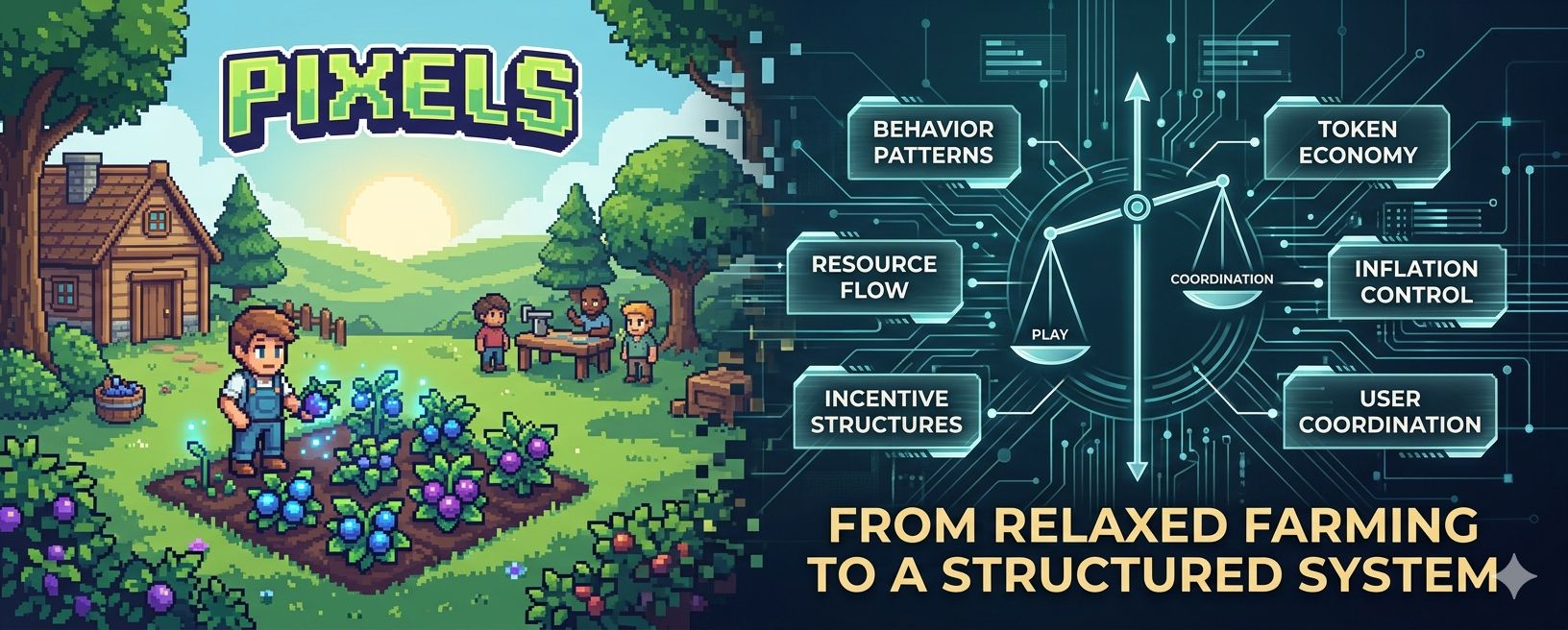
The more I look at Pixels, the more it reminds me of that kind of environment—but in a much more subtle and controlled way. On the surface, it presents itself as a relaxed, social farming game. Something simple, almost familiar. But underneath that surface, there’s a growing complexity that starts to feel less like a game and more like a structured system trying to manage behavior, incentives, and participation at scale.
And that shift raises an uncomfortable question: when does a game stop being about play and start becoming about coordination?
Most Web3 projects, especially in gaming, tend to lean heavily on visibility. Big promises, token narratives, community growth, and the idea that participation itself will lead to value. But what often gets ignored is the underlying structure—how rewards are actually distributed, how systems respond to user behavior, and whether the economy can sustain itself without constant external attention.
What’s interesting about Pixels is that it doesn’t fully rely on that surface-level excitement anymore. The integration with Ronin Network gives it a technical foundation, but what’s more noticeable is how the game has been evolving into something more system-driven. Farming, crafting, and exploration are still there, but they increasingly feel like inputs into a larger economic loop rather than ends in themselves.
That’s where things become both meaningful and complicated.
Because when a game starts functioning like a system, fairness becomes harder to define. Is fairness about equal opportunity, or is it about proportional reward based on effort and timing? And in a tokenized environment, where rewards have real value, even small imbalances can quietly reshape user behavior.
I keep noticing that Pixels doesn’t just reward activity—it subtly shapes it. Players aren’t just exploring because it’s enjoyable; they’re optimizing. They’re not just farming; they’re calculating yield. And over time, that changes the nature of participation itself. What begins as play slowly turns into strategy, and what feels like freedom starts to operate within invisible constraints.
This isn’t necessarily a flaw. In fact, it may be the point.
Traditional games often hide their systems behind entertainment. Web3 games, on the other hand, expose those systems more directly. Pixels sits somewhere in between. It softens the complexity with a casual interface, but underneath, it’s carefully balancing inflation, resource flow, and reward distribution.
And that balance is fragile.
Because any system that tries to manage value and behavior at the same time eventually runs into trade-offs. If rewards are too generous, the economy inflates. If they’re too restrictive, engagement drops. If early participants gain too much advantage, new users feel discouraged. But if everything is constantly adjusted, long-term trust starts to erode.
So the real question isn’t whether Pixels is “working” as a game. It’s whether it can maintain coherence as a system.
There’s also something else that’s easy to overlook. When people interact with a system like this daily, they begin to internalize its logic. They adapt to its incentives, even if they don’t fully understand them. Over time, the system doesn’t just guide behavior—it defines it.
And that creates a quiet tension.
Because systems aim for efficiency, but human behavior isn’t always efficient. Players want flexibility, unpredictability, even a sense of unfair advantage at times. A perfectly balanced system might be stable, but it can also feel rigid. On the other hand, too much flexibility can lead to exploitation and imbalance.
Pixels seems to be navigating that tension in real time. Not perfectly, but deliberately.
It’s not just building a game. It’s testing how far a structured digital economy can go while still feeling like an open-world experience. And that’s a much harder problem than it appears on the surface.
The deeper you look, the less it feels like a simple farming game and the more it starts to resemble a controlled environment where value, time, and behavior intersect. Not in an obvious way, but in a layered, almost invisible one.
And maybe that’s what makes it worth paying attention to.
Not because it promises something revolutionary, but because it quietly explores something most projects avoid: what happens after the hype fades, when the system itself has to stand on its own.
Can it sustain participation without constant excitement?
Can it remain fair without becoming predictable?
Can it grow without losing balance?
Those are not easy questions, and Pixels doesn’t fully answer them yet. But it doesn’t ignore them either.
And that might be the most important part.
Because in a space where many projects are still focused on attracting attention, Pixels is slowly shifting toward managing reality. Not perfectly, not without risk—but with a level of structural awareness that’s rare.
In the end, what makes this project compelling isn’t what it claims to be today. It’s what it’s quietly trying to become.
Not just a game people play…
but a system people adapt to.
And if that transition continues, the real impact won’t come from short-term growth or token performance. It will come from something far less visible, but far more lasting—the ability to shape how digital economies actually function when no one is watching.