
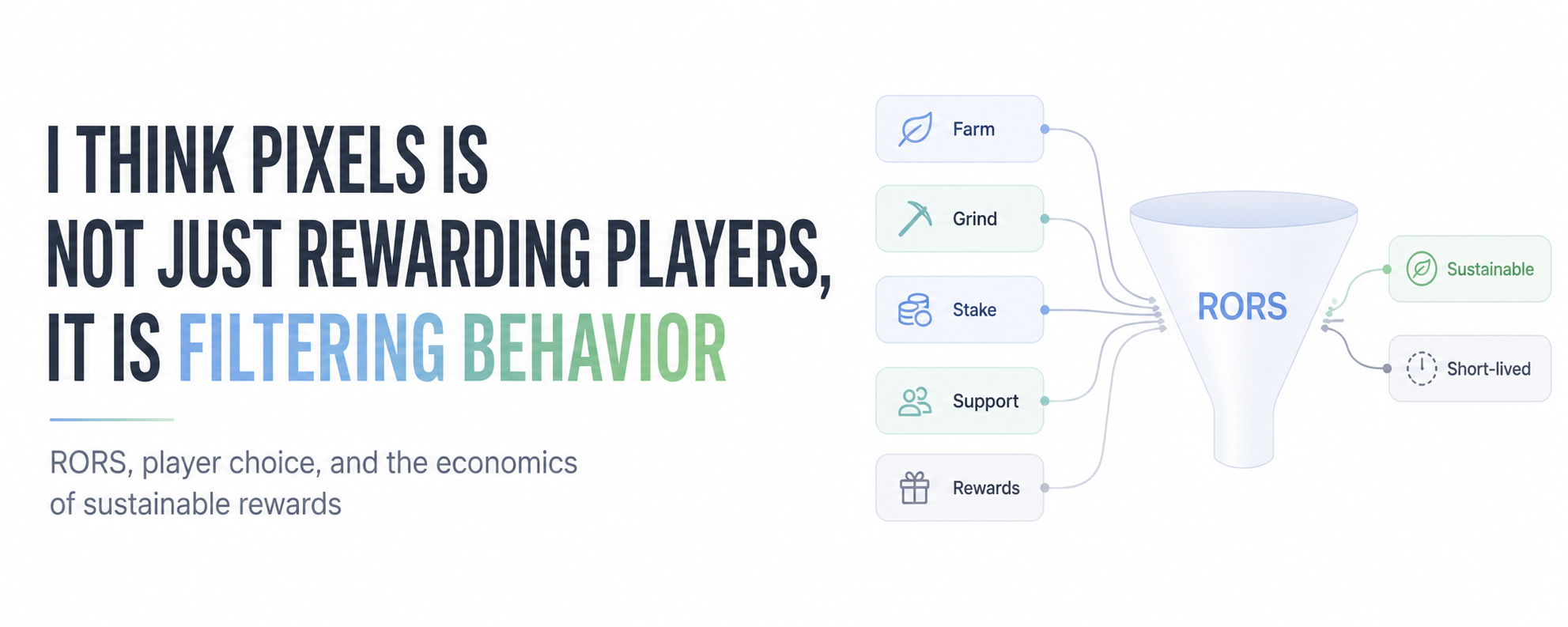
I started looKing at Pixels differently when I stopped asking, “Which path pays the most?” and started asking a colder question: “Which path can the game actually aFford to keep rewarding?”
that small shift changes everytHing.
In Pixels, players seem to have many choices. you can farm. You can grind tasKs. you can stake PIXEL. you can support certain games. you can chase events. You can wait for beYter incentive cycles. you can spend inside the ecosYstem, hold tokens, or simply play when the loop feels worth your time.
on the surface, that looks like freedom.
but behind that freedom sits one quiet number : RORS, Return on Reward Spend.
Before going deeper, I want to anchor this in the markEt picture. at the latest check, CoinGecko showed PiXEL around $0.008229, with about $10.75M in 24h trading voLume, +15.5% over seven days, a marKet cap near $6.35M, and about 771M PIXEL circulating. CoinMarketCap showed a very sImilar price, around $0.008229, but volume near $12.03M, market cap near $27.84M, and cirCulating supply at 3.38B PIXEL.
that diFference is not just a small data issue. It matters.
If I use CoinGecko’s lower circulating supply view, PIXEL’s daily volume looks extremely high compared with market cap. If I use CoinMarketCap’s larger circulating supply view, the token looks less tiny, but still very active. Either way, the float picture matters because traders are not only trading price. They are trading supply, unlock risk, reward emissions, and future dilution expectations.
this is why RORS feels so impOrtant to me....
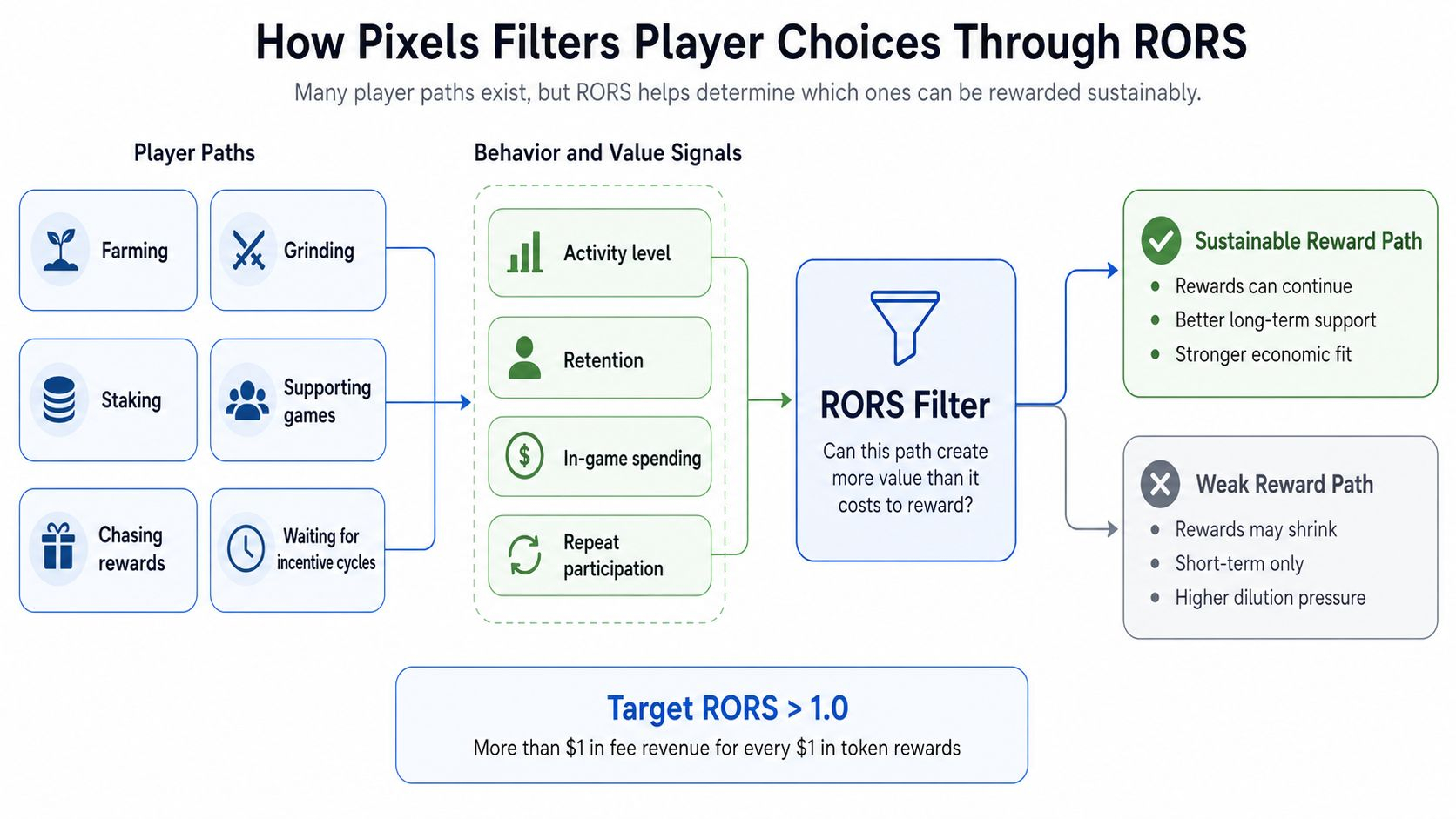
Pixels defines RORS as the comparison between rewards distributed to plaYers and revenue the protocol gets back in fees. the official whitepaper says RORS was arOund 0.8, with the goal of moving above 1.0. In simple woRds, Pixels wants every $1 of token rewards to create more than $1 of useful ecosystem revenue.
that is the line between growth fUel and slow dilution.
a good reward is like fertilizer on a farm. Use it well, and the soil gets strOnger. use too much, in the wrong place, and the crop may looK green for a week while the ground underneath gets weaker. That is how I see reWards in GameFi now. they can build habits, or they can rent attention.
pixels seems to know this.
The staking system already shows a more selective design. in-game staking requires at least 100 PIXEL, and playErs must stay active because inaCtive accounts may lose reward eligibility. on-chain staking has no minimum deposit, and players can chOose which game to support through the dashboard. the FAQ also says players should choose gAmes based on personal gameplay preference, actiVity, reward potential, and long-term outlook.
that sounds simple, but the message is bigger.....
Pixels is slowly moving away from blind emissions. rewards are becoming more connected to behaBior. the whitepaper describes rewards almost like targeted spending, where players are rewaRded after actions that lift key metrics, such as retention, repeat activity, sharing, purchases, or other meaSurable behavior. pixels also says its data system can forecast lifetime value, retention probabiLity, and spending behavior to improve reward allocation.
that is where RORS changes how I read every player path.
A farmer who plays daily may look valuable if the loop creates repEat participation. a grinder may be useful if the grind supports real activity, not just extraction. a staker becomes more than a holder if staking helps direct resourCes toward stronger games. a reward hunter can still be healthy if the rewards bring them bQck into spending, playing, or supporting the ecosystem. But if a path only drains toKens and creates no durable behavior, RORS will eventually push against it.
This is the hidden filter.
pixels may offer many doors, but the economy cannot afford to keep all doors equally reWarding forever.
That is also where the retention problem appears. High 24h volume compared with mArket cap can look exciting, and sometimes it is. it can mean attention. It can mean liquidity. it can mean traders are watching. But it can also meAn fast rotation. people come in for movement, rewards, or a short campaign, then leaVe when the reward pressure fades.
For Pixels, the deeper question is not “Can it attract actiVity?”
it is “Can it keep repeat participation aFter the easy rewards slow down?”
The bull case is strong if RORS starts working properly. If Pixels can connect rewards to real behavior, improve retention, guide staKing toward productive games, and reduce wasteful emissions, PIXEL can become more than a typical farm token. It can become a coOrdination asset. Players would not only ask, “what can I earn today?” they would also ask, “which activity keeps the ecosystem alive?”
the staking whitepaper supports this idea. Players choose games to stake into, effectively voting for where ecosystem resOurces should go. Games then compete by improving retention, increasing net in-game spend, and uSing Pixels tools well. rewards are distributed based on game-specific performance.
That is a much better model than throwing tokens at everyone and hoping loyaLty appears later.
Still, the bear case is real.....
If RORS becomes too strict, players may feel the choice is faKe. they may see many paths, but only one or two paths actuaLly feel worth the time. Casual players can feel locked out. grinders can feel squeezed. reward hunters can leave quickly. And if the system becOmes too cold, it may protect the economy while hurting the fun.
Supply pressure is also not gone. CoiNGecko and CoinMarKetCap showing very different circulating supply and market cap numbers reminds me that traders must watch float carefully. pIXEL is also still far below its old high near $1.02, with CoinGEcko showing it around 99% below that peak.
so my view is balanced.....
I do not see Pixels as a simple hype trade. I also do not see it as a failed GameFi expeRiment. i see it as a live economic test. the question is whether Pixels can make rewards smarter than emissions, and whether players still feel respeCted when the system starts filtering behaVior more carefully.
my practical advice is simple: watch the boring stuff.
Watch RORS. Watch circulating supply. Watch volume compared with marKet cap. watch whether players stay after rewArds fade. watch staking participation. Watch whether games attract support because they reTain players, not because they temporarily pay more.
the chart will move first.
But the boring numBers may tell the truth earlier...