

I used to think prediction markets were mostly a niche crypto idea that kept trying to sound bigger than they were. Smart concept, interesting mechanism, but always slightly outside the main conversation.
Then I noticed something had changed.
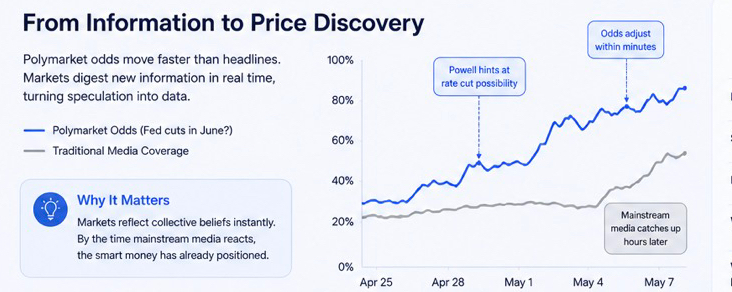
Whenever a major headline hit, people were no longer waiting for experts to interpret it. They were checking Polymarket odds first.
That shift matters more than many realize.
Because the real product Polymarket is building may not be betting markets at all. It may be a live market for attention, where uncertainty gets priced faster than traditional media can explain it.
That is a very different category.
Older prediction market projects understood the logic of incentives. If people can profit from being correct, markets should theoretically aggregate information better than noisy opinions. That idea was always powerful.
But theory alone didn’t create habit.
Projects like Augur built serious infrastructure early. Decentralized dispute systems, tokenized resolution logic, censorship-resistant markets. Important work. But using them often felt like participating in an experiment rather than entering a mainstream product. Good mechanism does not automatically create users.
That lesson repeats often in crypto.
You can have elegant tokenomics, decentralization, and technical purity. If people don’t naturally return, the system stays intellectually respected but socially small.
Polymarket approached the problem from the opposite side.
It didn’t start by asking how to perfect prediction markets. It started by becoming the place people wanted to check.
That sounds simple, but it’s hard to do.
When elections, ETF approvals, rate cuts, geopolitical events, lawsuits, sports outcomes, or policy rumors emerge, users now instinctively ask: what are the odds?
Not what is someone’s opinion.
Not what is trending.
What are the odds right now?
That behavior turns uncertainty into a dashboard.
And dashboards become habit loops.
The strongest network effects on the internet are often built around habit, not ideology. Google became default search because it was useful repeatedly. X became a live information hub because people refreshed it during breaking moments. Bloomberg terminals became essential because professionals needed constant market context.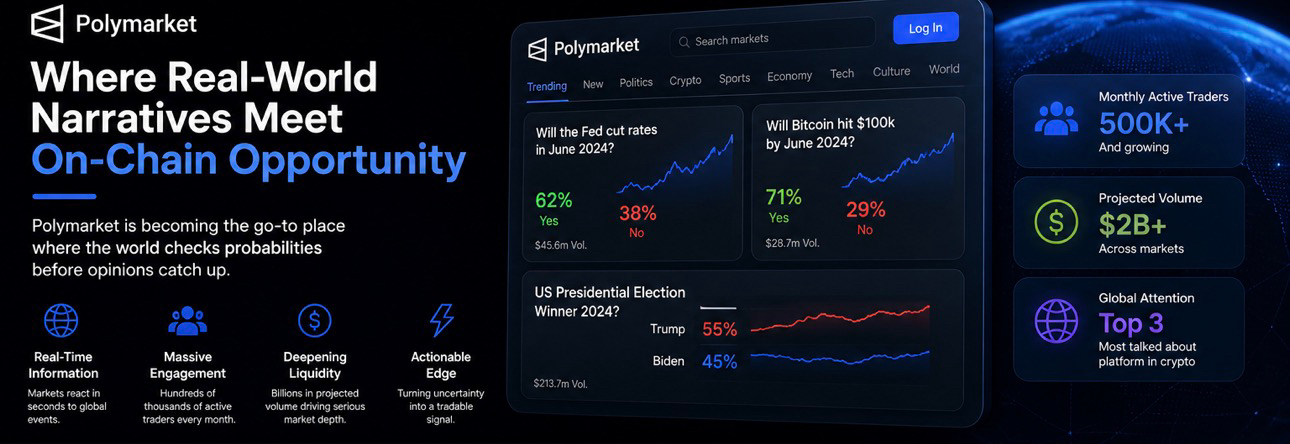
Polymarket is building a similar reflex inside a different lane.
When people refresh the platform during uncertain moments, it gains something more valuable than short-term fees. It gains attention memory.
Once users associate your product with “where I go when something matters,” you become difficult to replace.
This is where many token launches fail to think deeply enough.
They assume the token creates value.
Usually, attention creates value first.
Then the token may capture part of it.
That order matters.
If a platform has no durable attention, the token often becomes speculation floating above weak foundations. If the platform already owns a behavior pattern, then a token can potentially reinforce something real.
That is why discussion around a future $POLYX token attracts interest. Not because people need another ticker. Because users understand that ownership attached to an already relevant product can be different from ownership attached to an empty roadmap.
Still, a token alone solves nothing.
The real questions would be structural.
Would incentives deepen liquidity across important markets?
Would market creators be rewarded for launching useful, active markets instead of spam?
Would resolution systems become stronger and faster?
Would long-term users receive alignment instead of mercenary farming rewards?
Would governance improve the product, or simply create noise?
These questions matter more than token hype.
Crypto has enough examples of tokens extracting from products. What people want now are tokens that strengthen products.
Prediction markets especially need this discipline because their value depends on trust. If users think markets are shallow, manipulated, poorly resolved, or incentive-distorted, they leave quickly.
Trust here is practical, not philosophical.
People don’t need perfection. They need markets that feel liquid, responsive, and fair enough to use during real moments.
Another underrated part of Polymarket’s rise is that it sits between two powerful instincts: curiosity and positioning.
Humans naturally want to know what might happen.
Markets naturally reward being early.
Put those together, and you don’t just get engagement. You get recurring engagement.
That’s why prediction markets can feel more alive than static news articles. Every new headline changes probability. Every rumor can move price. Every debate becomes measurable.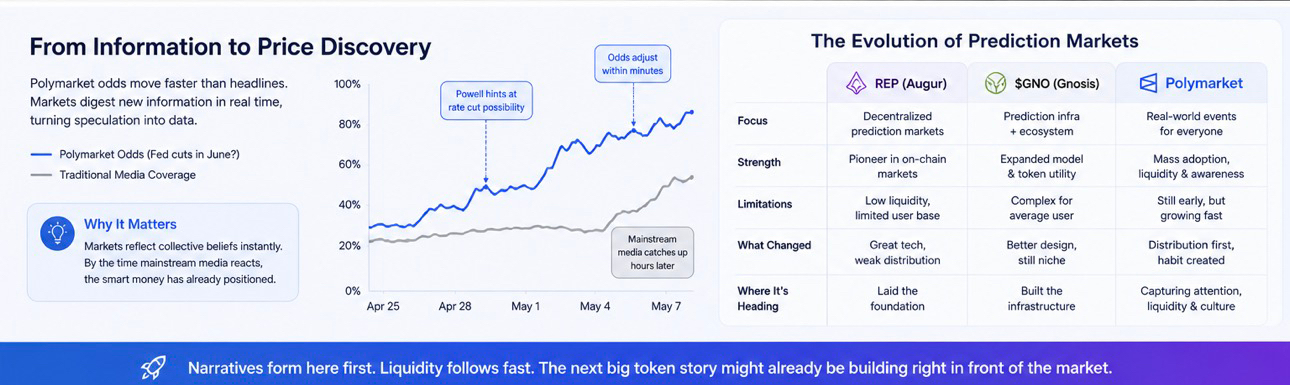
Even critics who dislike the concept often end up watching the odds.
That itself is signal.
The deeper implication is bigger than one platform.
We may be watching the emergence of a new information layer where narratives are continuously repriced by money, not just argued through words.
Traditional media reports facts after confirmation.
Social media spreads interpretations instantly, often without discipline.
Prediction markets occupy a strange middle ground. Imperfect, noisy, occasionally wrong but financially forced to update in real time.
That makes them useful.
Not infallible. Useful.
And usefulness is what drives durable platforms.
I also think many underestimate the global angle. In regions where institutions are distrusted, media is politicized, or information channels feel slow, users may increasingly prefer probabilistic dashboards over authority-based commentary.
Instead of asking who to believe, they ask what the market believes.
That psychological shift is powerful.
It moves trust from personalities toward price discovery.
Of course, markets can be wrong. Herd behavior exists. Thin liquidity can distort signals. Whale positions can create noise. Event wording matters. Resolution criteria matters. None of this should be worshipped.
But perfection was never the threshold.
The threshold was being more responsive than older systems.
That’s why Polymarket feels important right now.
It isn’t replacing journalism. It isn’t replacing research. It isn’t replacing expertise.
It is becoming the place many people check before those systems finish reacting.
And in internet markets, being the first tab people open is a serious asset.
So when people talk about Polymarket, I think they sometimes focus too narrowly on betting volume or future token speculation.
The larger story may be simpler.
It captured a new user habit at exactly the moment trust in slow narratives weakened.
That combination can create category leaders faster than most expect.
Polymarket didn’t just make outcomes tradable.
It made uncertainty consumable.
