

How Telegram Is Quietly Building One of the Most Powerful Blockchain Ecosystems in the World
For years, Telegram and TON existed in a strange relationship. Officially, they were separate. Unofficially, everyone knew they were still deeply connected.
Now, that separation is disappearing.
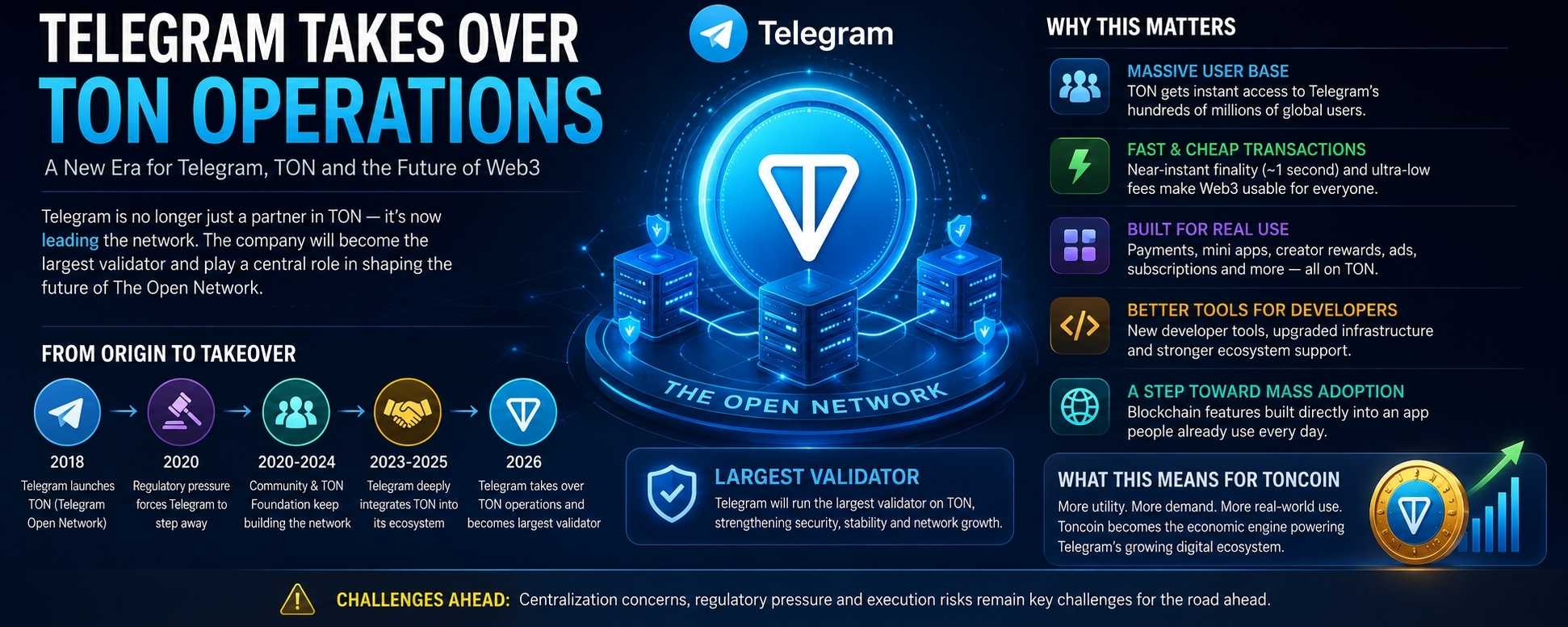
Telegram has officially stepped into a much bigger role inside The Open Network (TON), moving far beyond partnership status and becoming one of the main operational forces behind the blockchain. The company is expected to become the network’s largest validator while directly influencing upgrades, infrastructure, and future development.
This is not just another crypto partnership announcement.
It represents a major shift in how blockchain technology could be used by everyday people.
With hundreds of millions of users already inside Telegram, TON suddenly has something most blockchain projects have spent years chasing — real distribution.
And that changes everything.
The Story Behind TON
TON originally began as Telegram’s own blockchain project back in 2018.
At the time, most blockchains struggled with slow speeds, expensive fees, and poor user experience. Telegram wanted to create something different — a network capable of supporting millions of users directly inside a messaging platform.
The idea attracted massive attention almost immediately.
Investors poured billions into the project, and TON quickly became one of the most talked-about blockchain launches in the industry.
But things did not go as planned.
Regulatory pressure forced Telegram to step away from the project in 2020 after a legal battle with the U.S. Securities and Exchange Commission.
For a while, many believed TON was finished.
Instead, the community kept it alive.
Independent developers continued building the network under a decentralized structure, eventually forming what became known as the TON Foundation.
Even though Telegram officially left, the connection between the two never completely disappeared.
Telegram Slowly Returned to TON
Over the last few years, Telegram gradually started integrating TON into its ecosystem again.
At first, the changes were small.
Then they became impossible to ignore.
Wallet integrations appeared inside Telegram. Mini Apps started using TON infrastructure. Toncoin became tied to payments, creator rewards, digital services, and monetization systems across the platform.
By 2025, TON had effectively become Telegram’s main blockchain partner.
Many people inside the crypto industry already suspected Telegram was preparing for a much deeper role.
The latest announcement simply confirmed it.
Telegram is no longer experimenting with TON from a distance.
It is now actively helping run the network itself.
Why This Move Matters
Most blockchain projects face the same problem.
They build technology first and search for users later.
TON is different because the users already exist.
Telegram’s massive global audience gives TON something almost no blockchain network has — immediate access to real people using real products every day.
That creates a huge advantage.
Instead of convincing people to download separate crypto apps, Telegram can integrate blockchain tools directly into an app millions already use for messaging, business, communities, and digital payments.
For users, the experience becomes simpler.
For developers, the opportunity becomes much bigger.
And for TON, adoption could happen much faster than traditional blockchain projects.
Telegram Becomes a Major Validator
One of the biggest parts of the announcement was Telegram’s plan to become the largest validator on the TON network.
Validators are responsible for helping secure blockchain networks and verify transactions.
In simple terms, they help keep the system running.
By becoming a dominant validator, Telegram gains significant influence over the network’s future direction.
That does not automatically mean TON becomes centralized overnight.
The blockchain still operates through multiple validators and decentralized systems.
But Telegram’s influence is now clearly much stronger than before.
The company will likely shape:
Technical upgrades
Infrastructure improvements
Developer tools
Transaction efficiency
Ecosystem expansion
Network priorities
For supporters, this could make TON stronger and more stable.
For critics, it raises questions about how decentralized the network can remain over time.
TON Is Becoming Faster and Cheaper
The timing of Telegram’s deeper involvement is important because TON recently introduced major technical upgrades.
According to official updates, transaction confirmations on the network are now close to instant, with speeds reduced to roughly one second.
Transaction costs have also dropped significantly.
That matters because mainstream users usually avoid complicated or expensive blockchain systems.
If Telegram wants people using crypto features naturally inside chats, apps, games, and subscriptions, the experience must feel smooth and almost invisible.
Fast transactions and extremely low fees are essential for that vision.
TON appears to be moving closer to achieving it.
Telegram’s Bigger Vision
This move is about more than crypto trading or token prices.
Telegram seems to be building a much larger ecosystem around digital services.
The platform is already expanding beyond messaging through:
Mini Apps
Digital payments
Creator monetization
Subscription systems
Blockchain wallets
Online marketplaces
Community tools
TON could become the infrastructure layer powering all of it.
That would make Telegram very different from traditional social platforms.
Instead of simply hosting content and conversations, Telegram could eventually support entire digital economies inside the app itself.
Users may one day send payments, buy services, earn rewards, subscribe to creators, and interact with apps — all powered by TON in the background.
And many users may never even realize blockchain technology is involved.
The Risks Behind the Expansion
Despite the excitement surrounding the announcement, there are still concerns.
The closer TON becomes to Telegram, the more dependent it becomes on the company’s future.
Some analysts worry that too much influence from a single platform could weaken the decentralized nature of the network.
Others point to ongoing regulatory pressure surrounding large tech and crypto companies worldwide.
If Telegram faces legal or operational challenges in the future, TON could also feel the impact.
There is also the question of balance.
Can Telegram scale TON aggressively while still maintaining the trust and openness expected from blockchain networks?
That may become one of the biggest challenges ahead.
What This Means for Toncoin
The market reacted strongly after Telegram’s announcement.
Toncoin saw a sharp rise as investors viewed the news as a sign of long-term confidence in the ecosystem.
The reason is simple.
Toncoin is no longer being viewed as just another cryptocurrency.
Its role inside Telegram continues to expand through:
Payments
Creator rewards
Mini Apps
Advertising systems
Digital services
Subscription features
The more Telegram integrates TON into its platform, the more real-world utility Toncoin gains.
That creates stronger long-term demand than projects built purely around speculation.
Still, the future depends heavily on execution.
Telegram now carries enormous expectations.
A New Chapter for Blockchain Adoption
For years, the crypto industry has talked about mass adoption without truly achieving it.
Most blockchain networks remained too technical, too expensive, or too disconnected from everyday users.
Telegram and TON may finally be attempting a different approach.
Instead of asking people to enter the crypto world, they are bringing blockchain directly into an app people already use daily.
That strategy could change how millions experience digital payments and online services in the future.
Whether TON becomes a global blockchain success story or another ambitious experiment will depend on what happens next.
But one thing is clear.
Telegram is no longer standing beside TON.
It is now helping lead the entire network forward.