

According to CoinMarketCap data, the global cryptocurrency market cap now stands at $2.66T, up by 0,2% over the last 24 hours.
Bitcoin (BTC) traded between $79,181 and $81,180 over the past 24 hours. As of 15:00 PM (UTC) today, BTC is trading at $80,250, up by 0.15%.
Most major cryptocurrencies by market cap are trading mixed. Market outperformers include JTO, STRK, and NIL, up by 39%, 31%, and 27%, respectively.
Jobs Beat Keeps Bitcoin Near $80K — But Hormuz Tanker Attacks and a $277M ETF Outflow Day Suggest the Rally Isn’t Settled Yet
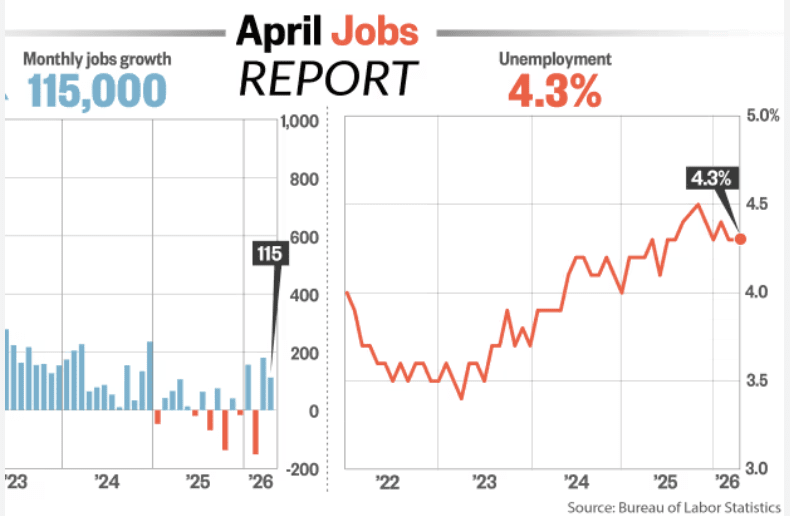
April payrolls came in at 115,000 — well above the 62,000 forecast — helping steady Bitcoin around $80,000 and supporting risk appetite heading into the weekend. But the macro picture remains complicated: ETFs snapped their five-day inflow streak with $277M in outflows, two Iranian tankers were attacked near Hormuz, and Wall Street’s record $2.6 trillion options surge is flashing both a bullish signal and a contrarian warning.
U.S. Economy Adds 115,000 Jobs in April, Nearly Doubling Forecasts — Bitcoin Holds Above $80,000
Key Takeaways:
April NFP came in at 115,000 — well above the 62,000 consensus — though below March's revised 185,000, signaling a resilient but gradually moderating labor market
Unemployment held steady at 4.3%; Bitcoin traded at $80,200 post-release, roughly flat on the day
Nasdaq 100 futures rose 0.9%; 10-year Treasury yield slipped 2bps to 4.37%
The Fed held at 3.50%–3.75% last week; Kevin Warsh is expected to be confirmed as chair later this month — markets will watch for early rate path signals
Oil remains elevated despite pulling back from recent highs, keeping inflation risks alive and the Fed's trade-off difficult regardless of who chairs the institution
Summary:
A jobs beat nearly double the forecast is the cleanest possible outcome for Bitcoin in the near term — it reduces recession fears and keeps risk appetite constructive without being strong enough to meaningfully push back rate cut expectations further. BTC holding $80,000 on the release rather than selling off confirms the market read it as neutral-to-positive. The bigger variable ahead is Warsh's early Fed signaling: a hawkish tilt strengthens the dollar and caps the rally; a data-dependent stance extends it.
$2.6 Trillion in One Day: What Wall Street's Record Options Binge Means for Bitcoin
Key Takeaways:
U.S. equity derivative exchanges recorded $2.6 trillion in S&P 500 call options volume on Wednesday — 60% of all S&P 500 options activity — the largest single-day figure on record
The notional volume nearly equals the entire crypto market cap of $2.73 trillion — all digital assets combined
Bitcoin has risen from below $70,000 to above $80,000 since early April in lockstep with double-digit S&P 500 and Nasdaq gains; BTC-equity correlation is back near 2023 highs
Goldman Sachs described current market conditions as a "semi-irrational chasing mode"; Nasdaq semiconductor RSI hit its strongest level since the 1999 dot-com peak
Overcrowded bullish positioning is a classic contrarian warning: a sudden stall in equity momentum could trigger simultaneous forced selling across stocks and crypto
Summary:
Wednesday's options volume is a double-edged signal for crypto. The record call buying confirms that the same risk appetite lifting Bitcoin is deeply embedded across Wall Street — a structural tailwind while it lasts. But Goldman's "semi-irrational chasing" warning and semiconductor RSI at dot-com bubble levels are serious caution flags. When positioning is this one-sided, the reversal risk is asymmetric: the rally can grind higher slowly, but the selloff — when it comes — tends to be fast and correlated across every risk asset including crypto.

Bitcoin ETFs Snap 5-Day Inflow Streak With $277.5 Million in Outflows as BTC Stays Above $80,000
Key Takeaways:
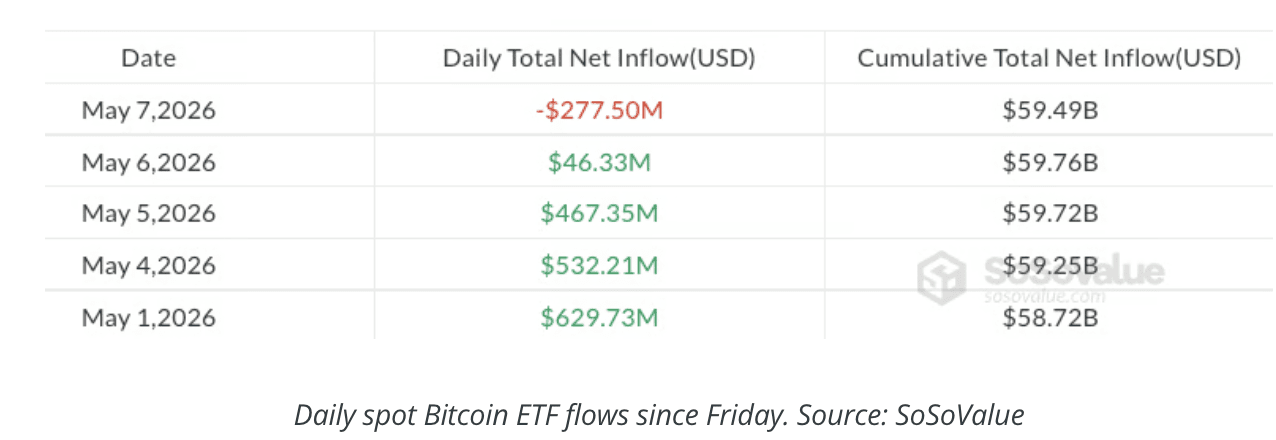
US spot Bitcoin ETFs recorded $277.5M in outflows Thursday — the first negative flow day in May — ending a five-day streak that had accumulated $1.7B in inflows
Fidelity's FBTC led outflows at $129M; BlackRock's IBIT followed at $98M; together they accounted for the vast majority of the day's redemptions
Morgan Stanley's MSBT recorded $7.3M in inflows on Thursday — continuing an unbroken inflow streak since its April 8 launch; total AUM now $232.6M, up 557% since debut
Bitcoin dropped below $80,000 intraday on Thursday before recovering; the Crypto Fear & Greed Index slipped back to 38 — "Fear" territory
Canton Network's 21Shares TCAN ETF debuted on Nasdaq, closing at $24.66 — the first US-listed ETF offering direct exposure to Canton Coin
Summary:
One outflow day after five straight inflow days and $1.7B in accumulated flows is noise, not a trend reversal — especially when the trigger was a sharp intraday BTC dip rather than a structural change in demand. The Morgan Stanley story is the more telling signal: MSBT has not had a single outflow day since launch, suggesting its institutional and wealth management client base is fundamentally stickier than the broader ETF market. Whether Thursday's outflows are a one-day correction or the start of a more sustained reversal depends almost entirely on whether Bitcoin can hold $80,000 as support through the weekend.
Iranian Oil Tankers Attacked Near Strait of Hormuz
Key Takeaways:
Radio recordings reveal two Iranian tankers — SEASTARIII and SEVDA — were attacked near the Strait of Hormuz on May 8
Iranian personnel reportedly sought assistance from nearby Iranian forces following the attacks
The incidents arrive as US-Iran diplomatic talks are described as progressing toward a deal — raising questions about who carried out the attacks and why
Summary:
Tanker attacks near Hormuz at the exact moment a peace deal is taking shape is the week's most destabilizing wildcard. The key unknown is attribution — Iranian tankers being attacked could implicate a third party seeking to derail the negotiations, or reflect internal Iranian factional conflict between hardliners and the civilian government pursuing the deal. Either scenario introduces uncertainty that keeps the oil risk premium alive and caps how aggressively markets can price in a full Hormuz reopening until the situation is independently verified and attributed.

U.S. Tokenized Asset Market Value Doubles, Driven by Major Financial Institutions
Key Takeaways:
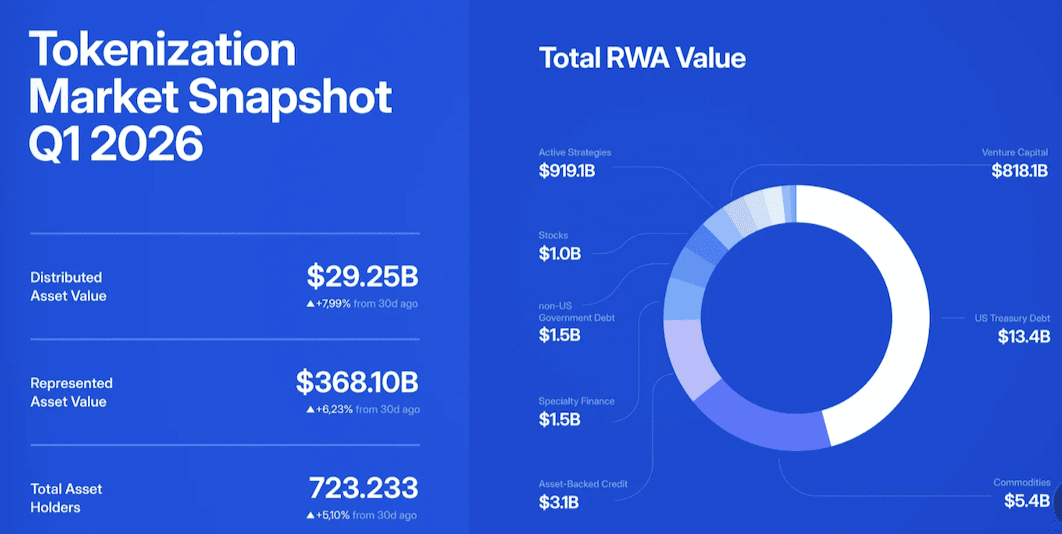
Fed Board member Lisa Cook disclosed that the US tokenized asset market has doubled over the past year to approximately $25B, driven primarily by large financial institutions entering the space
Cook expressed support for tokenization, citing benefits including improved collateral management efficiency, faster settlement times, and broader market access — particularly for emerging economies
Risk flag 1: some tokenized assets offer on-demand redemption while holding illiquid underlying assets — a mismatch that could trigger runs, with 24/7 trading potentially accelerating them
Risk flag 2: growing interconnection between tokenized and traditional financial markets could transmit shocks simultaneously across both systems
Cook framed tokenization as integration with existing infrastructure, not a replacement — a position that signals regulatory openness without endorsing disruption of legacy systems
Summary:
A sitting Fed board member publicly backing tokenization at an international central bank conference is a meaningful institutional signal — the technology has moved from fringe to mainstream enough that a financial stability regulator is now framing it as infrastructure rather than speculation. The liquidity mismatch warning is the most practically important risk flag: on-demand redemption backed by illiquid assets is the same structural vulnerability that triggered money market fund runs in 2008 and 2020. Getting that plumbing right is the prerequisite for the next leg of institutional adoption.
Market movers:
ETH: $2287.67 (-1.86%)
BNB: $639.01 (-1.57%)
XRP: $1.3899 (-1.63%)
SOL: $88.59 (-0.77%)
TRX: $0.3498 (+1.36%)
DOGE: $0.10751 (-3.47%)
WBTC: $79695.17 (-1.41%)
U: $1 (+0.01%)
XAUT: $4708.51 (-0.25%)
ADA: $0.2639 (-1.09%)