Most people still categorize OpenLedger as an “AI narrative token,” and I think that’s exactly why the market keeps mispricing it. The attention stays locked on model launches, GPU demand, and whatever new AI chatbot trend dominates the week, while a much deeper infrastructure shift is quietly forming underneath. What caught my attention wasn’t the hype cycle around OPEN itself, but the project’s move toward ERC-4626 vault integration and what that could mean when combined with programmable AI systems. This article argues that #OpenLedger is evolving beyond an AI data protocol because standardized vault architecture can turn AI-driven capital allocation into composable financial infrastructure, and most people are missing how important that design shift could become. I’ve spent enough time watching DeFi cycles to know that markets usually focus on front-end narratives first and infrastructure second. We saw it with exchanges, liquid staking, and modular chains. The projects that survive aren’t always the loudest; they’re the ones building rails other applications eventually depend on. That’s the lens I’m starting to view OpenLedger through now. Not as another speculative AI beta, but as a system attempting to connect verifiable AI coordination with programmable yield infrastructure in a way most investors still haven’t fully processed.
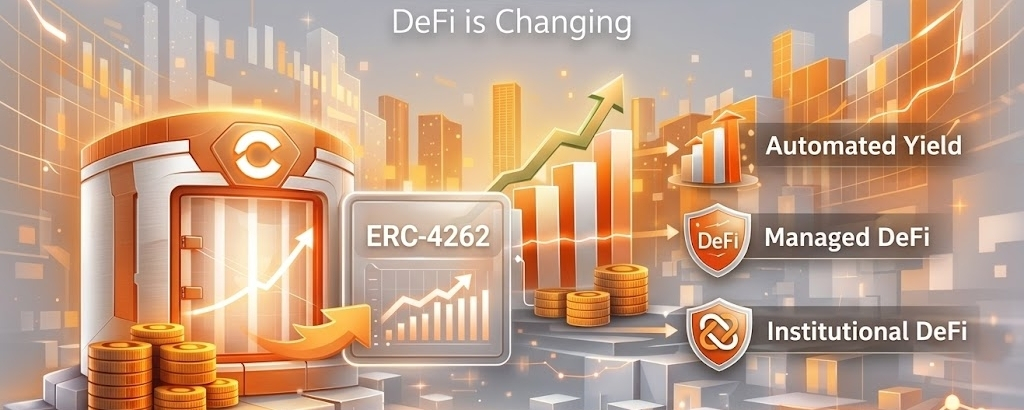
What makes this interesting is the mechanism itself, not just the branding around it. ERC-4626 matters because it standardizes how tokenized vaults interact across DeFi, which removes a huge amount of fragmentation in yield strategies. Most people think of AI in crypto as prediction models, trading bots, or automated agents chasing short-term returns. But I think the bigger shift is that AI systems are slowly becoming operational infrastructure for managing financial flows on-chain. If @OpenLedger combines attribution-based AI systems with standardized vault architecture, the token doesn’t just sit inside an ecosystem narrative anymore it potentially becomes part of how automated capital coordination works. That changes the value proposition entirely. The market still treats AI x DeFi as mostly experimental, partly because previous cycles were filled with unsustainable “AI trading” products that generated attention but not durable utility. What’s different here is the focus on verifiable contribution and structured interoperability. In OpenLedger’s model, value isn’t only generated from speculation around AI outputs. It can theoretically flow through coordinated systems where contributors, models, strategies, and execution layers interact transparently. That’s a very different architecture from the black-box yield systems DeFi users are used to. I’ve also noticed a broader trend where protocols integrating standardized infrastructure tend to attract builders faster because developers don’t want isolated ecosystems anymore. They want composability. They want plug-and-play liquidity, standardized accounting, and automation compatibility. ERC-4626 may sound technical on the surface, but structurally it reduces friction between protocols, which is exactly how ecosystems compound over time.
The part I think the market still underestimates is timing. AI infrastructure and DeFi infrastructure are maturing simultaneously, and eventually those two layers were always going to intersect. The question was never whether AI would participate in on-chain finance. The real question was whether there would be a transparent framework for coordinating it. If OpenLedger keeps building around attribution, interoperability, and standardized vault mechanics, it could position $OPEN closer to an infrastructure asset than a simple AI speculation token. That distinction matters because infrastructure narratives usually expand slowly, then suddenly become essential once ecosystem dependency forms around them. I’m not saying adoption is guaranteed, and I’m still watching whether real usage grows beyond early experimentation. But the design direction makes more sense to me now than most of the short-lived AI tokens that exploded last cycle. Markets are still pricing narratives. Meanwhile, some projects are quietly designing systems. That gap between perception and architecture is usually where the best asymmetric opportunities emerge. This isn’t about AI hype cycles. It’s about building financial coordination rails for autonomous on-chain economies.