
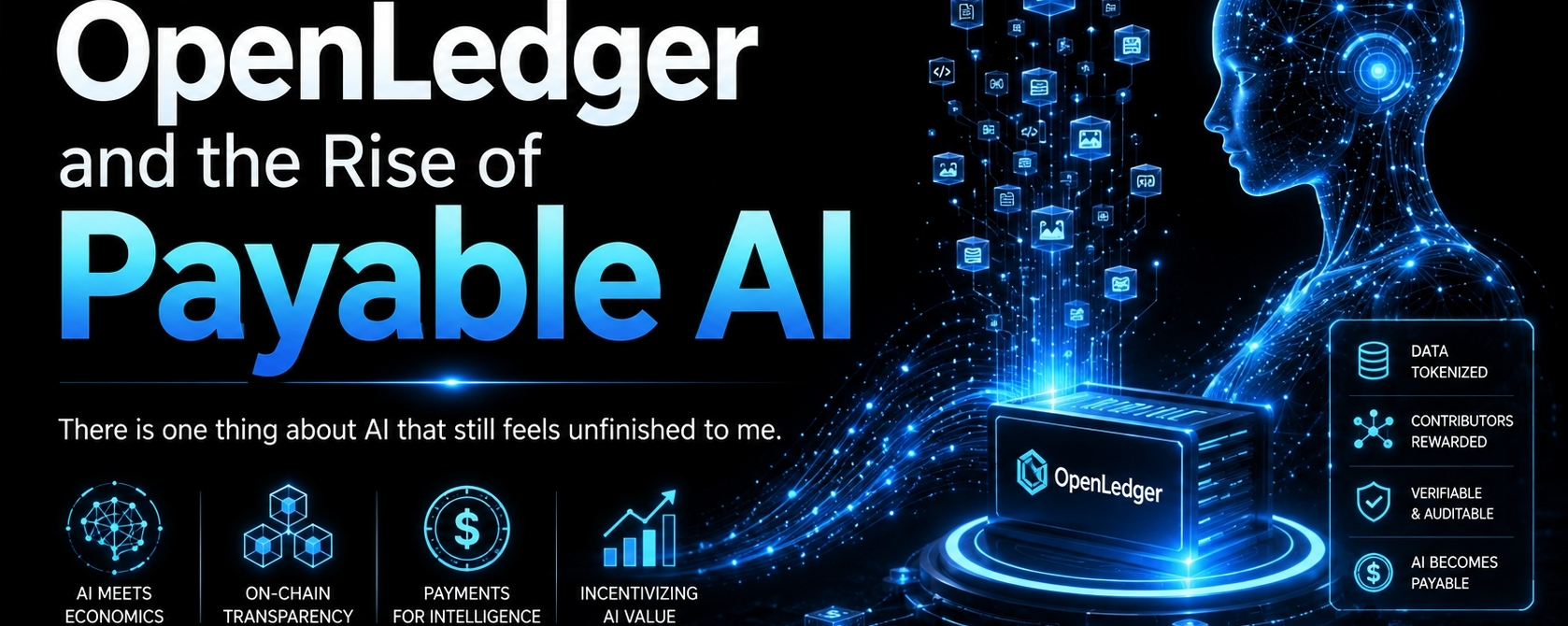

@OpenLedger #OpenLedger #OpenLedgers $OPEN
We keep talking about intelligence as if it appears from nowhere. A model answers a question, an agent completes a task, a system generates something useful, and the entire trail behind that output disappears. The data that shaped it, the people who contributed knowledge, the builders who fine-tuned it, and the networks that made it usable all fade into the background.
OpenLedger is interesting because it starts from that missing trail.
It is not just asking whether AI can become more powerful. It is asking whether AI can become economically honest.
That is where the idea of “Payable AI” begins.
To me, Payable AI means intelligence that does not only produce value, but also knows where that value came from. It is AI with a memory of contribution. AI that can recognize the dataset, the model, the agent, or the human input behind an output, and then turn that recognition into payment.
That sounds simple, but it challenges one of the biggest habits of the current AI economy: taking contribution seriously only after value has already been captured.
Most AI systems feel clean on the surface. You type something, receive an answer, and move on. But underneath that clean experience is a messy supply chain.
Someone created the data.
Someone organized it.
Someone cleaned it.
Someone trained or improved the model.
Someone built the agent.
Someone validated the results.
Someone gave the system the context that made it useful.
Yet in most cases, the final output gets all the attention while the contributors remain invisible.
This is the part OpenLedger is trying to bring into the open. Its core idea is that data, models, and agents should not be treated like background material. They should be treated like productive assets.
A useful analogy is not a search engine or a chatbot. It is a music track.
When a song earns money, there is usually a rights structure behind it. The singer, producer, songwriter, label, and publisher may all have different claims. The system is not perfect, but at least the culture accepts that creative output has a contribution chain.
AI does not have that culture yet.
OpenLedger is trying to build something closer to that for machine intelligence.
Not in a loud, marketing-heavy way where everything is called revolutionary. More like a settlement layer quietly asking: if this AI output created value, who helped create that value?
The obvious use case is rewards. If someone contributes valuable data, they should be paid when that data helps train or improve a model.
But attribution is bigger than payment.
Attribution changes behavior.
When contributors know their work can be traced and rewarded, they have a reason to provide better data. When bad or low-quality data can be identified, the system has a reason to reject it. When models can be linked back to the resources that improved them, users get more transparency. When agents act using specific models and datasets, the network has a clearer record of what powered those actions.
That is why OpenLedger’s Proof of Attribution is important. It is not just a technical label. It is the attempt to make contribution measurable inside the AI workflow.
Without attribution, AI becomes a black box that absorbs everything and pays almost nothing back.
With attribution, AI starts to look more like an economy.
The part of OpenLedger that deserves more attention is the Datanet.
A Datanet is not just a folder of data. It is a focused data network around a specific domain. That could be finance, law, gaming, robotics, coding, healthcare research, compliance, or any other area where general AI is not enough.
This matters because the future of AI will not only belong to massive general models. It will also belong to specialized intelligence.
A broad model can explain what supply-chain risk means. A specialized model can understand shipment documents, customs exceptions, supplier delays, invoice patterns, and the weird language real businesses use.
A broad model can explain smart contracts. A specialized model can detect dangerous contract patterns from real on-chain history.
A broad model can talk about autonomous agents. A specialized model can help agents operate inside a particular workflow with fewer mistakes.
That is the value of domain-specific data. It makes AI less impressive in a demo and more useful in real work.
OpenLedger’s Datanets are built around that idea. They allow data contributors to support specific AI systems while keeping a record of who contributed what. If the model trained on that Datanet becomes useful, the value does not have to disappear into a closed system. It can flow back toward the contributors.
The way I see it, Datanets are not libraries.
They are closer to farms.
A library stores knowledge. A farm produces recurring value when it is maintained properly. If the soil is bad, the crop suffers. If the contributors are careless, the model weakens. If the data is strong and specific, the system becomes more valuable over time.
That is a much better way to think about AI data. Not as raw material to be scraped once, but as living infrastructure that should keep rewarding the people who improve it.
The OPEN token becomes important because OpenLedger needs a native way to reward and coordinate all this activity.
In a weak AI-token project, the token usually sits outside the product. It exists, but the actual AI workflow could function without it.
OpenLedger is trying to make OPEN part of the workflow itself.
Data contributors need incentives.
Model builders need access and rewards.
Validators need economic alignment.
Users need a way to pay for useful AI outputs.
Agents need rails for execution.
Governance needs a shared unit of coordination.
That is where OPEN becomes more than a market symbol. Its strongest possible role is as the settlement asset for AI contribution.
The key question is simple: can real AI activity create real token demand?
That is the difference between a narrative and an economy.
If people only hold OPEN because AI is a popular sector, the thesis is shallow. But if OPEN becomes connected to data contribution, model usage, inference, agent deployment, staking, validation, and governance, then the token begins to reflect actual network activity.
That is the version of OpenLedger worth watching.
OpenLedger is no longer only presenting a concept. Its ecosystem now includes public infrastructure such as the explorer, staking access, AI Studio, and agent-related products like OctoClaw.
This matters because Payable AI cannot remain theoretical. It needs visible activity. It needs users. It needs models. It needs agents. It needs data networks that people actually want to build on.
The agent side is especially important.
Models answer questions. Agents perform tasks.
Once AI moves from answering to acting, attribution becomes much more serious. If an agent completes a workflow, what model did it use? What data improved that model? Who built the agent? Who validated the output? Who should be rewarded when the agent generates value?
This is where OpenLedger’s framing becomes stronger. Payable AI is not only about paying for training data. It is also about creating an economic record for autonomous work.
That could become very important as AI agents begin handling more real tasks across crypto, finance, research, customer operations, and on-chain automation.
The most compelling thing about OpenLedger is not that it combines AI and blockchain. Many projects do that, and most of them sound the same after a while.
What makes OpenLedger more interesting is that it focuses on a real tension inside AI: value is becoming easier to generate, but harder to fairly distribute.
That tension will only grow.
As AI models become cheaper to run and agents become easier to deploy, more people will build on top of shared intelligence. But the question of ownership will become harder. Who owns the improvement? Who deserves the reward? Who gets paid when a model becomes better because of a community’s knowledge?
OpenLedger is trying to answer that before the problem becomes too large to fix.
That is why I see Payable AI as a stronger phrase than “decentralized AI.” Decentralized AI is about where the system runs. Payable AI is about how value moves.
And value movement is the part that actually determines whether a network survives.
OpenLedger still has difficult questions ahead.
Attribution in AI is not easy. A model output is rarely caused by one single dataset or one single contributor. Measuring impact fairly is hard. Reward systems can be exploited. Low-quality data can flood open networks. Token incentives can attract people who care more about farming rewards than improving intelligence.
There is also the user experience problem.
If attribution makes the AI workflow slower or more complicated, developers may avoid it. The best version of OpenLedger has to make the accounting deep but the experience simple. Builders should not feel like they are filling out forms every time they train a model. Contributors should not need to understand every technical layer to earn from useful data.
The system has to feel natural.
Almost invisible.
That is the real challenge.
Payable AI should not feel like bureaucracy. It should feel like royalties.
OpenLedger is building around a simple but powerful idea: AI should not forget who helped make it useful.
That may sound philosophical, but it is also practical. The AI economy is moving toward agents, specialized models, and domain-specific data. In that world, contribution becomes valuable only if it can be traced. And once it can be traced, it can be priced.
This is why OpenLedger feels different from many AI-token narratives. It is not just trying to make AI more available. It is trying to make AI more accountable.
The project still has to prove that its attribution system can work at scale, that Datanets can attract high-quality contributors, and that OPEN can become deeply connected to real usage rather than surface-level speculation.
But the thesis is worth taking seriously.
Because the next stage of AI may not only be about smarter models.
It may be about models that remember their debts.
And if OpenLedger succeeds, Payable AI could become the missing economic layer between intelligence, ownership, and reward.
