

The Bitcoin market is undergoing a major structural transformation that goes beyond price action itself. One of the clearest signals is the sharp decline in retail investor activity visible on-chain.
According to CryptoQuant analyst Darkfost (@Darkfost_Coc), BTC inflows to Binance from retail investors — defined as holders with less than 1 BTC — have fallen to their lowest level ever recorded (see attached chart: Binance Retail Inflow). The monthly average retail BTC inflow now stands at only around 314 BTC. For comparison, inflows peaked near 5,400 BTC in 2018, around 2,600 BTC in 2021, and approximately 1,200 BTC during the first local top in March 2024.
At first glance, it may appear that retail investors are simply disappearing from the market. However, the reality is more nuanced. The key change is not necessarily that individuals stopped buying Bitcoin, but that the way they gain exposure to BTC has fundamentally changed.
In previous cycles, retail investors primarily bought BTC directly through exchanges like Binance or Coinbase. Today, a growing portion of capital flows through spot Bitcoin ETFs. Instead of self-custody, many investors now access BTC through brokerage accounts and institutional products offered by firms such as BlackRock and Fidelity.
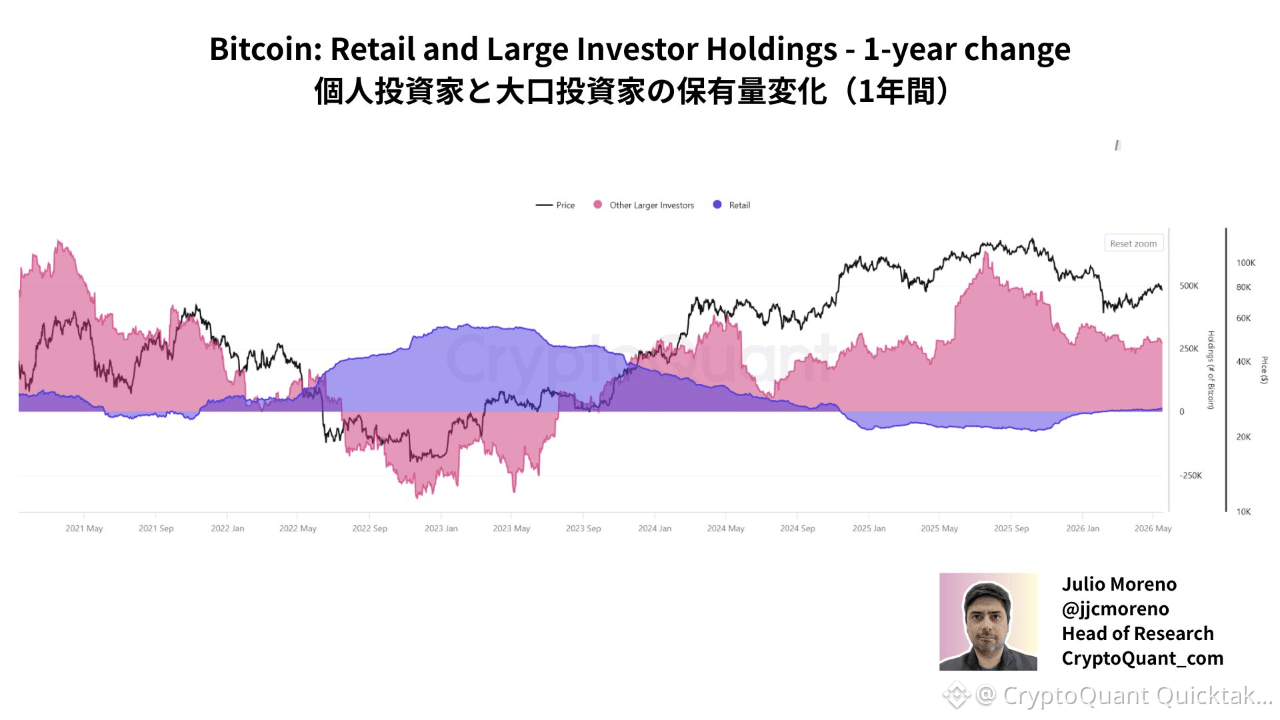
This structural shift can also be seen in the chart “Bitcoin: Retail and Large Investor Holdings - 1-year change.” Retail accumulation surged during the 2022–2023 bear market, while large investors reduced exposure. Since 2024, however, the trend has completely reversed. Large investors and institutional participants have rapidly accumulated BTC, while retail participation has weakened significantly.
As a result, Bitcoin is increasingly behaving less like a speculative retail-driven asset and more like a macro liquidity asset influenced by ETF flows, interest rates, derivatives positioning, and global liquidity conditions.
Written by XWIN Japan