
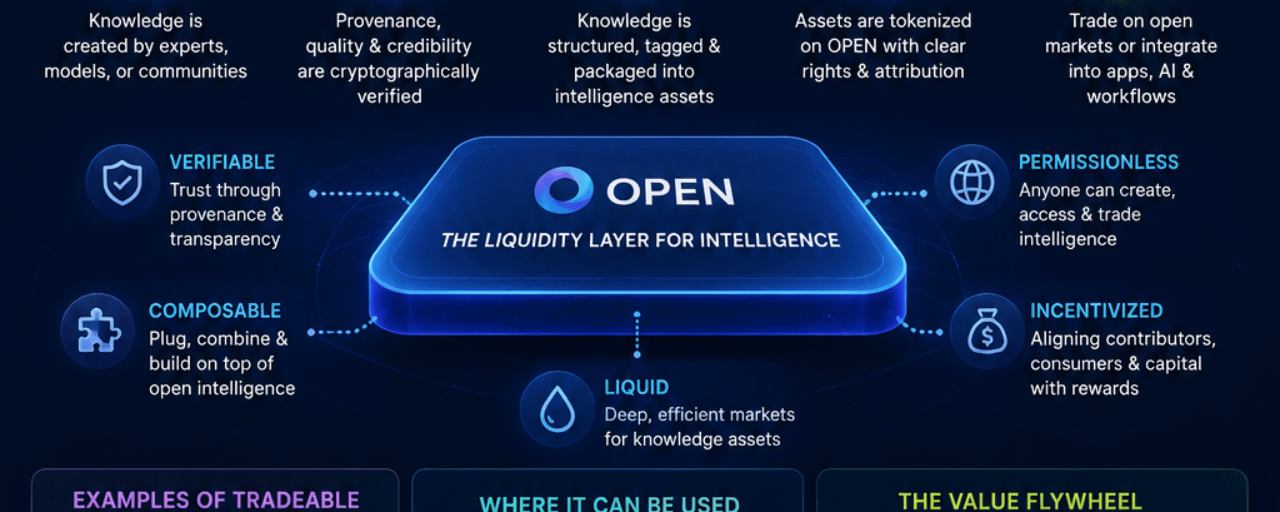
Somewhere between the AI boom and the latest infrastructure cycle, crypto quietly started chasing something much bigger than compute. It started chasing ownership over intelligence itself.
I remember the first night I went through OpenLedger’s documentation because I initially thought it was another predictable AI infrastructure trade. The market has seen dozens of those already. Most of them package the same narrative differently: decentralized compute, decentralized data, decentralized inference. Useful themes, but still familiar. What made me pause with OPEN was not the technical architecture. It was the economic direction hiding underneath it.
The protocol seems to be asking a much stranger question than most people realize. What happens if useful knowledge becomes liquid in the same way capital became liquid through DeFi?
That idea sounds abstract at first, but the market implications are massive.
Crypto already turned idle capital into productive capital. Ethereum normalized programmable assets. DeFi transformed passive holdings into yield-generating instruments. Liquidity pools turned dormant tokens into active market infrastructure. Stablecoins made dollar mobility feel native to the internet. The next logical layer may not be financial capital at all. It may be human intelligence.
That is the part of the OPEN thesis I keep returning to.
Most internet platforms extract value from human contribution without allowing contributors to directly own the economic upside of the systems they improve. People train recommendation engines, moderation systems, search algorithms, and AI models every single day without thinking about it. The value accumulates at the platform level while the contributors remain economically disconnected from the intelligence they help create.
OpenLedger appears to be trying to reverse that relationship by turning knowledge contribution into an on-chain economic activity instead of invisible digital labor.
From a trader’s perspective, that changes the way the token should be analyzed. I do not think the real question is whether OPEN has advanced technology. Infrastructure markets are full of technically capable projects that never achieved durable network behavior. The real question is whether the protocol can create repeated economic participation after the speculative phase cools down.
That distinction matters because crypto markets are extremely good at pricing narratives temporarily and extremely ruthless at exposing weak retention later.
I have seen this cycle enough times to recognize the pattern. Early liquidity arrives before the network proves demand. Traders position around future adoption rather than current usage. Volume spikes. Social engagement explodes. Then eventually the market begins asking harder questions. Are users staying? Are developers building because the network solves a real coordination problem or because incentives temporarily make participation profitable? Is the token circulating through actual economic activity or mainly through speculative rotation?
This is where the OPEN model becomes interesting to study.
The protocol is not just trying to tokenize participation. It is trying to create an economy where intelligence itself behaves like a productive asset. That sounds subtle, but economically it is very different from most infrastructure tokens. Traditional networks often rely on predictable loops. Validators secure the system. Users pay fees. Developers build applications. Token holders speculate on growth.
An intelligence network is structurally more fragile because the core resource constantly changes in value. Knowledge is dynamic. Human expertise evolves. Context shifts rapidly. AI systems require continual refinement to remain useful. That means OpenLedger cannot survive purely through static network effects. It needs constant inflows of valuable contribution.
In practical terms, the network only works if contributors repeatedly decide that participating is economically rational.
That is much harder than attracting one-time activity.
The more I think about it, the more I believe the success or failure of OPEN depends less on technical throughput and more on behavioral retention. Markets underestimate this constantly. Sustainable networks are not created by attention alone. They are created by repeated human behavior becoming economically habitual.
That is why I am watching contributor retention far more closely than headline metrics.
Anyone can attract temporary activity with emissions and incentives. Crypto history is full of networks that looked unstoppable during subsidy phases and collapsed the moment rewards compressed. Real durability appears when participation continues even after the easy incentives fade.
This is where the liquidity layer concept becomes important.
Liquidity is usually discussed in trading terms, but at a deeper level liquidity simply reduces friction between effort and economic reward. DeFi reduced friction for capital deployment. OpenLedger is attempting to reduce friction for intelligence monetization. If successful, contributors may eventually treat specialized knowledge the same way liquidity providers treat productive capital.
The challenge is that human behavior is unpredictable.
Most people still do not think of their expertise as an asset class. They understand salaries and freelance work. They understand content monetization. But turning recurring intelligence contribution into a tradeable economic primitive requires an entirely new behavioral framework. The market may be underestimating how long that transition could take.
At the same time, if the model works even partially, the upside becomes structurally different from a typical AI narrative token.
Because the network effect would not come from speculation alone. It would come from intelligence compounding inside the system. Every useful contribution potentially increases the value of future contributions. Every developer integrating the network potentially creates additional demand for contributors. That creates the possibility of recursive economic behavior instead of simple transactional usage.
Still, this is where caution matters.
The design can make conceptual sense while the economics remain unproven. That is an inference, not a conclusion.
I also think traders need to separate AI excitement from actual network utility. The broader market currently rewards almost anything connected to artificial intelligence, but speculative attention is not the same as durable demand. If OPEN eventually becomes dependent on emissions instead of organic participation, the token could face the same structural problems that damaged previous infrastructure cycles.
Are contributors remaining active because they believe the network creates long-term economic opportunity or because short-term rewards temporarily outweigh the risk? Are developers repeatedly sourcing intelligence from the network after initial testing?
Those signals matter more than aggressive projections.
Binance exposure and liquidity visibility can accelerate market discovery for OPEN, but exchange liquidity alone cannot sustain a network economy. Eventually the market begins looking beneath price action. It starts measuring behavioral consistency. Repeated usage becomes more important than narrative velocity.
I think the strongest future signal for OpenLedger would not be explosive growth. It would be stable recurring participation across multiple market conditions. That would suggest the network is creating genuine economic coordination rather than temporary excitement.
A useful chart here would probably compare contributor retention against token emission dependency over time. Another strong visual would track recurring developer demand instead of raw user acquisition. Those metrics reveal whether intelligence inside the network is becoming economically sticky.
At its core, the OPEN thesis is not simply about AI infrastructure. It is about whether crypto can build a functioning market around human intelligence itself. That is a far more difficult challenge than tokenizing compute or data storage because intelligence is emotional, contextual, inconsistent, and deeply tied to human incentives.
But if the system succeeds, the implications become enormous. It would mean knowledge is no longer just consumed by platforms. It becomes a liquid economic layer owned and circulated by participants themselves.
That is why I think traders watching OPEN should stop focusing only on price expansion and start watching behavior. Watch whether contributors return after rewards normalize. Watch whether developers continue integrating the network after experimentation ends. Watch whether participation deepens quietly instead of exploding loudly.
Because the real test for a liquidity layer is never hype. The real test is whether economic activity survives once attention disappears.