
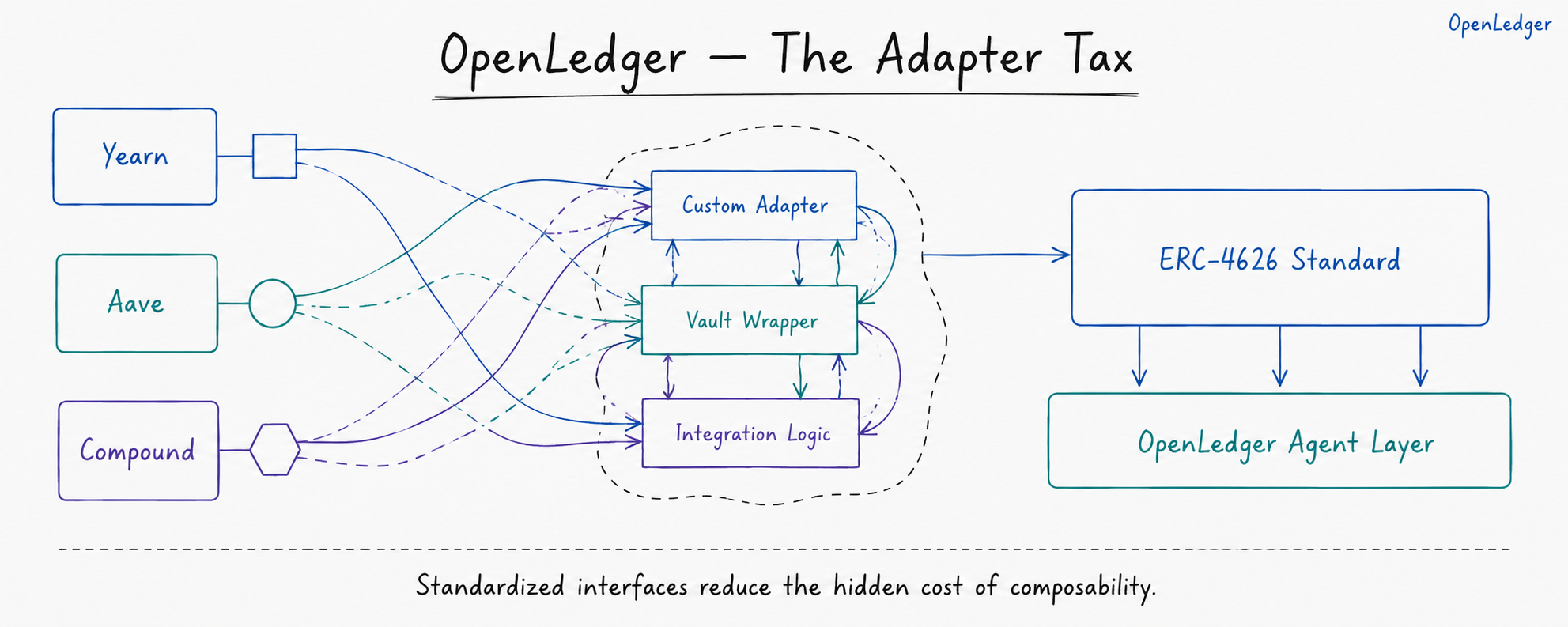


I once spent three days writing integration code for a yield aggregator.
Not strategy logic.
Not risk models.
Not the actual product.
Just the plumbing required to make three different vault interfaces reach the same function.
Deposit assets.
Earn yield.
Withdraw.
Same operation.
Completely different implementations.
Yearn handled deposits one way.
Aave handled them another.
Compound used something else entirely.
Each integration needed its own adapter.
Each adapter expanded the audit surface.
Each audit surface created another place something could fail.
Three days of engineering for functionality that should have shared one interface from the start.
I keep thinking of that as the adapter tax.
The engineering cost developers pay every time DeFi protocols build incompatible vault architectures without agreeing on a common language first.
The adapter tax compounds quietly.
It isn't just development time.
Every custom adapter increases surface area.
A mistake inside one integration can ripple through every system depending on it downstream.
Every new protocol connection expanded the fragility a little further.
Before ERC-4626, this was normal infrastructure work.
You wanted composability.
You paid the adapter tax.
You hoped the adapters survived production traffic.
The alternative was staying siloed and giving up the composability that made DeFi interesting in the first place.
ERC-4626 changed the problem at the interface layer.
One deposit structure.
One withdrawal structure.
One share accounting model.
Protocols implementing the standard speak the same vault language.
Aggregators stop rebuilding integrations from scratch every time they touch a new protocol.
The plumbing becomes inherited infrastructure instead of duplicated engineering work.
That's where OpenLedger's ERC-4626 adoption sits differently for me.
Not just as compatibility.
As a requirement for AI managed capital to move across DeFi cleanly.
Before standardized vaults, an AI agent managing yield across protocols needed protocol specific logic underneath every interaction.
Different deposits.
Different accounting.
Different withdrawal flows.
The agent's intelligence wasn't the bottleneck.
The interface fragmentation was.
ERC-4626 removes a large part of that constraint.
An OpenLedger agent interacting with compliant vaults no longer needs to understand every custom implementation detail just to move capital between strategies.
The ERC-7540 extension matters for the same reason.
Standard ERC-4626 assumes synchronous settlement.
Deposit assets.
Receive shares.
Done.
AI agents don't always operate synchronously.
They batch execution.
Adjust positions across time windows.
Settle asynchronously while conditions shift underneath them.
ERC-7540 extends the vault framework to support async settlement flows without breaking the interface structure itself.
OpenLedger put it directly.
Yield stops looking like a static strategy outcome.
It starts looking like continuous execution.
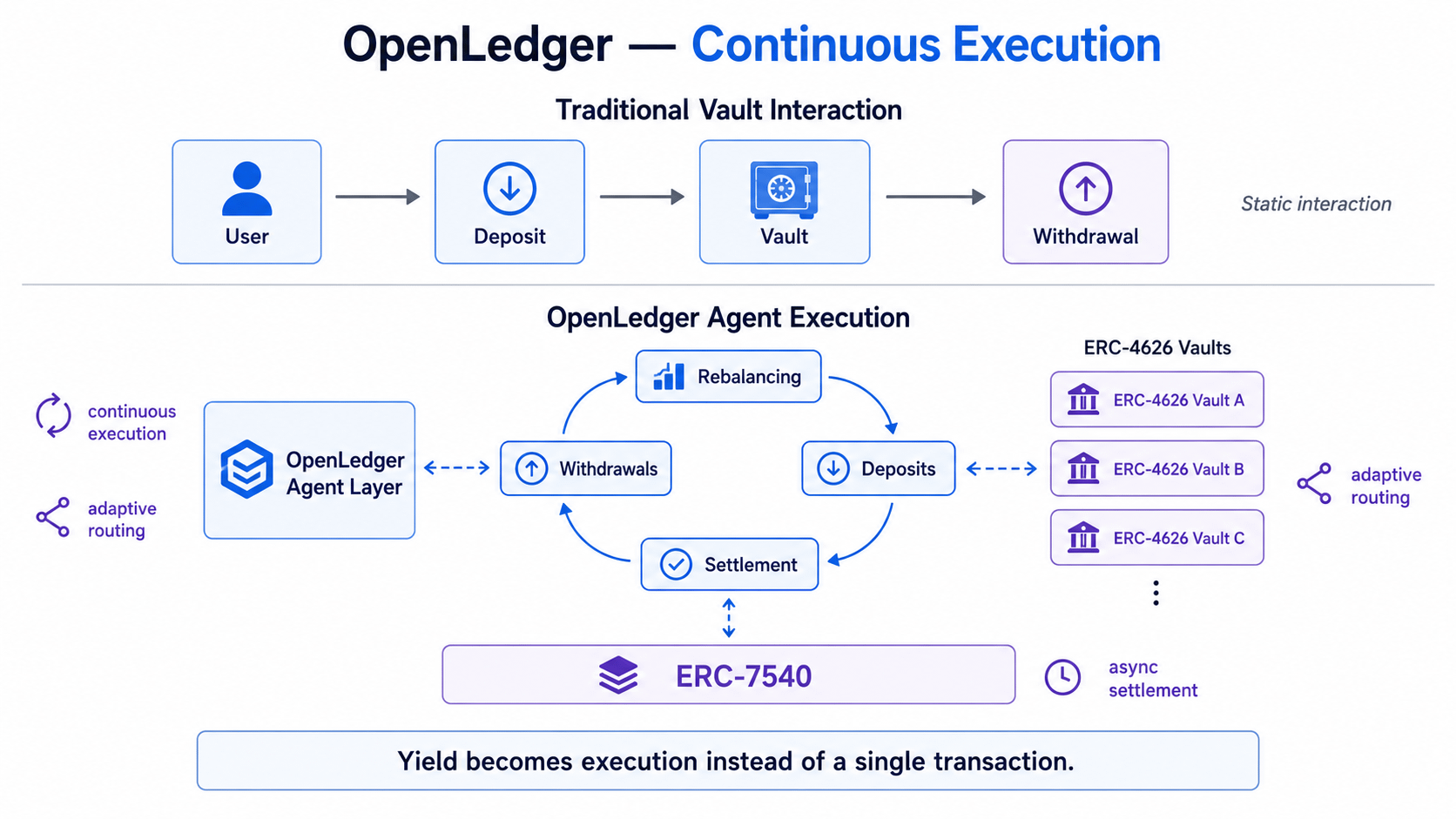
An agent operating inside infrastructure designed for that behavior instead of fighting against it.
$OPEN flows through this mechanically.
Every vault interaction on OpenLedger, deposits, withdrawals, rebalancing, attribution events, requires $OPEN as gas.
Standardized vault infrastructure means more protocols can integrate with OpenLedger's agent layer without custom adapter work slowing the process down.
More composability creates more vault interactions.
More vault interactions create more execution.
More execution creates more $OPEN demand.
The adapter tax disappearing isn't just a developer quality of life improvement.
It's part of what makes OpenLedger's agent economy reachable by the DeFi infrastructure that already exists.
But standardization doesn't solve everything.
ERC-4626 creates a shared interface.
It doesn't create shared behavior underneath it.
Two compliant vaults can still behave very differently once markets become unstable.
Different liquidation mechanics.
Different risk assumptions.
Different behavior under stress.
An agent composing across compliant vaults still has to understand what exists underneath the standard itself.
The adapter tax gets reduced.
The need for intelligent execution doesn't disappear with it.
I don't know yet how far OpenLedger's execution layer has gone in solving that second problem.
But I know the first one, the plumbing, is cleaner than it's been before.
And that alone changes what's realistically buildable.