
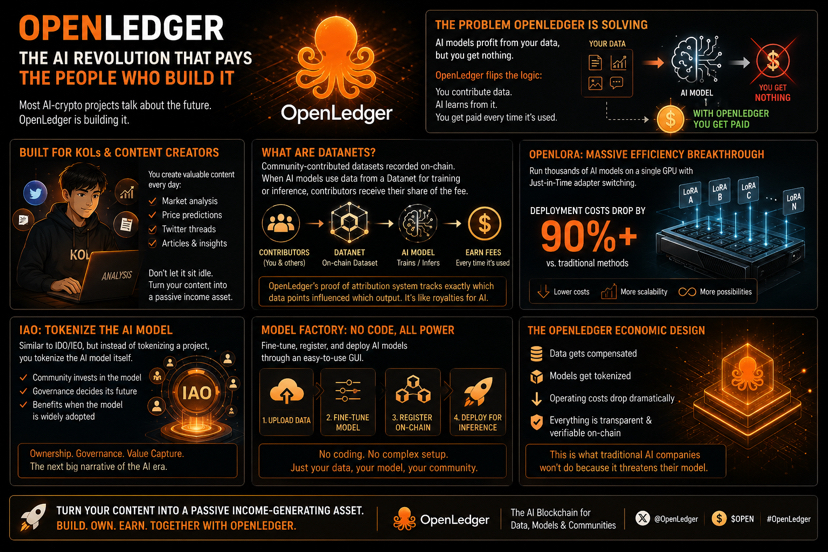
Honestly, it took me about two hours sitting and reading through OpenLedger's whitepaper before it really sank in, not because it was difficult, but because it was... different. Different in the sense that they're solving a problem most of us know exists but nobody has really been willing to touch, and that's the question of who actually owns AI data, and what do the people who created it actually get in return.
I'm a small KOL, I create content every day, and if there's one thing I understand clearly it's the value of information and the effort it takes to produce it. Now imagine you're contributing data, say your market analysis posts, your price predictions, or even your Twitter threads, to an AI model. That AI learns from you, but you get nothing back. Sound familiar? That's the reality of the entire AI industry right now, and OpenLedger wants to flip that logic on its head.
What OpenLedger calls Datanets is actually quite interesting when you look at it from a content creator's perspective. Each Datanet is a community-contributed dataset recorded on-chain, meaning every time an AI model uses data from that Datanet to generate a response or run inference, the people who contributed that data receive their corresponding share of the fee. This isn't theory, OpenLedger has already built a proof of attribution system to track exactly which data points influenced which specific output. It's like royalties in music, you write a riff, someone samples it, you get paid every time it plays.
Now let's think about this a bit more practically. I'm speaking directly to KOLs here, especially those of you building an audience in crypto or finance. Say you have a library of market analysis, articles, threads, hundreds of insight posts you've created over years. Instead of letting it sit idle on Binance Square or Twitter, OpenLedger lets you contribute that library into a Datanet specializing in financial analysis. When developers use that Datanet to train or fine-tune their models and those models run inference for users, you receive a portion of the inference fees. No coding required, no need to understand AI, you just need your data to be high enough quality.
OpenLedger also has OpenLoRA, a system that allows thousands of AI models to run on a single GPU through Just-in-Time adapter switching. Deployment costs drop by over 90% compared to traditional methods. This matters because it means the barrier to building a specialized AI model is no longer just a problem for well-funded teams. A small community, a KOL with a few tens of thousands of followers, can absolutely come together to build and run their own AI model without burning money on servers.
And then there's the Initial AI Offering, or IAO. Similar to IDOs or IEOs many people already know, but instead of tokenizing a project, you tokenize the AI model itself. The community can invest in that model's development, participate in governance to direct how it gets trained further, and benefit when the model gets widely adopted. I think this is an incredibly strong narrative for the next bull cycle, not just generic "AI coins" but actual ownership within an AI ecosystem.
Model Factory solves the technical problem for people who don't know how to code. The entire workflow of fine-tuning a model, registering it on-chain, and deploying it for inference can all be done through a GUI interface. OpenLedger is turning something that was previously only for engineers into something anyone with an idea and data can access.
What I find truly different about OpenLedger isn't the technology, though the technology is quite solid, it's the economic design. Data gets compensated, models get tokenized, operating costs drop significantly, and everything can be traced back on-chain. This is exactly what traditional AI companies are deliberately avoiding because it threatens the business model of the giants.
If you're a KOL thinking about diversifying not just through trading but by turning your content into a passive income-generating asset, OpenLedger is something genuinely worth spending serious time researching. @OpenLedger $OPEN #OpenLedger