
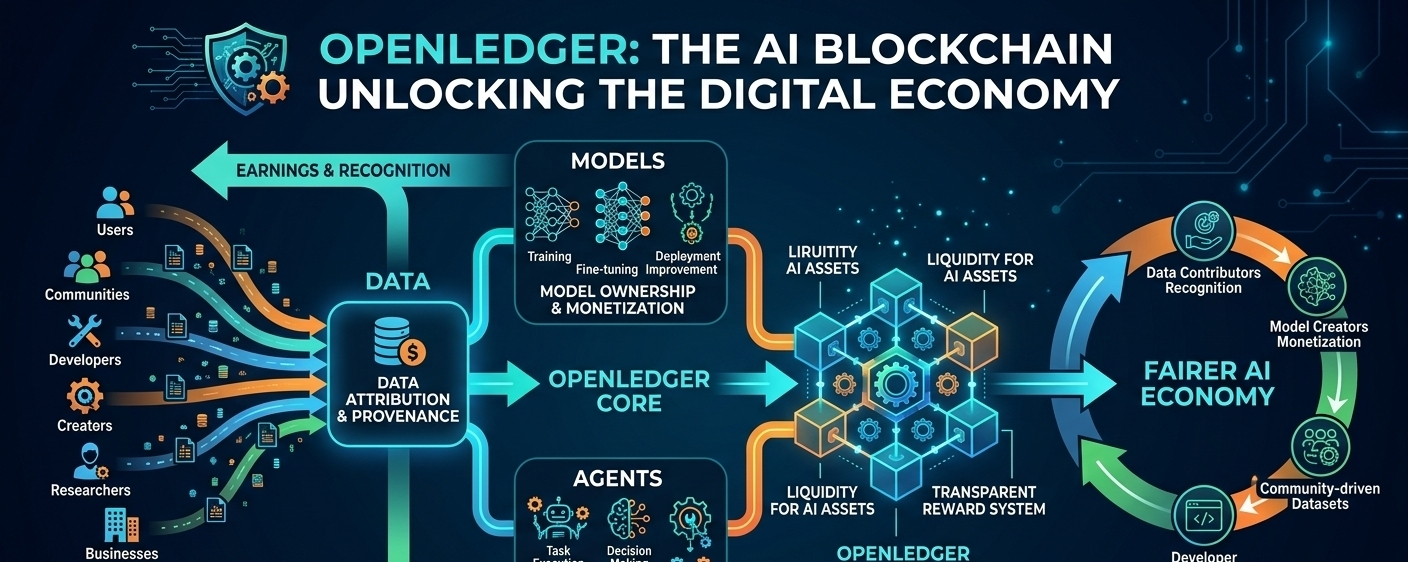

OpenLedger is one of those projects that sounds complex at first, but the main idea is actually very simple. It is trying to answer a question that will become more important as AI grows: if data, models, and agents create value, who should earn from that value?
Today, most AI systems are built using massive amounts of data. That data can come from users, communities, developers, creators, researchers, and businesses. But once the data is used, the original contributors often disappear from the value chain. They may help train powerful AI systems, but they rarely get credit or rewards.
OpenLedger wants to change that.
At its core, OpenLedger is an AI-focused blockchain built to unlock liquidity for data, models, and agents. In simple words, it wants to make AI assets easier to own, track, use, and monetize. Instead of data sitting silently in the background, OpenLedger wants to turn it into something measurable and valuable.
The project’s biggest idea is attribution. If a dataset helps train a model, and that model later creates value, OpenLedger wants the system to recognize that contribution. This could allow contributors, model builders, and agent creators to earn from the AI economy in a more transparent way.
That is why the project feels exciting. It is not only talking about AI hype. It is trying to build an economic layer around AI itself.
One important part of OpenLedger is its focus on data. In the AI world, high-quality data is like fuel. Without good data, models become weak, inaccurate, or generic. OpenLedger aims to support specialized datasets that can power better AI models for specific industries and communities.
Another key part is models. AI models are becoming digital assets. People train them, improve them, fine-tune them, and use them in apps. OpenLedger wants these models to have clearer ownership and monetization paths.
Then there are agents. AI agents are software systems that can perform tasks, make decisions, interact with tools, and even work across blockchain networks. If agents become a major part of the future internet, then tracking their activity and value will be very important. OpenLedger is positioning itself for that future.
The benefit is clear. If OpenLedger works well, it could create a fairer AI economy. Data contributors could get recognition. Developers could build on trusted AI assets. Model creators could monetize their work more easily. Communities could create valuable datasets instead of giving everything away for free.
But the challenges are also real.
The first challenge is technical. AI attribution is not easy. A model may learn from millions or billions of data points. Proving exactly which data created which value is complicated.
The second challenge is adoption. OpenLedger needs real developers, real datasets, real models, and real users. A strong idea is not enough in crypto. The network must create actual demand.
The third challenge is competition. AI blockchain is becoming a crowded space. Many projects are trying to connect AI with decentralization, data ownership, compute, agents, and model marketplaces. OpenLedger must prove that its system is useful, not just interesting.
The fourth challenge is trust. If the project wants to become an important AI economy layer, people will need confidence in its technology, token model, transparency, and long-term execution.
Still, the vision is powerful.
OpenLedger is trying to build a world where AI value does not flow in only one direction. Instead of big platforms capturing everything, the project imagines a more open system where contributors can participate in the upside. Data becomes liquid. Models become monetizable. Agents become productive economic actors.
That is what makes OpenLedger worth watching.
It is not guaranteed to win. No early project is. But the problem it is attacking is real, and the timing is important. AI is growing fast, and the question of ownership will only become louder.
In the end, OpenLedger feels like a project built around a simple but serious belief: intelligence should have an economy, and the people who help create that intelligence should not be invisible.
If OpenLedger can turn that belief into working infrastructure, it could become one of the more meaningful bridges between AI and blockchain. If not, it will still be part of a bigger conversation that the tech world can no longer ignore.