
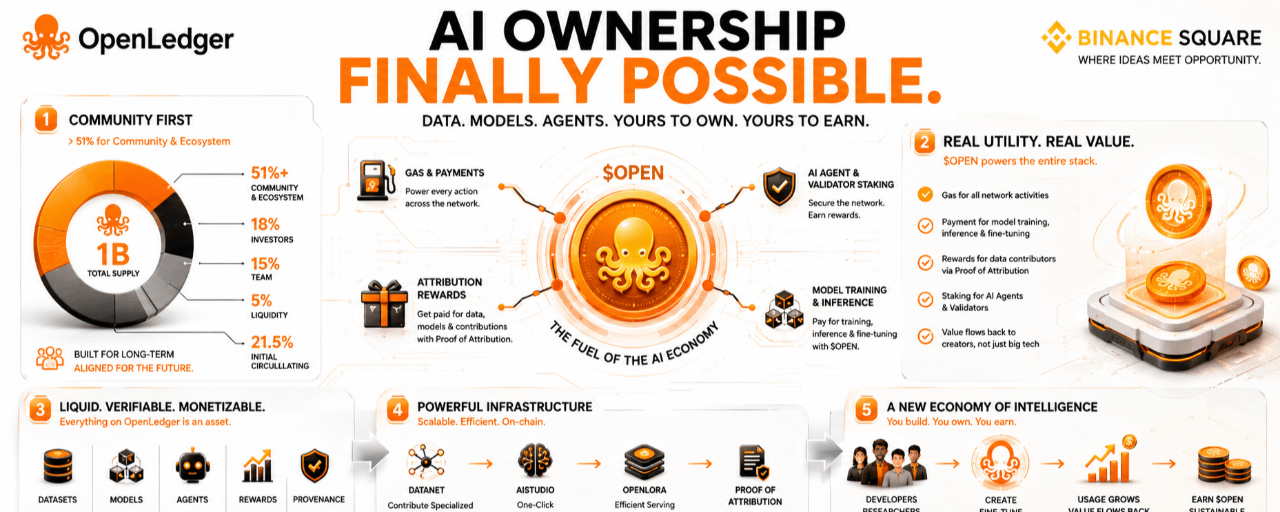
I have been digging into @OpenLedger for the past week and the more I read about its tokenomics and architecture the more i realize this project is solving a problem most people in ai and web3 have quietly accepted as unsolvable.
Most AI today is a black box. 💻

You use the model but you never really own it. You contribute data but you rarely get rewarded fairly. openledger flips that entire dynamic by making data models and agents liquid verifiable and monetizable assets on chain. the native token $open sits at the center of this new economy and its design feels deliberately built for long term sustainability rather than short term hype.
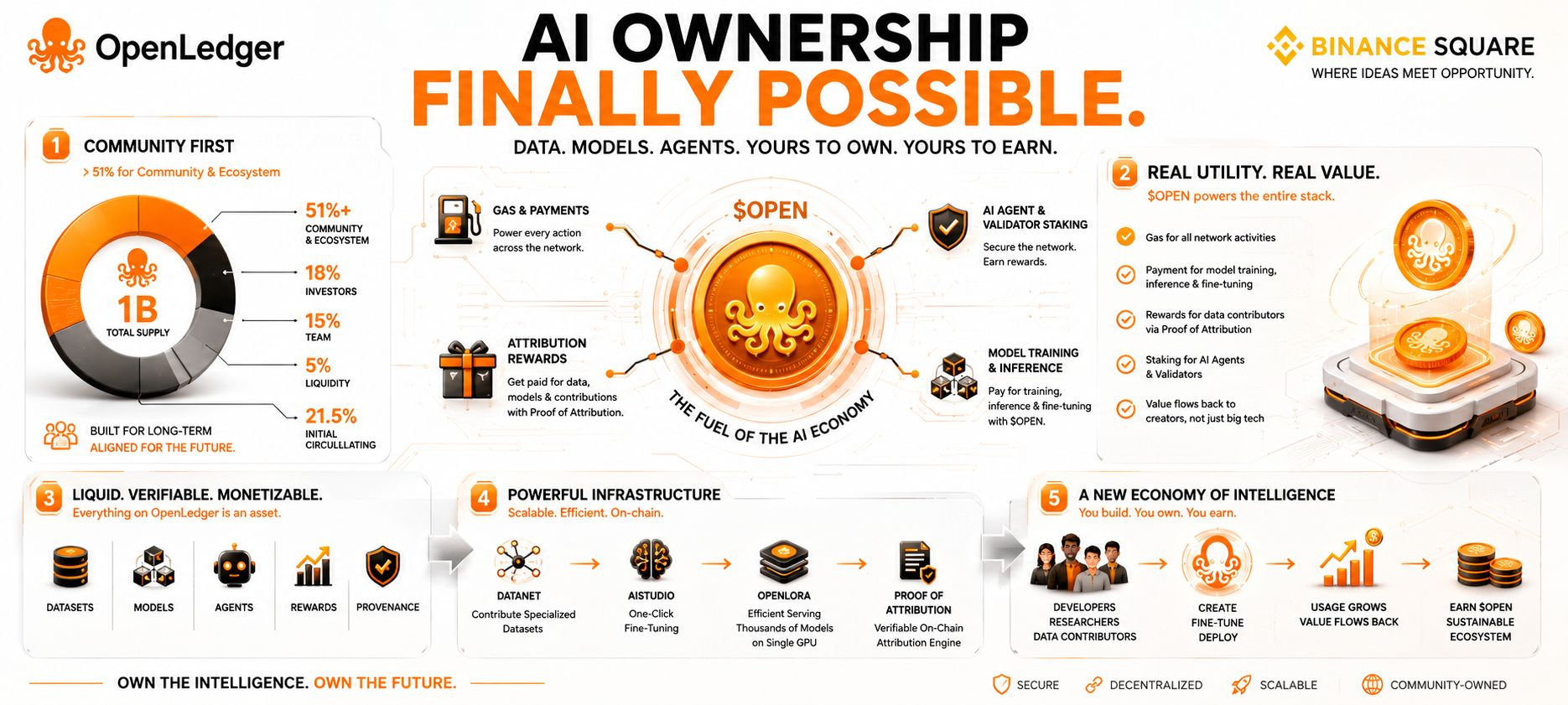
With a total supply of one billion tokens the allocation is heavily skewed toward the community. over fifty one percent goes to community and ecosystem rewards spread over years. this is not the usual team heavy dump structure you see in many projects. instead it creates real incentives for ongoing participation. investors get around eighteen percent team fifteen percent and liquidity five percent. the initial circulating supply sits at roughly twenty one point five percent which gives the token room to breathe without immediate massive sell pressure.
What makes the tokenomics truly unique is how deeply open is tied to real utility across the entire stack. it serves as gas for all network activity. it is the payment token for model training inference and fine tuning. it rewards data contributors through the proof of attribution system and it is used for staking by ai agents and validators. every time someone uses a model or dataset on the network the contributors get paid in open based on verifiable on chain attribution. this turns data from something you give away for free into a real economic asset.
The technology behind this is what makes the economics work in practice. the proof of attribution engine records exactly which data which adapter and which model contributed to each inference. combined with openlora’s efficient serving layer that can run thousands of fine tuned models on a single gpu the network can scale without exploding costs. data net lets users contribute specialized datasets and earn rewards when those datasets improve models. aistudio makes fine tuning accessible with one click while maintaining full on chain provenance.
For the openledger community this creates a completely new incentive loop. creators researchers and everyday users can now build fine tune and deploy their own models while earning from usage instead of feeding big tech for free. the ecosystem becomes self sustaining because value flows back to the people who actually create the intelligence.
In the broader web3 ai space openledger stands out because it does not treat AI as a marketing buzzword. it builds the rails for a true ownership economy where intelligence is liquid composable and fairly rewarded. most projects talk about decentralization. openledger is making it economically viable at scale.
I am still early in my journey with the project but the combination of thoughtful tokenomics transparent attribution and efficient infrastructure makes me believe this could become foundational infrastructure for the next wave of ai innovation in web3.
The more i use it the more i see the vision. this is not just another chain chasing AI hype. this is infrastructure designed to let regular people own and profit from the intelligence they help create.
Have you started exploring OpenLedger yet? What part of the tokenomics or architecture surprised you the most