
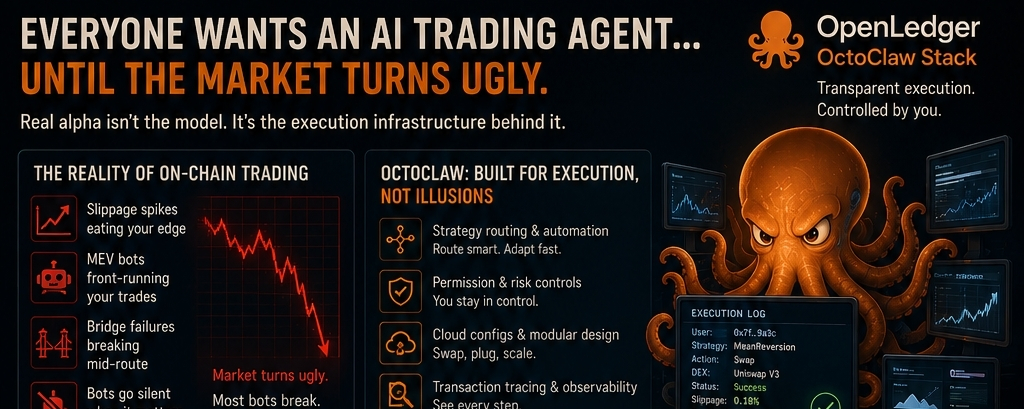


Most one-click trading bots look impressive during calm conditions, but once slippage spikes, MEV bots swarm, or a bridge fails mid-route, the whole system suddenly goes silent. That’s why I started digging deeper into @OpenLedger and its OctoClaw stack. Not because of the AI buzzwords, but because I’m tired of flashy chatbot-style tools pretending they can survive real on-chain chaos.
What caught my attention is that OctoClaw doesn’t market itself like some magic profit machine. Instead, it focuses more on execution infrastructure strategy routing, permission controls, cloud configs, transaction tracing, and keeping the user in control of the critical layers. That approach already feels more grounded than most AI trader projects throwing signals inside a fancy UI.
A lot of on-chain automation tools still behave like black boxes. They trigger trades, move funds, and rotate positions without clearly exposing why a strategy executed, what data triggered it, or where the actual slippage damage happened. In DeFi, blindly trusting a black-box execution layer is basically handing your wallet to probability itself.
OpenLedger seems to be pushing toward a more transparent execution framework instead of hiding everything behind marketing narratives. Strategy templates, data sources, execution permissions, and runtime controls are treated more like visible infrastructure rather than mysterious AI magic. That matters way more to serious users than another chatbot pretending to be a super trader.
I also like that the architecture appears modular instead of tightly glued together. You can swap models, data providers, RPC endpoints, or execution targets without rebuilding the entire stack from scratch. A lot of competing systems completely break the moment an API changes or a provider goes offline. Decoupling those layers is what separates an actual production environment from a temporary demo.
That said, the real risk starts when autonomous agents begin touching real assets through ERC-4626 vaults, cross-chain execution, and automated yield routing. At that point, execution transparency becomes everything. If an agent can move capital but cannot fully explain why it acted or why it refused to act then the AI layer becomes another dangerous black box waiting for a volatility event to expose it.
At the end of the day, the hardest part of AI trading isn’t generating market commentary. It’s maintaining clean boundaries between data, permissions, execution, and capital movement while surviving real network stress. Anyone can build a dashboard. Very few can build reliable execution infrastructure.
That’s why I’m watching projects like #OpenLedger more from an engineering perspective than a hype perspective. In this market, smooth demos mean nothing. Stable execution under pressure is the only thing that actually matters. $ETH