
there was a moment when i almost dismissed openledger completely.
not because the idea sounded impossible, but because it sounded too familiar.
ai. blockchain. liquidity. agents. data monetization.
i’ve watched this industry recycle those words so many times that eventually they stop feeling like concepts and start feeling like marketing gravity. everything gets pulled toward the same language because everyone is terrified of sounding irrelevant. and at first, openledger felt trapped inside that exact cycle to me. another system trying to convince the market that attaching crypto rails to ai infrastructure automatically creates meaning.
but then something strange happened.
the more i followed the project’s evolution, the less it behaved like a normal crypto narrative.
most projects spend their energy trying to manufacture excitement. openledger keeps spending its energy trying to solve attribution. and i think that difference is far more important than people realize.
because attribution sounds boring until you understand what’s actually happening underneath modern ai systems.
right now, almost every major model in existence is feeding on invisible human contribution. not just obvious things like images or articles, but behavioral residue itself. conversations. reactions. corrections. preferences. emotional tone. patterns of attention. billions of microscopic fragments of human cognition absorbed into systems that later generate enormous economic value.
and yet somewhere along the process, the people behind those contributions disappear.
their influence survives.
their visibility doesn’t.
i keep coming back to that.
because the deeper i look into openledger, the more it feels like the project is trying to rebuild visibility itself. not visibility in the social media sense. economic visibility. structural visibility. proof that intelligence did not emerge from nowhere. proof that models are downstream from human contribution. proof that value has ancestry.
and honestly, once i started seeing it that way, the entire project became harder to simplify.
especially recently.
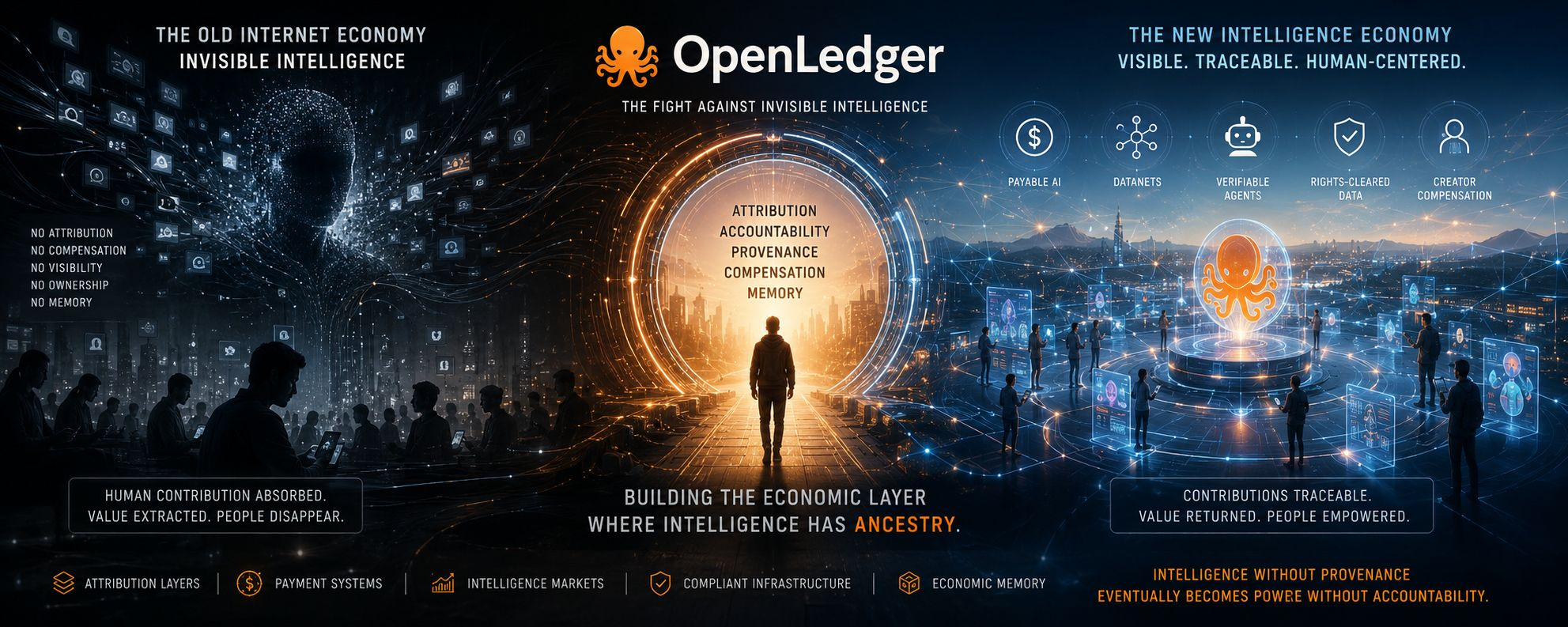
their recent ecosystem expansion around payable ai, datanets, and agent infrastructure changed the emotional texture of the project for me. the system is evolving toward something much larger than token speculation. contributors can now feed datasets into structured economic environments where training, usage, and output attribution become programmable. ai agents operating within the network are increasingly tied to accountability mechanisms instead of existing as black-box abstractions. partnerships around rights-cleared training and creator compensation are pushing the project toward legally traceable intelligence economies rather than anonymous extraction pipelines.
that may sound technical on the surface.
but psychologically, it changes everything.
because once contribution becomes traceable, human behavior changes.
people stop acting like disposable users inside platforms. they start acting like participants inside an economy where their knowledge, creativity, and data have measurable consequence. and maybe that’s the part of the ai revolution that still feels unresolved to me.
everyone keeps talking about smarter models. faster inference. autonomous agents. recursive intelligence.
almost nobody talks seriously about the emotional economy underneath those systems.
what happens to people when intelligence itself becomes automated labor?
what happens when models begin outperforming humans using knowledge extracted from humans who were never compensated in the first place?
what happens when the internet stops being a place humans use and slowly becomes a place machines negotiate with other machines?
the longer i sit with openledger, the more it feels like the project was built around those uncomfortable questions instead of around hype cycles.
and that changes the way i interpret the recent structural developments happening across the ecosystem.
the partnerships are no longer random announcements. they form a pattern. attribution layers. payment systems. verifiable agents. rights infrastructure. compliant data economies. on-chain intelligence markets. it all points toward the same deeper thesis: the future ai economy will eventually require memory.
not memory as storage.
memory as accountability.
memory as economic lineage.
memory as proof of contribution.
because intelligence without provenance eventually becomes dangerous. not only politically or legally, but economically. if nobody can identify where intelligence came from, then power concentrates around whoever owns the largest black box. and history shows that invisible systems almost always centralize value upward while decentralizing risk downward.
maybe that’s why openledger keeps lingering in my mind long after i close the tabs.
it doesn’t feel like a project obsessed with replacing humans.
it feels like a project quietly trying to stop humans from becoming economically invisible inside machine systems.
and i think that distinction matters more than people realize.
especially now, while the industry is still distracted by surface-level narratives. price action. token rotations. ai agent memes. speculative mania. everyone keeps staring at outputs while ignoring the architecture underneath them.
but architecture determines power.
always.
who owns intelligence. who tracks contribution. who receives compensation. who controls memory. who disappears from the system entirely.
those questions are slowly becoming more important than the models themselves.
and maybe that’s the realization i wasn’t expecting when i first looked into openledger.
i thought i was studying another ai-blockchain experiment.
instead, i think i was accidentally staring at an early attempt to redesign the economic relationship between humans and intelligence itself.
and honestly, i still don’t know if the market fully understands how big that idea actually is.