
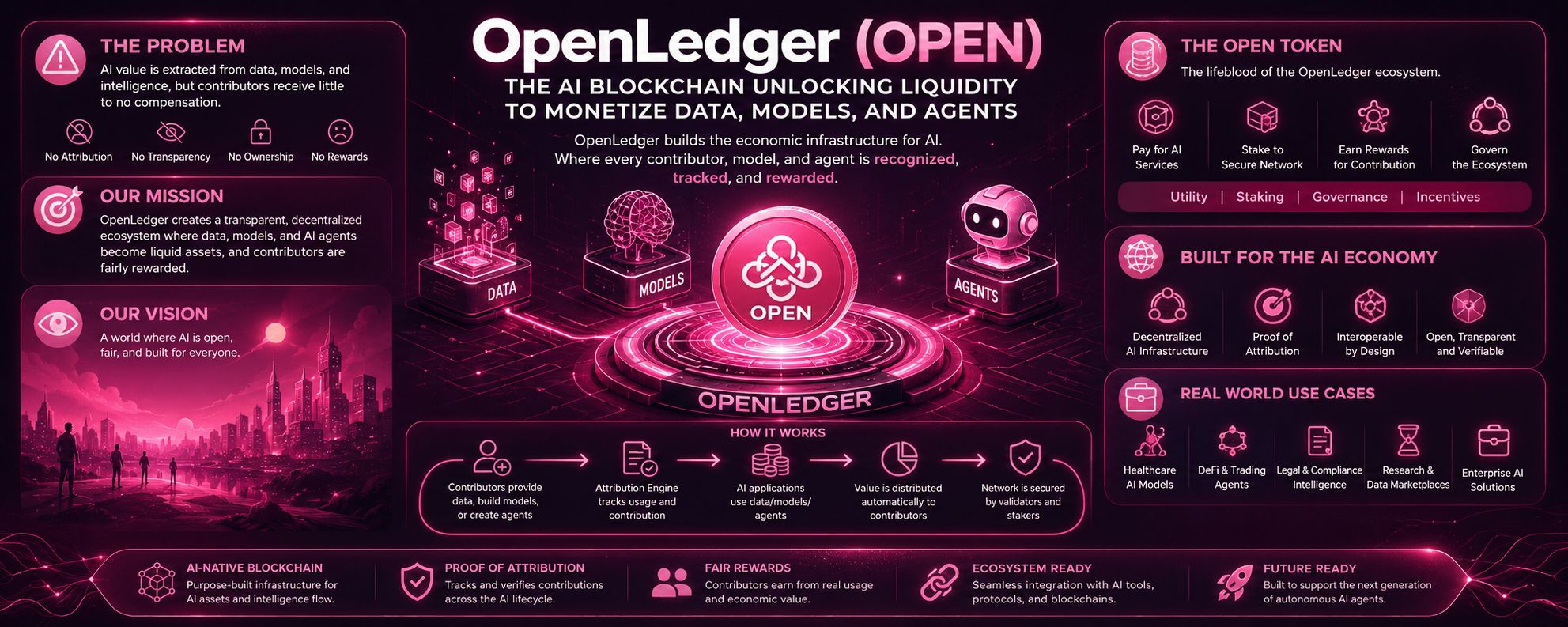

OpenLedger is entering the market at a time when both artificial intelligence and blockchain are going through an identity shift. AI is becoming one of the most powerful industries in the world, but the structure behind it remains deeply centralized. A handful of companies own the infrastructure, the models, the distribution, and most importantly, the economic upside. At the same time, millions of people unknowingly contribute value every day through data, research, interactions, and content, yet almost none of them participate in the wealth created from that intelligence.
That imbalance is the foundation of OpenLedger.
The project is not simply trying to become another AI token riding a trend cycle. Its broader ambition is to build an economic layer where data, AI models, and autonomous agents can function as transparent and monetizable assets inside an open network. The core belief behind the protocol is surprisingly simple: if human knowledge and machine intelligence are creating value together, then contributors should not disappear from the equation once the model is trained.
The current AI industry largely operates like a black box. Data flows into massive systems, models are trained behind closed doors, and commercial products emerge without clear visibility into where the underlying intelligence originated. OpenLedger wants to change that dynamic by creating infrastructure where attribution becomes part of the system itself rather than an afterthought. Instead of information being absorbed into centralized AI platforms forever, the project wants contributions to remain traceable and economically connected to future usage.
That idea becomes more important when you look at where AI is heading. Models are no longer just chatbots or research tools. AI is becoming infrastructure for finance, healthcare, customer service, trading systems, legal analysis, robotics, and autonomous digital agents. As these systems become economically valuable, the question of ownership becomes impossible to ignore. Who owns the intelligence? Who gets paid when models generate revenue? And how do you measure contribution in an environment where information constantly overlaps and evolves?
OpenLedger is attempting to answer those questions through blockchain architecture designed specifically for AI activity.
The easiest way to understand the project is to think of it as a specialized network where datasets, models, and AI applications interact inside a transparent economic framework. Traditional blockchains were primarily designed for financial transactions and smart contracts. OpenLedger, however, is trying to build infrastructure optimized around intelligence production itself. In this system, data providers, model developers, validators, and application builders all become participants inside the same economic cycle.
The project places heavy emphasis on attribution. In practical terms, that means trying to track where value inside AI systems comes from. If a model improves because of a specific dataset or contributor, OpenLedger wants that relationship to remain visible rather than disappearing during the training process. The long-term goal is to create an environment where contributors receive rewards tied to the actual usage and success of the models they helped shape.
This becomes particularly interesting when you compare OpenLedger to the dominant AI companies today. Large AI labs operate through scale. They gather enormous amounts of proprietary data, spend billions on compute infrastructure, and train giant generalized models. OpenLedger appears to be moving in a different direction. Instead of focusing entirely on massive universal AI systems, it leans toward specialized intelligence markets. That means smaller, domain-focused models built around finance, healthcare, enterprise operations, legal systems, research environments, or niche industries where targeted expertise matters more than sheer scale.
That distinction could become important in the future because the AI industry may eventually split into two worlds. One world will be controlled by massive frontier models owned by large corporations. The other could consist of specialized decentralized systems optimized for specific industries and communities. OpenLedger is positioning itself closer to the second category.
Another layer of the project revolves around AI agents. The team appears to believe that autonomous software agents will eventually become major economic participants inside blockchain ecosystems. Instead of humans manually interacting with every application, AI systems themselves could execute transactions, consume data, interact with smart contracts, manage digital assets, or provide services autonomously. In that future, blockchain networks become coordination layers not just for people, but also for machines.
This is where OpenLedger starts to feel less like a traditional crypto project and more like an experiment in digital economic infrastructure. The protocol is not only concerned with payments or token transfers. It is trying to build a marketplace where intelligence itself becomes programmable, measurable, and financially connected.
The OPEN token sits at the center of this system. Its role is designed around network participation, staking, incentives, payments, and ecosystem coordination. In theory, as AI applications grow inside the network, economic activity flows through the token itself. Businesses or users pay for AI services, contributors receive compensation, validators secure the network, and stakers participate in maintaining the system. The success of the token therefore depends less on speculation alone and more on whether the ecosystem can create sustainable AI-driven demand over time.
That is where the real challenge begins.
Building blockchain infrastructure is difficult, but building a functioning decentralized AI economy is significantly harder. OpenLedger is attempting to solve problems that even centralized AI companies have not fully solved yet. Attribution sounds elegant conceptually, but measuring contribution inside AI systems is extremely complex. Models are trained on overlapping information from thousands or millions of sources. Determining exactly which contributor created measurable value is not always straightforward.
There is also the issue of data quality. Open networks naturally attract spam, duplicated content, and low-quality submissions when financial incentives exist. If contributors are rewarded for uploading datasets, the network needs strong validation mechanisms to ensure quality does not collapse under economic pressure. Without proper filtering systems, decentralized AI marketplaces risk becoming noisy and unreliable.
Competition is another major factor. The intersection of crypto and AI has become one of the most crowded sectors in the industry. Projects are now competing across decentralized compute, inference markets, AI agents, data marketplaces, and model monetization infrastructure. OpenLedger is not operating in isolation. It is entering a rapidly expanding race where dozens of teams are attempting to define what decentralized AI infrastructure will eventually look like.
At the same time, centralized AI companies continue to move aggressively. The largest technology firms already control massive amounts of data, computing power, engineering talent, and distribution. OpenLedger therefore faces a difficult balancing act. It must prove that decentralized coordination can offer advantages strong enough to compete against highly efficient centralized systems.
Despite those risks, the project touches on a genuinely important long-term issue. The AI economy currently concentrates value in ways that may become politically, economically, and socially difficult to sustain. As artificial intelligence becomes more embedded into everyday life, questions around ownership, transparency, compensation, and contribution will only become larger. People will increasingly want to know how models were trained, whose information was used, and whether contributors deserve ongoing economic participation.
OpenLedger is essentially building around that future possibility.
What makes the project interesting is not just the technology itself, but the broader economic philosophy underneath it. Most AI systems today are designed around extraction. Data is collected, absorbed, monetized, and centralized. OpenLedger is attempting to design a structure around participation instead. The project believes intelligence production can become more open, traceable, and economically shared through blockchain coordination.
Whether that vision succeeds remains uncertain. The technical challenges are enormous, adoption is still early, and the market itself is evolving rapidly. But unlike many superficial AI narratives in crypto, OpenLedger is at least targeting a real structural problem rather than inventing one for speculation.
The future of AI may not belong entirely to centralized corporations, nor entirely to decentralized networks. More likely, the industry will evolve into a hybrid system where open and closed infrastructures coexist. If that happens, projects like OpenLedger could become important because they provide the missing economic rails connecting contributors, developers, and intelligent systems together.
At its core, OpenLedger is trying to answer a question that the broader AI industry still avoids: if intelligence is becoming the most valuable resource in the digital economy, should ownership of that intelligence remain concentrated in a few hands, or should the people contributing to it finally become part of the value chain as well?
That question may ultimately matter far more than the token price itself.