

Whenever I explore [OpenLedger] one idea keeps coming back again and again:
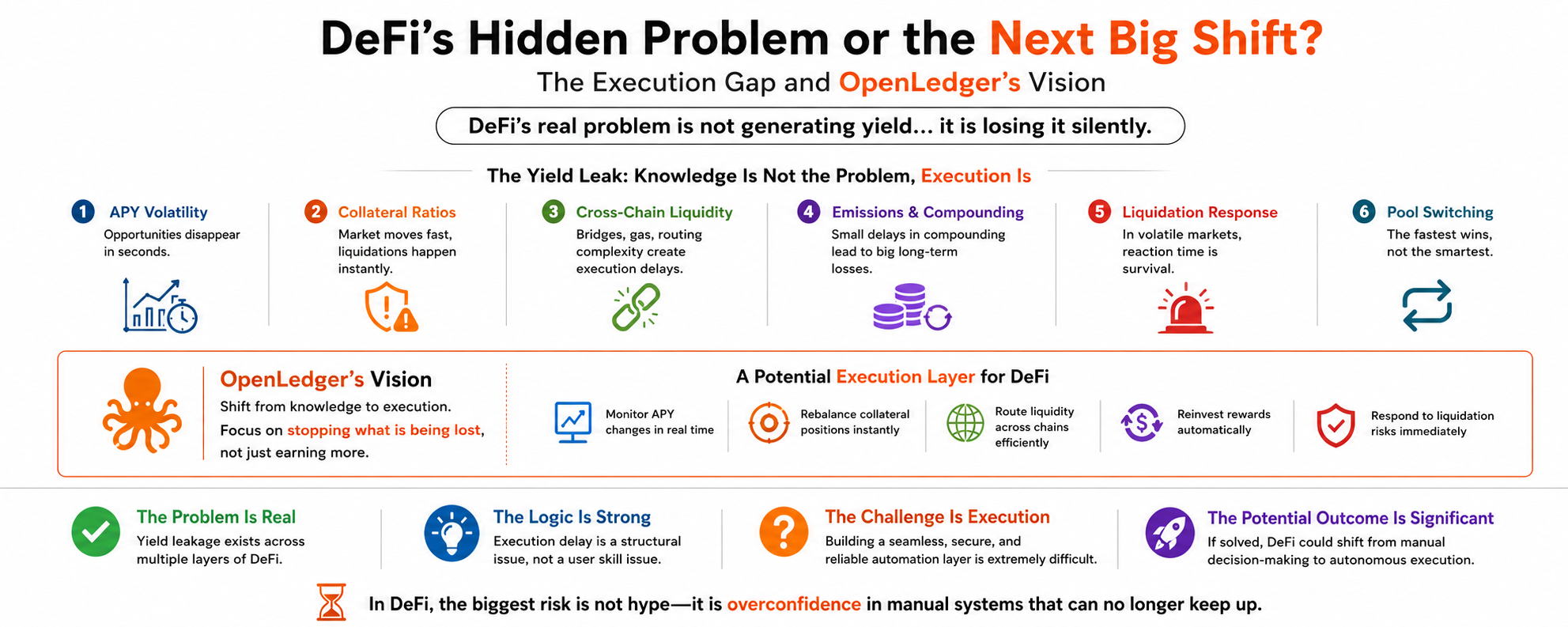
DeFi’s real problem is not generating yield it is losing it silently.
Across multiple top creator perspectives, a shared theme emerges even though each explains it differently. Some focus on APY fluctuations, others on liquidation risks, while some highlight cross-chain inefficiencies. But when you combine all of them, a single pattern becomes clear:
The market moves faster than humans can execute.
And that gap is exactly what people now call the “yield leak.”
Yield Leak: Knowledge Is Not the Problem, Execution Is
In DeFi, opportunities exist everywhere. New pools, new incentives, shifting APYs, and constantly evolving protocols. On paper, everything looks profitable.
But creators consistently point out a simple truth:
Most users already know what to do they just cannot do it fast enough.
The issue is not intelligence. It is execution.
DeFi operates 24/7 without pause. Meanwhile, human behavior is:
slow
inconsistent
emotionally driven
dependent on timing and fees
limited by attention
This mismatch creates continuous inefficiencies where potential profit quietly disappears.
1. APY Volatility: Opportunities That Disappear in Seconds
APY rates across protocols change frequently. One creator highlighted how users often miss optimal yield windows simply because they cannot monitor markets constantly.
By the time a user notices a high-yield opportunity, the conditions have already shifted.
In this environment, timing matters more than knowledge.
2. Collateral Ratios: The Silent Risk of Liquidation
Another major concern is collateral management in lending protocols. Maintaining safe ratios is not a one-time action it requires constant adjustments.
If the market moves sharply and users fail to react in time, liquidation happens instantly.
This is one of the most unforgiving parts of DeFi, where seconds can determine profit or total loss.
3. Cross-Chain Liquidity: Simple in Theory, Complex in Practice
Moving capital across chains to chase better yields sounds easy in theory. In reality, it is slow, fragmented, and costly.
Users face:
bridge delays
gas fluctuations
routing complexity
execution risk
Because of these barriers, many opportunities are never fully captured.
4. Emissions and Compounding: Small Delays, Big Losses
Compounding rewards is one of the most powerful strategies in DeFi. However, it requires consistent reinvestment.
Humans often delay this process due to:
transaction fees
timing uncertainty
manual effort
Even small delays reduce compounding efficiency over time, leading to hidden yield leakage.
5. Liquidation Response: When Speed Becomes Survival
Market crashes expose one of the biggest weaknesses in manual systems: reaction time.
Automated systems can respond instantly, while humans cannot. This delay often results in unnecessary losses during volatile periods.
Creators emphasize that in high-volatility environments, execution speed is not optional it is survival.
6. Pool Switching: The Fastest Wins, Not the Smartest
Yield opportunities are dynamic. The highest-performing pools today may not exist tomorrow.
The key difference highlighted by creators is simple:
Knowledge helps identify opportunities
Speed determines who actually captures them
This is where execution becomes more important than strategy.
OpenLedger’s Core Idea: The Shift From Knowledge to Execution
Across all these perspectives, one central narrative becomes clear:
DeFi is shifting from a knowledge-driven game to an execution-driven system.
The vision behind OpenLedger is not just about creating new yield strategies. It is about reducing inefficiencies that already exist in the system.
Instead of focusing on “earning more,” the emphasis is on:
“Stopping what is being lost.”
This framing is powerful because it targets existing pain rather than hypothetical gains.
A Potential Execution Layer for DeFi
If automated execution systems potentially powered by AI and smart contracts work as intended, they could:
monitor APY changes in real time
rebalance collateral positions instantly
route liquidity across chains efficiently
reinvest rewards automatically
respond to liquidation risks immediately
In such a system, humans would no longer compete on speed.
They would compete on strategy.
Final Perspective: Strong Idea, Difficult Execution, Massive Implication
When combining all creator insights, the conclusion is balanced:
The problem is real
Yield leakage exists across multiple layers of DeFi.
The logic is strong
Execution delay is a structural issue, not a user skill issue.
❓ The challenge is execution itself
Building a seamless, secure, and reliable automation layer is extremely difficult.
The potential outcome is significant
If solved, DeFi could shift from manual decision-making to autonomous execution systems.
But the key risk remains the same:
If execution fails, the idea remains theoretical.
If it succeeds, it could redefine DeFi efficiency entirely.
In the end, this is not just a story about yield.
It is a story about time, speed, and the evolution of financial execution.
And in DeFi, the biggest risk is not hype it is overconfidence in manual systems that can no longer keep up.
