
I’m waiting.Not for price. Not even for adoption anymore. Just for that rare moment when something in crypto stops feeling like noise and starts feeling strangely inevitable.
I’ve been noticing how casually people give away value online now. Every prompt typed into an AI model. Every correction. Every dataset cleaned by someone sitting alone at 2AM. Every small interaction feeding systems that grow larger while the people feeding them disappear into the background.
Most people don’t think about it. They just use the product and move on.
That’s probably why OpenLedger caught my attention.
Not immediately. At first it sounded like another clean narrative wrapped around AI and blockchain because the market always needs a fresh story to survive another cycle. AI agents, decentralized models, data liquidity — the words are everywhere now. After a while they start sounding hollow. But I kept looking at it anyway.
Because underneath the branding, the idea feels uncomfortably real.
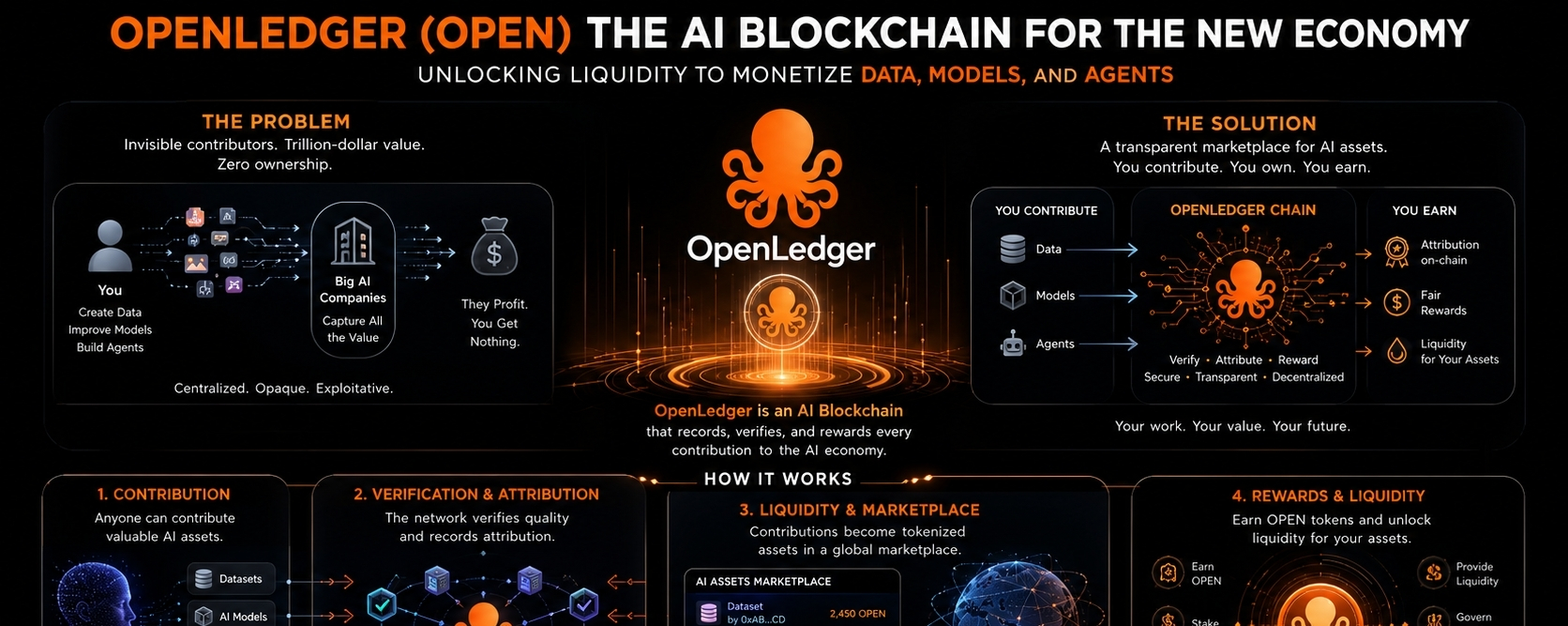
AI is becoming an economy before people fully realize it. Data has value. Models have value. Even behavior has value now. But the structure around it still looks old. A few companies absorb most of the upside while contributors become invisible. People train systems they’ll never own.
OpenLedger seems to be built around that imbalance.
Not by trying to fight AI, but by turning contribution itself into something liquid. Something measurable. Data providers, model builders, agent creators — all connected through a blockchain layer that tries to track where value actually comes from.
Simple idea. Hard execution.
And that’s the part I keep thinking about.
Because crypto is full of systems that make sense logically but fail socially. Users say they care about decentralization until convenience shows up. Developers talk about open ecosystems until funding dries up. Retail rotates narratives faster than products can mature. Attention moves before infrastructure does.
So I keep asking myself whether people truly want ownership, or if they just want access.
There’s a difference.
OpenLedger feels like it understands that AI won’t just be about models. It’ll be about coordination. Who contributed. Who gets rewarded. Which data created which output. Whether attribution can exist in a machine economy that moves faster than humans can track.
That part matters more than people think.
Right now most AI systems feel like giant black boxes fed by invisible labor. OpenLedger is trying to make the invisible layer visible again. Not emotionally. Economically.
Still, good ideas alone rarely win here.
Timing matters. Distribution matters. Liquidity matters more than people admit. A protocol can be technically brilliant and still die quietly because nobody cared at the right moment. I’ve seen that happen too many times. Crypto has a strange habit of rewarding narratives first and utility later — if utility ever comes at all.
And AI moves fast enough to make entire architectures feel outdated within months.
That uncertainty sits in the back of my mind whenever I look at OPEN.
Not fear exactly. Just realism.
I think a lot of people assume the future AI economy will naturally become decentralized because decentralization sounds fair. But fairness has never been enough on its own. The systems that dominate are usually the ones that reduce friction the most, even if they extract the most value too.
That’s why I keep watching projects like this carefully instead of emotionally.
Because if OpenLedger works, it probably won’t happen through one explosive moment. It would happen quietly. Slowly. Developers integrating without people noticing. Data becoming traceable. Agents becoming monetizable. Infrastructure settling underneath the surface while everyone else keeps chasing louder things.
And maybe nobody outside a small circle even notices until much later.
Or maybe people simply won’t care where AI comes from as long as the answers are fast and convenient.
I don’t know.I just keep coming back to the thought that the internet trained everyone to create value for free. Now AI is accelerating that behavior even further. OpenLedger is one of the few projects looking directly at that reality instead of pretending it doesn’t exist.