

I’ve seen this pattern enough times to know it by heart. A project launches, the chat gets loud, the charts move, and everybody suddenly acts like they’ve discovered the future. Then the easy excitement fades, and the real question shows up: who’s still here when the noise dies down? That’s the part I keep looking at, because the first wave is rarely the truth. OpenLedger interests me for that reason more than for any headline. Its official pitch is pretty clear: it’s an AI blockchain built to connect data, models, and agents, and its docs say the whole stack is meant to run on-chain, from dataset uploads and model training to reward credits and governance. That’s not just trader language. That’s builder language.
What makes it worth a closer look is that OpenLedger is not trying to sell a vague “AI + crypto” story. The docs talk about Proof of Attribution, which is basically the idea that data contributions can be linked back to model outputs so contributors can get credit and rewards based on impact. The model side is not abstract either. ModelFactory is described as a fine-tuning platform with a GUI-first workflow, secure dataset access, a chat interface, RAG attribution, and support for models like LLaMA, Mistral, Qwen, and DeepSeek. OpenCircle, meanwhile, is pitched as the place where serious builders launch AI systems that are open, composable, and verifiable from day one. That combination matters, because builder tools are what make a network useful after the hype cycle ends.
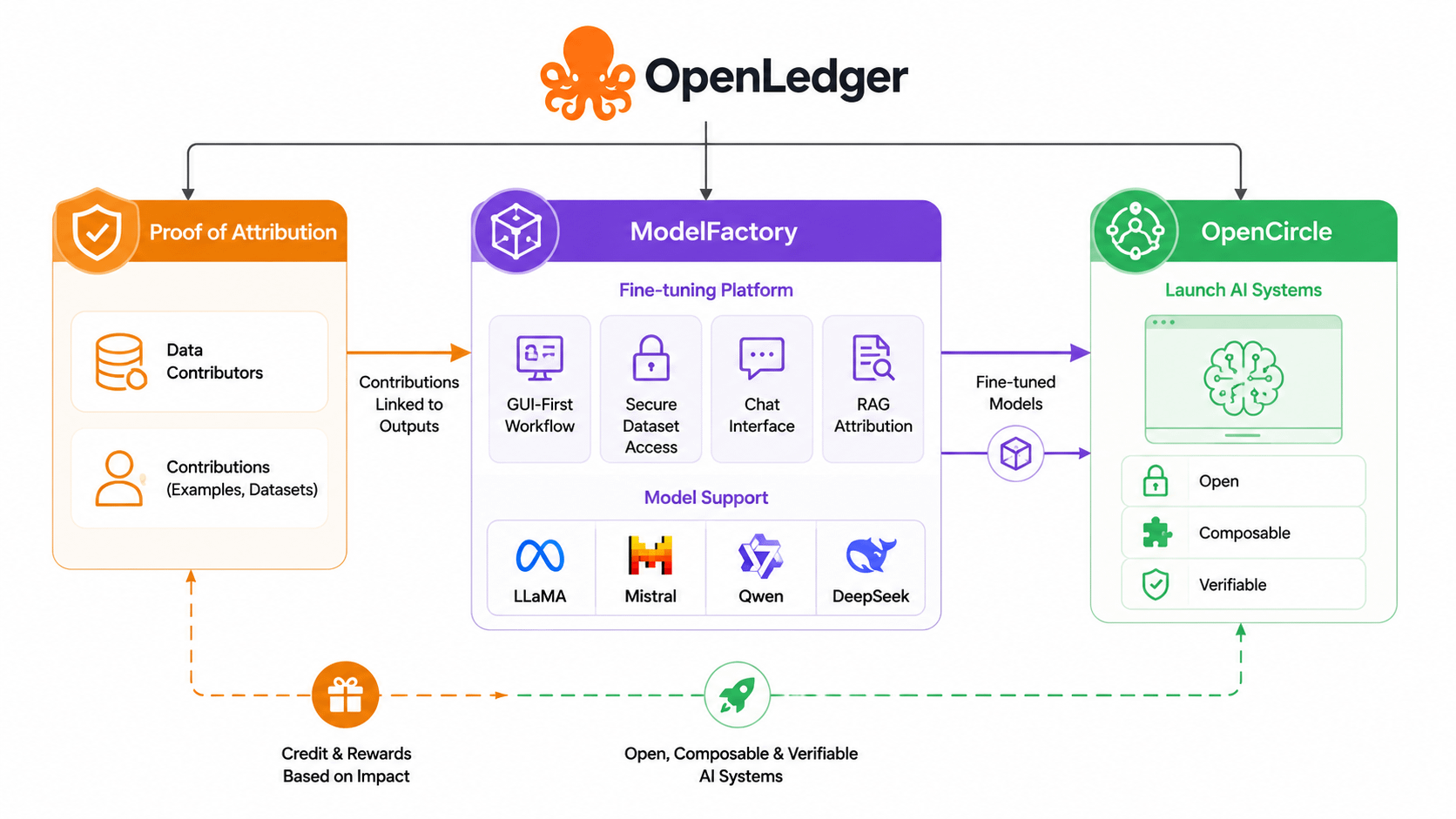
Now let’s talk about the retention problem, because that’s the real issue here and it’s bigger than people admit. Getting someone to show up once is easy. Getting them to stay, keep uploading useful data, keep fine-tuning models, keep building agents, and keep paying attention after the reward banners disappear, that’s the hard part. OpenLedger’s own token design shows why this matters. The token is supposed to cover governance, gas on its L2, incentives for contributors, bridging, and agent staking. In plain English, that means OPEN only has real long-term weight if people actually keep using the network for real work. If builders leave after the first incentive wave, then the token ends up being carried mostly by traders, not by usage. And once a token starts depending more on speculation than participation, the whole thing gets shaky fast. That’s not a dramatic take. That’s just how incentive-driven ecosystems usually age.
There’s also a simple test for whether a project understands retention or just talks around it: what does it do to keep people coming back? OpenLedger has leaned hard on rewards and campaigns. Binance said OPEN’s HODLer airdrop allocation was 10,000,000 OPEN, with another 15,000,000 OPEN planned six months later, and it listed the circulating supply at launch as 215,500,000 OPEN, or 21.55% of the 1,000,000,000 max supply. Binance also announced the OPEN listing on September 8, 2025, and later ran a 25,000,000 OPEN booster event tied to user participation. Those are real numbers, and they tell you something practical: the project knows incentives help launch momentum. The weak spot is that incentives are not loyalty. They can buy attention, but they do not automatically buy habit.
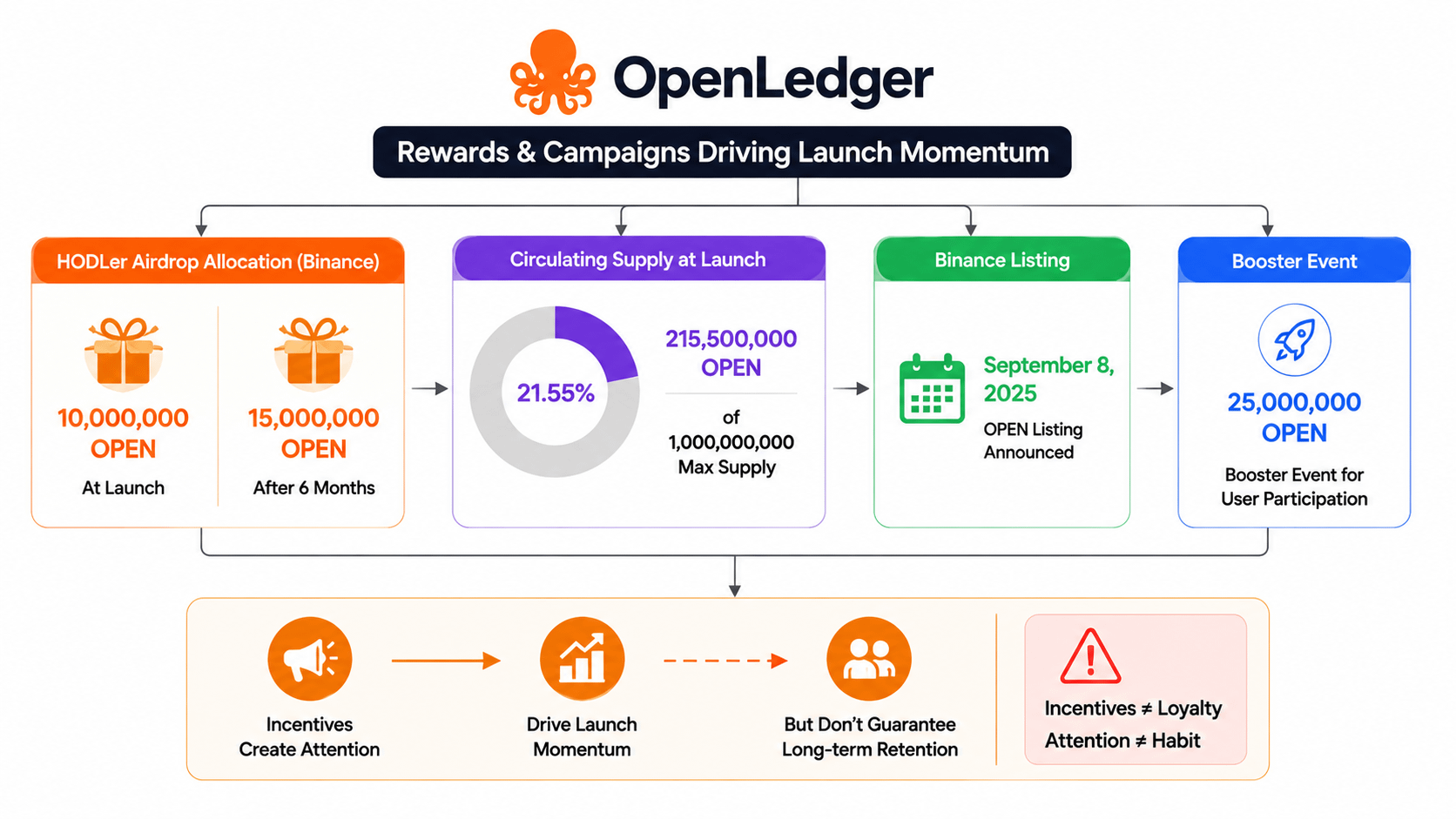
And that’s where I’d keep one eye open. The risk is pretty obvious, even if people don’t like saying it out loud. A lot of these networks look strongest right after the airdrop, the listing, or the reward campaign. That’s when everyone is active, everyone is experimenting, and every metric looks like it’s going up forever. But if the builders do not find real reasons to stay, then the data flow dries up, model activity slows, and the token loses the usage story it needs to stand on. OpenLedger’s thesis is strongest when it’s about attribution, secure fine-tuning, and verifiable AI work. If it turns into a place people only visit for rewards, then the whole pitch gets thinner. The good part is that the product direction is more serious than most. The bad part is that serious direction still has to prove staying power.
So where do I land on it? Honestly, I think OpenLedger is more interesting as a builder story than a trading story. That’s already a good sign, because the best projects usually make money for traders only after they become genuinely useful to builders. I like the fact that it has a clear theory of value, a defined token role, and a product stack that actually sounds connected to a real workflow instead of a random roadmap slide. But the retention problem is still the big one, and it’s the one I’d keep checking over time. If builders keep showing up, the token has a real chance to mean something. If they don’t, then all the incentive math in the world won’t save it. So yes, I’d keep watching it. Not blindly. Just seriously.