



I’ve been thinking a lot about what makes certain AI systems feel temporary while others feel like they’re building toward something larger.
At first, most projects look similar. Better models, faster execution, more capable agents. The usual cycle of infrastructure improving itself. But the more I look at @OpenLedger , the less it feels centered around individual products and the more it feels centered around flow itself.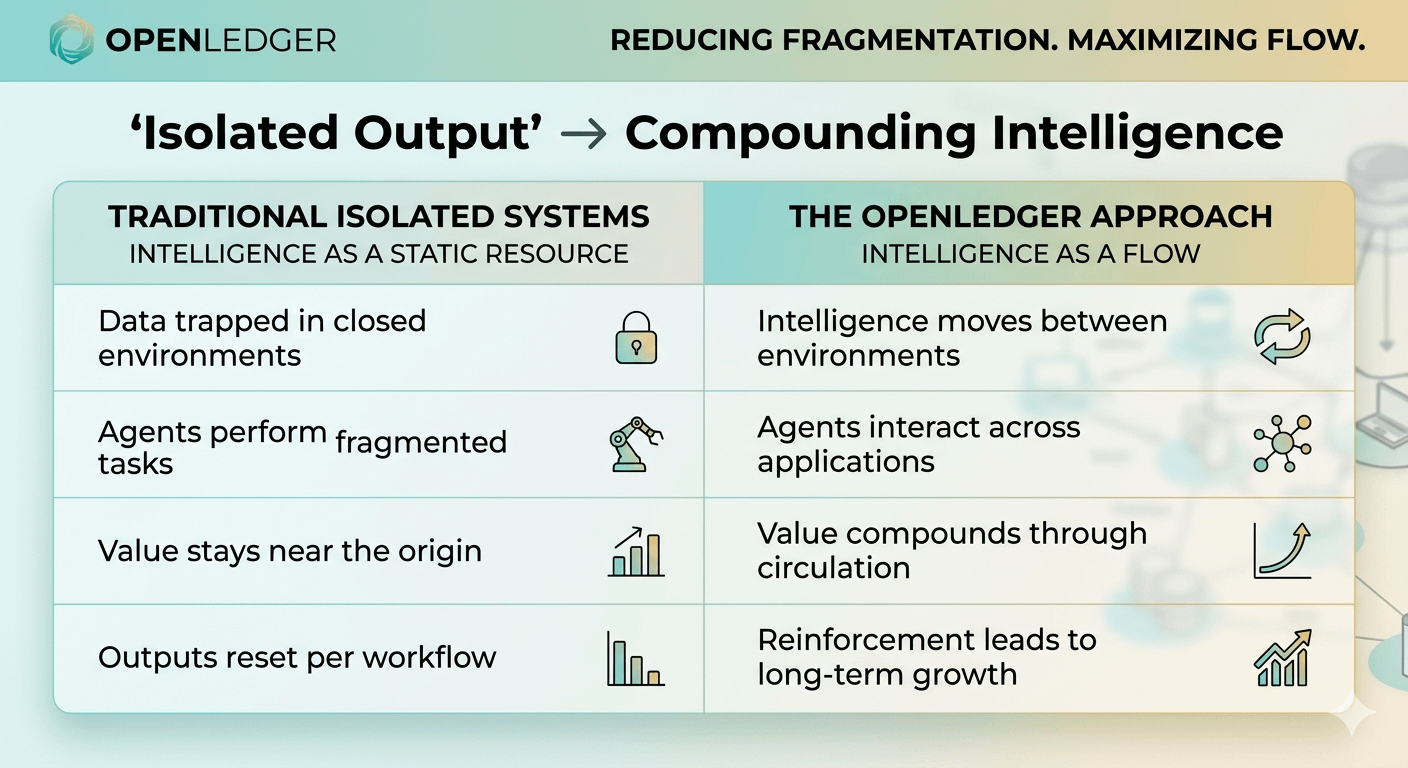
That’s the part I keep coming back to.
Because most systems today still treat intelligence like isolated output. A model generates something useful. An agent performs a task. Data gets processed somewhere inside a closed environment. Value is created, but it often stays trapped near the place where it originated.
And trapped systems don’t compound very well.
That’s where OpenLedger starts feeling slightly different to me. Not because it’s simply adding AI to blockchain infrastructure, but because it seems more focused on how intelligence moves between environments rather than where it starts.
That changes the structure quite a bit.
Because once systems are designed around movement instead of isolation, intelligence stops behaving like a static resource. Data can contribute across networks. Agents can interact beyond a single application layer. Models stop operating as disconnected endpoints and start becoming part of a broader economic flow.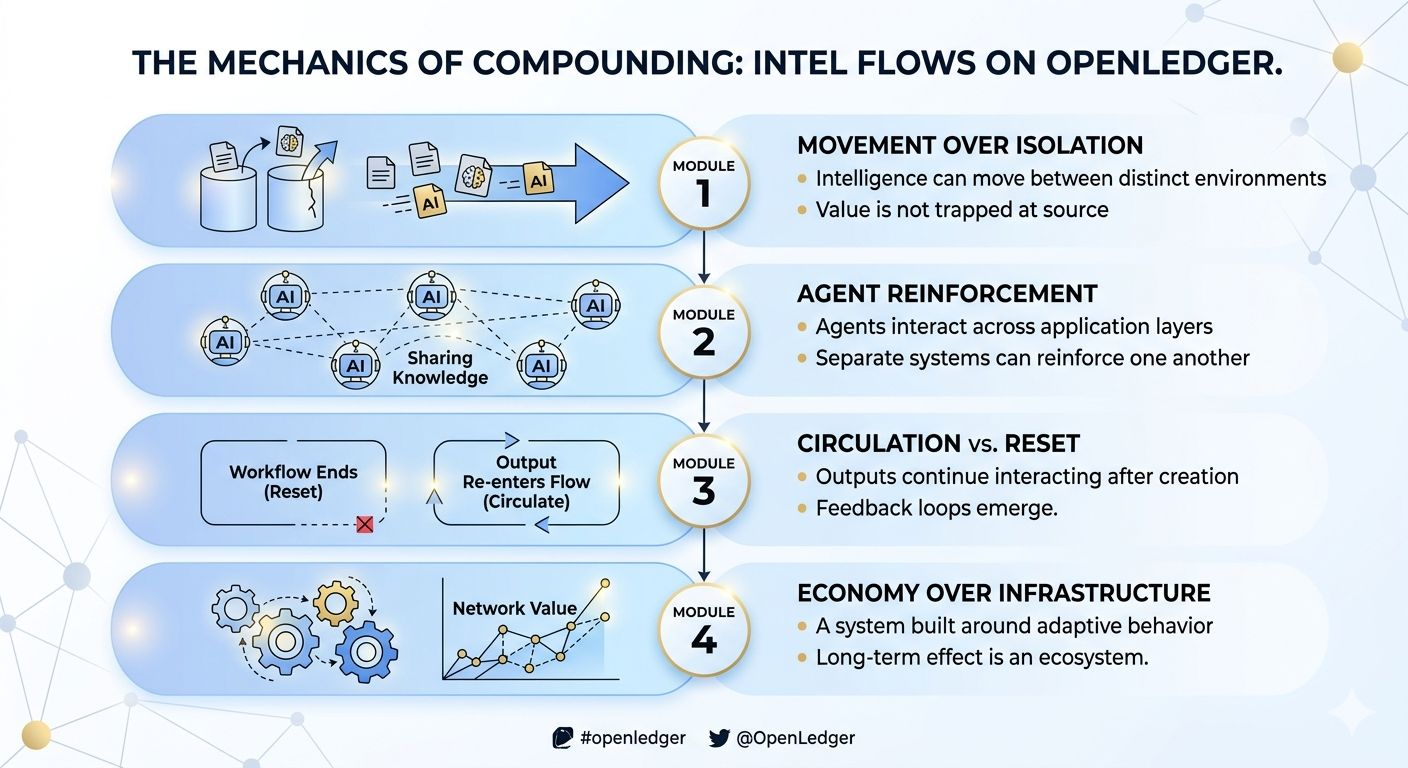
At least from where I’m standing, OpenLedger feels less interested in building one dominant destination and more interested in creating conditions where separate systems can reinforce one another over time.
And reinforcement matters more than people realize.
Because compounding doesn’t happen simply because activity exists. It happens when outputs continue interacting after they’re created. When intelligence can circulate instead of resetting inside separate silos every time a workflow ends.
That feels closer to an economy than traditional infrastructure.
But economies introduce their own complexity.
Because once intelligence begins flowing across interconnected systems, predictability starts weakening. Interactions multiply. Incentives overlap. Agents respond to changing environments instead of fixed instructions. And systems built around adaptive behavior rarely move in perfectly controlled directions.
Feedback loops emerge.
Unexpected coordination appears.
Sometimes value accumulates in places nobody initially expected.
That’s probably the most interesting part to me.
Not the idea that OpenLedger is building AI infrastructure, but the possibility that it’s trying to build an environment where intelligence itself can keep compounding through interaction rather than remaining fragmented across isolated layers.
And if that’s true, the long-term effect may look less like a platform growing larger and more like an ecosystem becoming increasingly interconnected over time.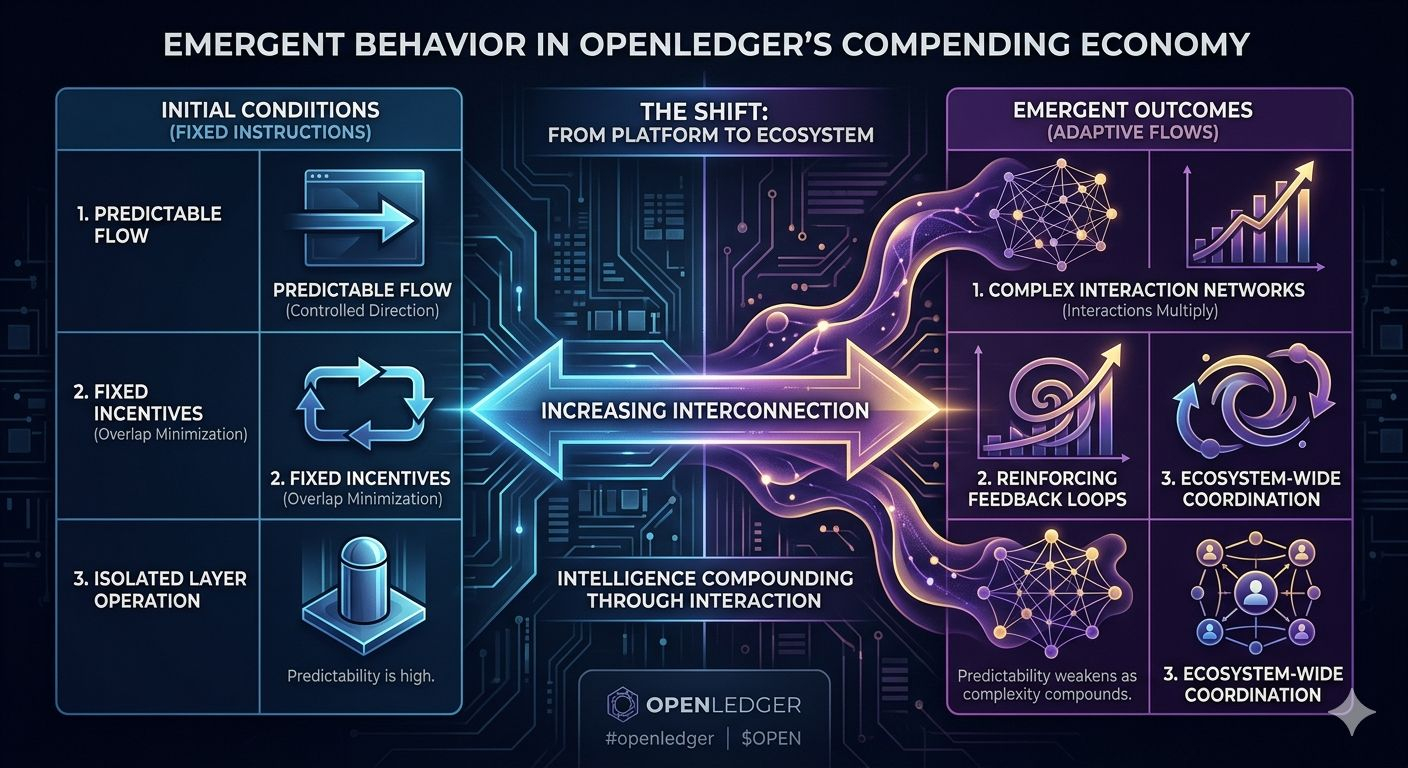
I’m not fully convinced where @OpenLedger ultimately lands yet.
Maybe these systems still centralize eventually. Maybe intelligence naturally consolidates around dominant networks no matter how open the structure begins.
But I do think OpenLedger feels unusually focused on something many projects overlook early:
Not just creating intelligent systems.
But creating conditions where intelligence can continue flowing, interacting, and compounding long after the initial output is produced.
And that feels like a deeper layer than most AI infrastructure conversations are currently paying attention to.