
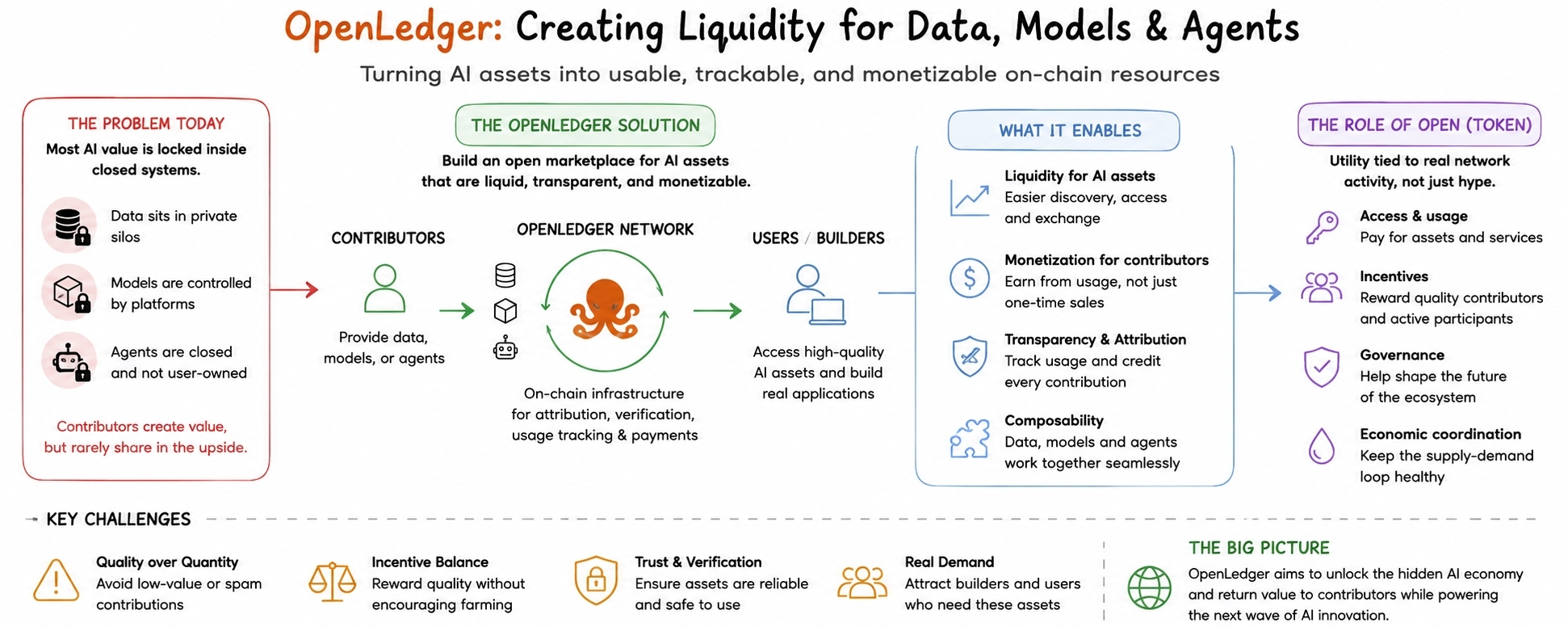

OpenLedger is one of those projects I’m watching with a bit of patience, because the idea feels more interesting when I look past the usual AI-token noise. I’m not really focused on the label itself. I’m more interested in what it is trying to do underneath: create liquidity around data, models, and agents that usually stay locked inside private systems. In AI, a lot of value is created by users, builders, datasets, feedback, and behavior, but most of that value is captured by closed platforms. OpenLedger seems to be asking a simple but difficult question: can those AI assets become usable, trackable, and monetizable in a more open market?
That is where the project starts to feel different from the usual “AI blockchain” pitch. It is not enough to say that AI and crypto belong together. A project has to show why the connection is useful. OpenLedger’s stronger idea is that data, models, and agents should not just sit in isolated systems where only a few platforms benefit from them. If these assets can be brought into an on-chain environment with clearer ownership, usage, and incentives, then the network has a more practical reason to exist.
Still, this kind of idea is not easy to turn into something sustainable. Data is not valuable just because someone uploads it. A model is not useful just because it has a market around it. An agent is not important just because it sounds automated. The real value depends on quality, demand, reliability, and whether people actually want to use these resources for something practical. This is the part I think matters most for OpenLedger. It has to create liquidity, but it also has to make sure the things becoming liquid are worth something beyond speculation.
That is always the harder side of crypto incentives. When rewards appear, people naturally look for the easiest way to earn them. Some users may bring useful data or build real tools, but others may only chase rewards. If the system rewards activity without judging usefulness, it can become crowded with low-quality supply. On the other hand, if OpenLedger can reward meaningful contributions and connect them to real demand, the economy becomes much more interesting. Liquidity would not just mean buying and selling. It would mean giving AI assets a clearer path to value.
This is also where OPEN has a cleaner story than many tokens tied to the AI trend. A lot of AI tokens mostly move with market attention. They become exciting when the narrative is hot, and they lose strength when traders move on. OPEN has the chance to be tied to something more direct if it becomes part of access, usage, contribution, verification, or coordination inside the network. That does not automatically make it strong, but it gives the token a better question to answer. Is the network being used because people need it, or is the token only moving because AI is popular?
The access problem is important too. Most people use AI without owning much of what they help create. They give data, attention, prompts, feedback, and behavior, but the economic value usually flows back to the platform. OpenLedger seems to be pushing against that pattern by trying to make AI resources more open and more monetizable. That is a meaningful direction, but it also puts pressure on the project. It has to offer more than a nice idea. It has to give users and builders a real reason to participate.
Adoption will probably come slowly if it comes at all. A data provider has to believe the network can reward quality. A developer has to believe the tools are useful enough to build with. A user has to trust that the agents or models available through the system can actually help them. These are practical things. They do not happen because the project has a strong narrative. They happen when people return to the network because it saves time, creates value, or gives them access to something they could not easily get elsewhere.
The agent side is especially interesting, but also easy to overstate. Agents sound powerful because they suggest automation and real activity, but not every agent becomes useful. A good agent needs reliable inputs, clear purpose, and enough trust for people to depend on it. If OpenLedger can connect agents with useful data and models while keeping the economic activity transparent, that could become a stronger part of the ecosystem. But if agents become mostly speculative assets, the story becomes weaker and more dependent on hype.
Sustainability is the part I keep coming back to. OpenLedger needs more than early excitement. It needs a healthy loop between supply and demand. Useful data, models, and agents need to attract users. Those users need to create enough demand to reward contributors. Contributors then need a reason to keep improving what they provide. If that loop works, OPEN has a more grounded role. If it breaks, the network may still look active for a while, but the activity could feel thin underneath.
I also think OpenLedger has to be careful not to let the market simplify it too much. Calling it an AI blockchain may make it easier to understand quickly, but it also misses the more important idea. The project is more interesting as infrastructure for turning AI assets into economic resources. That is a slower and harder story, but it is also more serious. It gives OpenLedger a chance to be judged by actual usage instead of only by the strength of the AI narrative.
For now, I see OpenLedger as a project with a real idea, but still with a lot to prove. The concept of unlocking liquidity for data, models, and agents makes sense in an AI market where value is often closed, concentrated, and difficult for contributors to monetize. But the real test will be whether people use the network when the excitement is quieter. If OpenLedger can build trust, attract useful assets, support real demand, and keep incentives from turning into simple farming, then its position becomes stronger over time. Until then, it feels like something worth watching carefully, with interest, but not blind certainty.